|
VOOZH | about |
|
VOOZH | about |
BooleanField is a true/false field. It is like a bool field in C/C++. The default form widget for this field is CheckboxInput, or NullBooleanSelect if null=True. The default value of BooleanField is None when Field.default isn’t defined. One can define the default value as true or false by setting the default attribute to true/false simultaneously.
Syntax:
field_name = models.BooleanField(**options)
Illustration of BooleanField using an Example. Consider a project named geeksforgeeks having an app named geeks.
Refer to the following articles to check how to create a project and an app in Django.
Enter the following code into models.py file of geeks app.
Add the geeks app to INSTALLED_APPS
Now when we run makemigrations command from the terminal,
Python manage.py makemigrations
A new folder named migrations would be created in geeks directory with a file named 0001_initial.py
Now run,
Python manage.py migrate
Thus, an geeks_field BooleanField is created when you run migrations on the project. It is a field to store boolean value - True/False.
BooleanField is used for checking the particular condition, for example, to check if Email of a user is verified or not. One can use BooleanField to mark it True or False. We can also set it to False by using default=True.
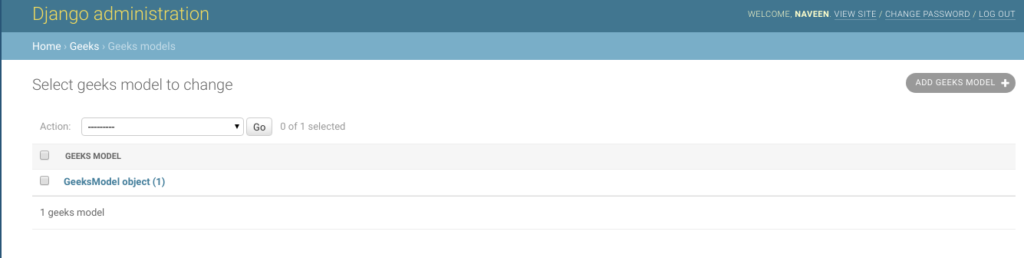
Now let's check it in admin server. We have created an instance of GeeksModel.
Field Options are the arguments given to each field for applying some constraint or imparting a particular characteristic to a particular Field. For example, adding an argument null = True to BooleanField will enable it to store empty values for that table in a relational database.
Here are the field options and attributes that a BooleanField can use.
| Field Options | Description |
|---|---|
| Null | If True, Django will store empty values as NULL in the database. Default is False. |
| Blank | If True, the field is allowed to be blank. Default is False. |
| db_column | The name of the database column to use for this field. If this isn’t given, Django will use the field’s name. |
| db_index | If True, a database index will be created for this field. |
| db_tablespace | The name of the database tablespace to use for this field’s index, if this field is indexed. The default is the project’s DEFAULT_INDEX_TABLESPACE setting, if set, or the db_tablespace of the model, if any. If the backend doesn’t support tablespaces for indexes, this option is ignored. |
| Default | The default value for the field. This can be a value or a callable object. If callable it will be called every time a new object is created. |
| help_text | Extra “help” text to be displayed with the form widget. It’s useful for documentation even if your field isn’t used on a form. |
| primary_key | If True, this field is the primary key for the model. |
| editable | If False, the field will not be displayed in the admin or any other ModelForm. They are also skipped during model validation. Default is True. |
| error_messages | The error_messages argument lets you override the default messages that the field will raise. Pass in a dictionary with keys matching the error messages you want to override. |
| help_text | Extra “help” text to be displayed with the form widget. It’s useful for documentation even if your field isn’t used on a form. |
| verbose_name | A human-readable name for the field. If the verbose name isn’t given, Django will automatically create it using the field’s attribute name, converting underscores to spaces. |
| validators | A list of validators to run for this field. See the validators documentation for more information. |
| Unique | If True, this field must be unique throughout the table. |