|
VOOZH | about |
|
VOOZH | about |
Fourier analysis is a scientific computing technique widely used in signal processing, image compression and numerical simulations. The idea is that any complex signal can be expressed as a combination of simple, periodic components like sine and cosine waves. This process of decomposition is called the Fourier Transform.
The Fast Fourier Transform (FFT) is one algorithm that makes Fourier analysis practical for real-world applications. SciPy is a core library for scientific computing in Python, offers a module called fftpack that allows users to perform these transformations efficiently. This article provides an overview of FFT using SciPy’s FFTPack.
A time-domain signal(Audio waveform) is a sequence of amplitude values over time. The Fourier Transform converts this into the frequency domain, showing what frequency components make up the signal. For example, a guitar string vibrating at multiple harmonics can be broken down into these individual frequencies.
In digital systems, we work with a sampled version of the signal. This discrete set of samples is transformed using the Discrete Fourier Transform (DFT). The DFT is defined mathematically as:
Here, is the input signal, and is the transformed frequency component. Computing this directly for large N is computationally expensive. The Fast Fourier Transform (FFT) reduces this complexity by using symmetries in the DFT formula.
SciPy’s FFTpack module provides a interface to compute both FFT and its inverse (IFFT). These functions accept NumPy arrays and return the transformed signal in complex number form.
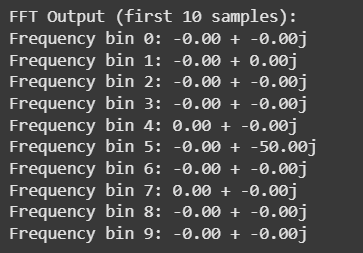
Output:
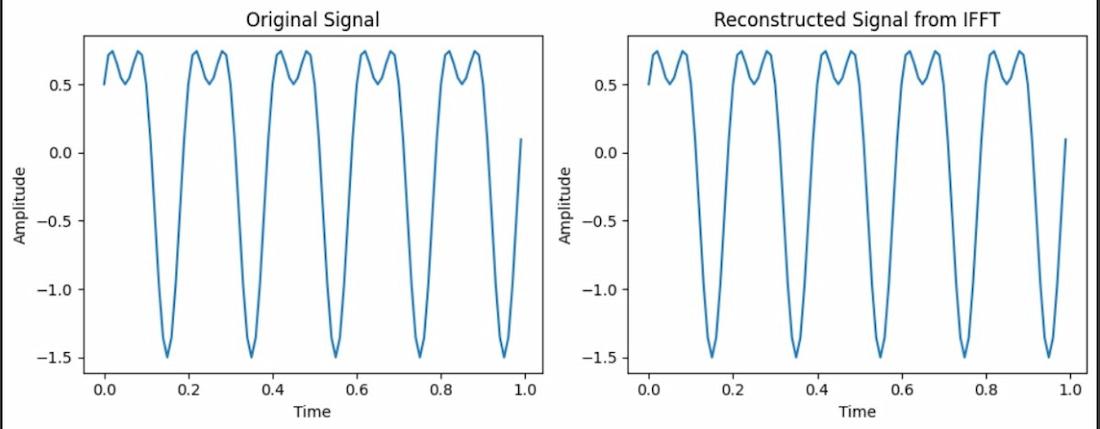
Output:
This script shows both the transformation and the reconstruction. After applying FFT, the output is a list of complex numbers representing frequency amplitudes and phases. Applying IFFT reconstructs the original signal (within a margin of numerical error).
fft2, fftn), useful for image and volumetric data.SciPy’s FFTpack makes frequency-domain analysis in Python accessible and efficient. It helps in working with sound signals, compressing images or analyzing time series data.