|
VOOZH | about |
|
VOOZH | about |
Geometry is the branch of mathematics that deals with the shapes, angles, dimensions, and sizes of various things that we see in everyday life. It is mainly divided into plane and solid geometry. In plane geometry, 2d shapes such as triangles, squares, rectangles, and circles are studied. Whereas, in solid geometry, 3d shapes such as cubes, cuboids, cones, etc. are studied.
The basic geometric principles are based on points, lines, and planes explained in coordinate geometry. All the geometrical shapes are based on these geometrical concepts.
The geometry can be divided into different parts:
Algebraic Geometry : This branch of geometry focuses on the zeros of the multivariate polynomial. It consists of linear and polynomial algebraic equations for solving sets of zeros. Applications in this category include string theory and cryptography.
Discrete Geometry: This branch of geometry mainly focuses on the position of simple geometrical objects such as points, lines, triangles, etc. It includes problems based on ordinary continuous spaces that have a combinatorial aspect.
Differential Geometry: It comprises algebraic and calculus techniques for problem-solving. The various problems include problems like general relativity in physics etc.
Euclidean Geometry: In Euclidean geometry, we study planes and solid figures based on axioms and theorems. The fundamental theorems of Euclidean geometry include Points and Lines, Euclid’s Axioms and Postulates, Geometrical Proof, and Euclid’s Fifth Postulate.
There are two types of shapes in Euclidean Geometry: Two dimensional and Three-dimensional shapes. Flat shapes are 2D shapes that include triangles, squares, rectangles, and circles. 3D shapes such as cubes, cuboids, cones, and so on are also known as solids. Fundamental geometry is based on points, lines, and planes, as described in coordinate geometry.
It has multiple applications in the fields of Computer Science, Mathematics, etc.
The five postulates of Euclidean geometry are as follows:
Some of Euclid's axioms in geometry that are universally accepted are :
There are two types of Non-Euclidean Geometry- Spherical and Hyperbolic Geometry. It is different from Euclidean geometry due to the difference in the principles of angles and parallel lines.
The study of plane geometry on the sphere is known as spherical geometry. The sum of angles in the triangle is greater than 180°.
A curved surface is referred to as hyperbolic geometry. It is used in Topology.
The planar triangle has a total of angles that is less than 180°, depending on the interior curvature of the curved surface.
Plane geometry is concerned with the shapes that can be drawn on paper. Euclidean geometry involves the study of plane geometry.
A 2D surface spread infinitely in both directions is referred to as a plane. The basic components of the plane are:
All two-dimensional figures have only two dimensions: length and width. Plane figures consist of squares, triangles, rectangles, circles, and so on.
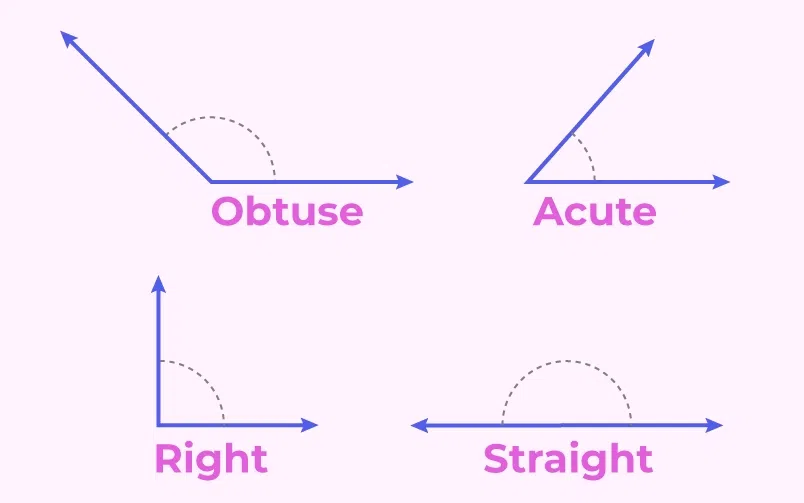
In planar geometry, an angle is formed when two rays intersect, called the sides of the angle, and share a common endpoint known as the vertex of the angle.
There are majorly four types of angles
You can find similar topics discussed in depth in the below articles.
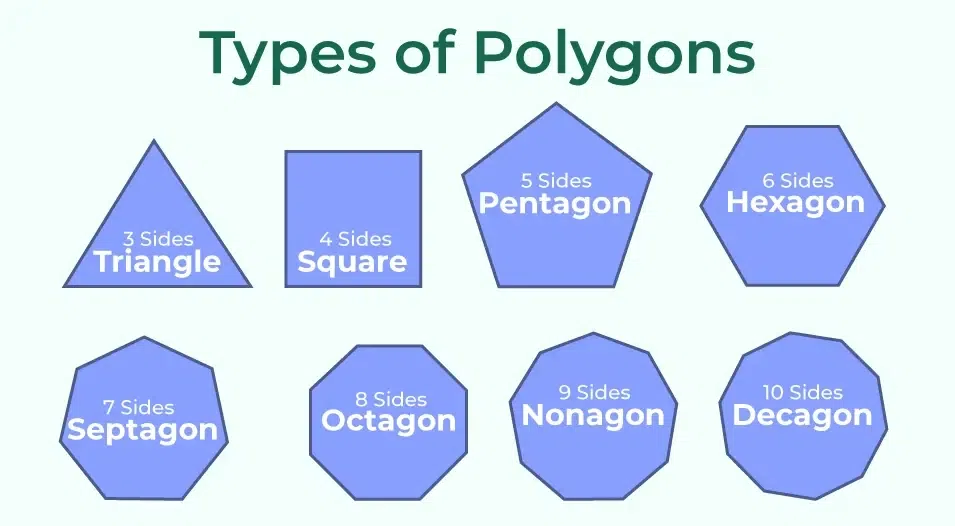
A figure that is made up of a finite number of straight-line segments closing in a loop. The word 'poly' means multiple.
The sum of internal angles of a polygon is : (n-2) * 180
where n is the number of sides.
The types of polygons are:
Name | Number of Sides | Number of vertices | Number of diagonals | Interior Angle Measure for Regular Polygon |
|---|---|---|---|---|
Triangle | Polygons with 3 sides | 3 | 0 | 60° |
Quadrilateral | Polygons with 4 sides | 4 | 2 | 90° |
Pentagon | Polygons with 5 sides | 5 | 5 | 108° |
Hexagon | Polygons with 6 sides | 6 | 9 | 120° |
Heptagon | Polygons with 7 sides | 7 | 14 | 128.571° |
Octagon | Polygons with 8 sides | 8 | 20 | 135° |
Nonagon | Polygons with 9 sides | 9 | 27 | 140° |
Decagon | Polygons with 10 sides | 10 | 35 | 144° |
Here is a list of articles related to Polygons:
Geometry is one of the oldest branches of mathematics that is concerned with the shape, size, angles, and dimensions of objects in our day-to-day life. Geometry in
A circle is a closed shape. From a fixed point known as the center, all the points of a circle are of the same distance.
Here is a list of articles where you can find in-depth knowledge about circles.
Similarity: Two figures are considered similar if they have the same shape or equal angle but may not be necessarily of the same size.
Congruence: Two figures are said to be congruent if they are the same shape and size i.e. they are equal in all means.
Here is a list of articles where you can find in-depth knowledge about the above topic.
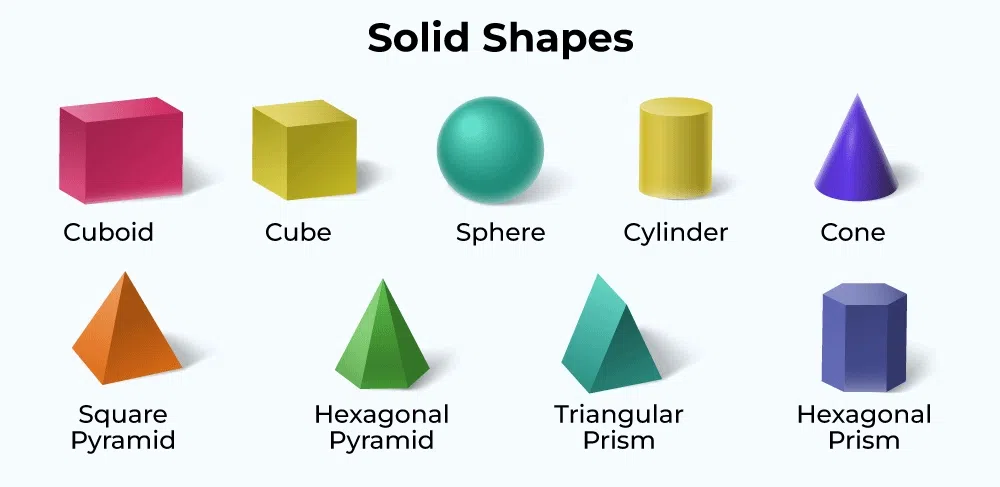
Solid geometry is the study of three-dimensional structures such as cubes, prisms, cylinders, and spheres. 3D figures' three dimensions are length, width, and height. However, certain solids do not have faces (e.g. sphere).
The analysis of three dimensions in Euclidean space is known as solid geometry. The structures of our environment are three-dimensional.
Both three-dimensional shapes are created by rotating two-dimensional shapes.
Essential characteristics of 3D forms are :
Edges: An edge is the line segment that joins one vertex to another. It helps in forming the outline of 3D shapes. It means it joins one corner point to another.
Faces: It is defined as the flat surface enclosed by edges that geometric shapes are made up of. It is a 2D figure for all 3D figures.
Vertices: A vertex is a point where the edges of the solid figure meet each other. It can be referred to as a point where the adjacent sides of a polygon meet. The vertex is the corner where edges meet.
The number of edges, faces and vertices in different solid shapes is given in the table:
Solid Shapes | No. of. Edges | No. of. Faces | No. of. Vertices |
|---|---|---|---|
9 | 5 | 6 | |
12 | 6 | 8 | |
12 | 6 | 8 | |
15 | 7 | 10 | |
18 | 8 | 12 | |
6 | 4 | 4 | |
8 | 5 | 5 | |
10 | 6 | 6 | |
12 | 7 | 7 |
Here is the list of Planar Geometry and Solid Geometry related articles:
Three-dimensional geometry studies the geometry of shapes in 3D space in the cartesian planes. Every point in the space is referred by 3 coordinates, (x, y, z) that are real numbers.
Here is a list of articles where you can find in-depth knowledge about three-dimensional geometry.
Read More: Geometry Formulas

.webp)
.png)