 |
VOOZH | about |
|
VOOZH | about |
Aiohttp library in Python is an asynchronous HTTP client and server framework that is built on top of the asynchronous I/O library asyncio in Python. Using this library, we can build web applications and RESTful APIs, and also we can handle synchronous HTTP requests in the application. This library has the support for middleware for mainly intercepting and also for modifying requests and responses. In this article, we will see two different methods to install the Aiohttp library in Python.
Pre Requisites
Here are some prerequisites to installing the Aiohttp in Python.
First, open the command prompt with the administrative user on your system and execute the below command in the prompt to install aiohttp using PIP.
pip3 install aiohttp
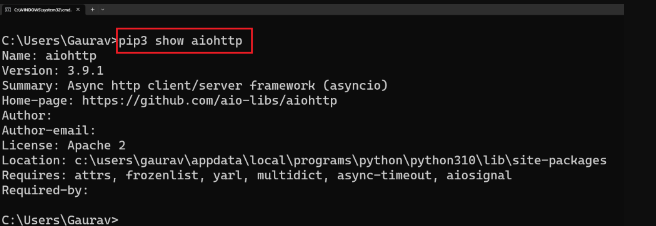
Once the installation is completed, our next task is to verify the successful installation. So we can verify it by checking the information about the library. Execute the below command in the prompt to verify.
pip3 show aiohttpOutput:
We can also install the library by using Conda. So to install the Aiohttp using conda, execute the below command in the terminal.
conda install -c conda-forge aiohttp
This will ask for confirmation, where we need to provide 'y' to confirm the installation.
To verify that aiohttp was successfully installed on the system with conda, run a command in the command window.
conda list aiohttpOutput:
In this example, we define an asynchronous function fetch_data that takes a URL, makes an HTTP GET request using aiohttp, and returns the response text. The main function is the entry point of the program and it calls asyncio.run(main()) to run the asynchronous main function.
Run the Server :
python scripts_name.pyOutput:
Installing Aiohttp in Python is a straightforward process, achieved through the use of the pip install aiohttp command. This enables developers to seamlessly incorporate asynchronous HTTP functionality into their Python projects. Aiohttp stands out as a powerful and widely adopted library for asynchronous web development, providing a flexible framework for handling HTTP requests concurrently.


.png)


