|
VOOZH | about |
|
VOOZH | about |
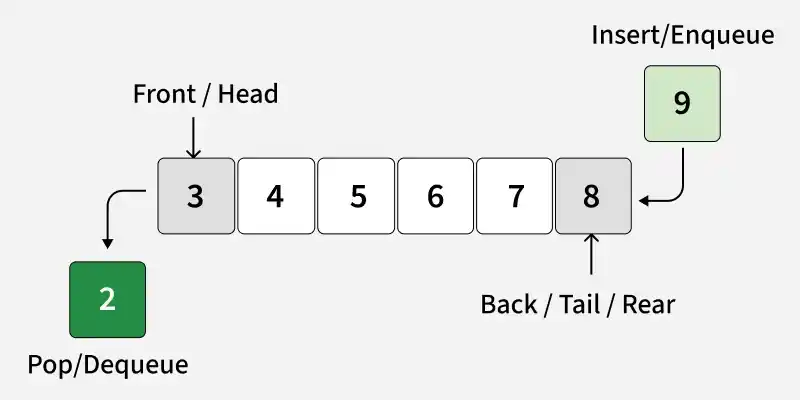
Queue is a linear data structure that stores items in a First In First Out (FIFO) manner. The item that is added first will be removed first. Queues are widely used in real-life scenarios, like ticket booking, or CPU task scheduling, where first-come, first-served rule is followed.
There are various ways to implement a queue in Python by following ways:
Lists can be used as queues, but removing elements from front requires shifting all other elements, making it O(n).
Initial queue: ['a', 'b', 'c']
Elements dequeued from queue:
a
b
c
Queue after removing elements: []
Explanation: We added elements using append() and removed from the front using pop(0). After removing all elements, queue is empty.
deque (double-ended queue) is preferred over a list for queues because both append() and popleft() run in O(1) time.
Initial queue: deque(['a', 'b', 'c'])
Elements dequeued from the queue:
a
b
c
Queue after removing elements: deque([])
Explanation: popleft() efficiently removes the first element without shifting, making deque ideal for queues.
Python’s queue module provides a thread-safe FIFO queue. You can specify a maxsize. Key Methods are:
Initial size: 0
Is full: True
Elements dequeued from the queue:
a
b
c
Is empty: True
Is empty: False
Is full: False
Explanation: queue.Queue class handles thread-safe operations. You can check fullness or emptiness before adding or removing elements.
To practice problems related to Queue, refer to this article Queue Data Structure