|
VOOZH | about |
|
VOOZH | about |
API testing in Swagger involves validating the functionality and performance of APIs developed using the Swagger framework. Swagger, now known as the OpenAPI Specification, provides a standardized way to document and define RESTful APIs. API testing in Swagger focuses on verifying that the API endpoints adhere to the specified OpenAPI documentation, ensuring correct request and response formats, parameter validations, and overall API behavior. This process helps identify and address issues early in the development lifecycle, ensuring that the API functions reliably and efficiently.
In the realm of software, applications frequently require the exchange of information or the initiation of actions among themselves. APIs serve as messengers, streamlining and enabling this communication process. Ex. An e-commerce website, for instance, might employ an API to retrieve product details from a database.
In the context of Swagger, API testing is comparable to using a detailed map (Swagger documentation) to navigate and test communication paths (APIs) among distinct software components. It guarantees that the messengers (APIs) convey the correct messages and yield the anticipated results, thus averting communication breakdowns and potential software issues.
API testing ensures that different parts of a software application can talk to each other effectively. It helps catch issues early, preventing errors from reaching the end-users.
In this example code is a simple example of a CRUD (Create, Read, Update, Delete) API using Flask, Flask-RESTful, and Flasgger for Swagger documentation. Let's break down the code:
Imports:
request: Provides an easy way to access the incoming request data.Api and Resource from flask_restful: Simplifies the creation of RESTful APIs.Swagger from flasgger: Integrates Swagger for API documentation.from flask import Flask, request
from flask_restful import Api, Resource
from flasgger import Swagger
App Initialization:
Creates a Flask app, initializes the Flask-RESTful API, and integrates Swagger for API documentation.
app = Flask(__name__)
api = Api(app)
swagger = Swagger(app)
In-Memory Data Storage:
Creates a simple in-memory data storage for employees.
employees_data = [
 {'id': 1, 'name': 'Abhilash Gaurav'},
 {'id': 2, 'name': 'Ramish Verma'}
]
Resource Classes:
EmployeesResource: Handles operations related to a list of employees.
GET: Retrieves a list of all employees.POST: Adds a new employee.class EmployeesResource(Resource):
# ... (GET and POST methods)
EmployeeResource: Handles operations related to an individual employee.
PUT: Updates an existing employee.DELETE: Deletes an existing employeeclass EmployeeResource(Resource):
# ... (PUT and DELETE methods)
API Routes:
api.add_resource(EmployeesResource, '/employees')
api.add_resource(EmployeeResource, '/employee/<int:employee_id>')
The <int:employee_id> in the URL specifies that employee_id should be an integer.
Main Execution:
if __name__ == '__main__':
 app.run(debug=True)
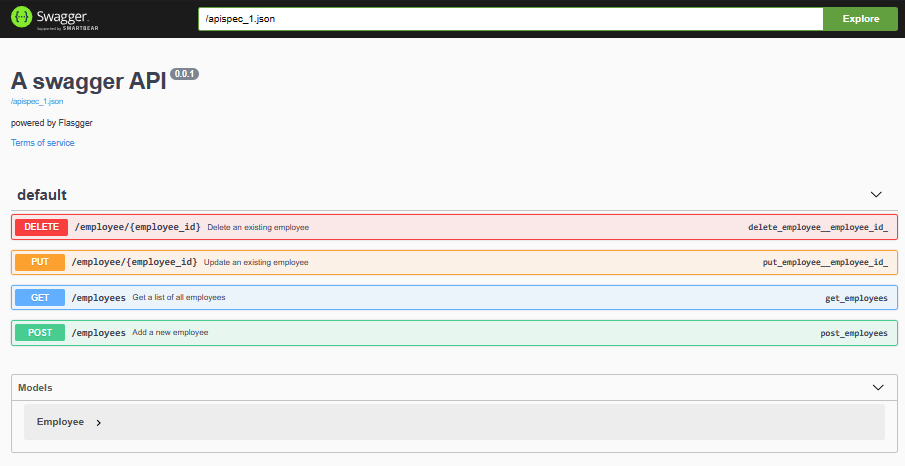
Above code defines a RESTful API for managing employees, complete with Swagger documentation. The API supports creating, reading, updating, and deleting both individual employees and a list of all employees. The Swagger documentation is automatically generated based on the provided comments. basically its above process help us to testing API with swagger or postman.
Output:
Testing APIs with Swagger is a crucial aspect of ensuring the reliability and functionality of web services. Swagger provides a powerful framework for API testing, offering a standardized and interactive documentation platform. By defining API requests and expected responses in a Swagger file, developers can easily execute tests and validate endpoints. This process streamlines communication between development and testing teams, fostering collaboration and reducing the likelihood of misinterpretations.