Spring Data REST automatically exposes Spring Data repositories as REST APIs, eliminating the need for controller code. By defining repositories (like CrudRepository), endpoints are generated automatically, with options for customization using annotations and configuration.
Supports pagination, sorting, and filtering for efficient data access
Provides flexible customization using annotations and configuration
Real-world example: In an e-commerce application, product and customer repositories can be directly exposed as REST APIs using Spring Data REST, allowing frontend applications to perform operations like viewing products, adding items, or updating customer details without needing custom controller logic.
Architecture of Spring Data REST
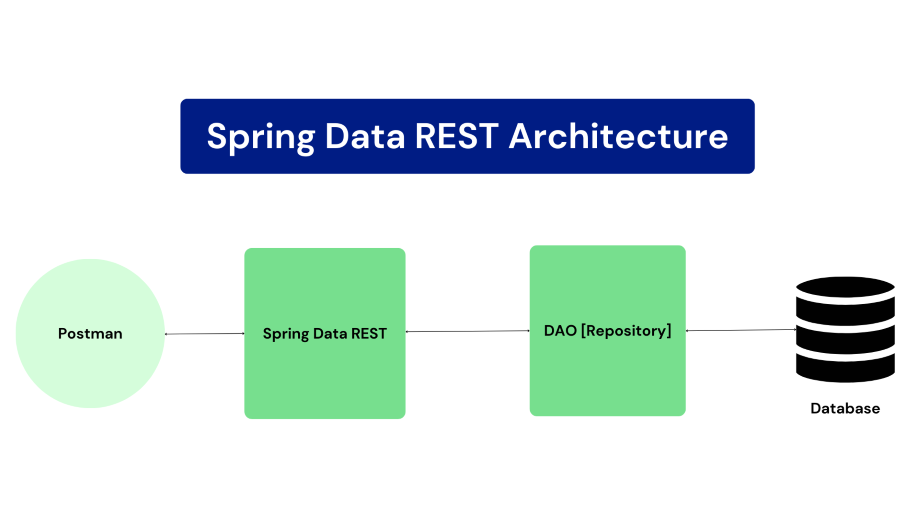
Spring Data REST follows a layered architecture where repositories act as the data access layer, and it automatically exposes them as RESTful endpoints using Spring MVC.
The Spring Data REST architecture diagram you sent shows the following components:
Spring Data REST: Spring Data REST is a framework that makes it easy to build hypermedia-driven REST web services on top of Spring Data repositories.
DAO [Repository]: The DAO layer is responsible for interacting with the underlying data store. It is implemented using Spring Data repositories.
Database: The database is the underlying data store that Spring Data REST uses to store and retrieve data.
Postman: Postman is a tool that can be used to send and receive HTTP requests. It is used in the diagram to show how to interact with the Spring Data REST API.
Spring Data REST architecture works as follows:
A client sends an HTTP request to the Spring Data REST server.
The Spring Data REST server receives the HTTP request and routes it to the appropriate repository.
The repository interacts with the underlying data store to perform the requested operation.
The repository returns the results of the operation to the Spring Data REST server.
The Spring Data REST server returns the results of the operation to the client.
Hypermedia as the Engine of Application State (HATEOAS)
HATEOAS (Hypermedia as the Engine of Application State) is a fundamental aspect of RESTful web services. It describes how relationships and links to related resources are represented in REST APIs.
Spring HATEOAS library is used under the hood to generate links. Resources implement the Resource interface.
HATEOAS support makes the APIs intuitive to use and enables building discoverable, stateless clients.
How Spring Data REST follows HATEOAS
Automatic resource exposure: Spring Data REST automatically exposes your domain model entities as REST resources and includes hypermedia links in the resource representations.
Flexible configuration: Spring Data REST allows you to customize the hypermedia links that are included in the resource representations.
Support for hypermedia formats: Spring Data REST supports HAL, a popular hypermedia format.
The _links object in the response contains the hypermedia links. The self link points to the resource itself, the profile link points to the user's profile, and the orders link points to the user's orders.