|
VOOZH | about |
|
VOOZH | about |
In chemistry, many substances, when dissolved in water produce ions and allow the solution to conduct electricity. Such substances are known as electrolytes. However, all electrolytes do not behave in the same way. Some substances break completely into ions, while others break only partially. This difference in the extent of ionisation leads to the classification of electrolytes into strong and weak electrolytes.
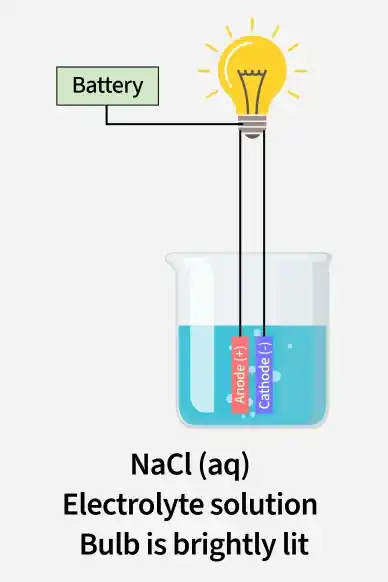
Electrolytes are substances that dissociate into ions when dissolved in water and allow the solution to conduct electricity. Electrolytes can be strong or weak. Conductivity depends on number of ions present
When an electrolyte dissolves in water:
Examples:
- HCl → H + + Cl ⁻ (acid)
- NaOH → Na ⁺ + OH - (base)
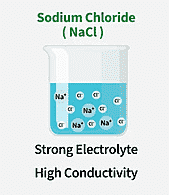
A strong electrolyte is a substance that completely ionises (dissociates) into ions when dissolved in water.
When a strong electrolyte is added to water:
Examples:
- HCl → H ⁺ + Cl ⁻
- HNO3 → H ⁺ + NO3 ⁻
- NaOH → Na ⁺ + OH ⁻
- KCl → K ++ Cl ⁻
Strong electrolytes show the following important properties:
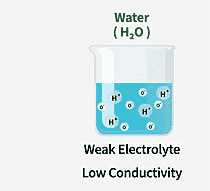
A weak electrolyte is a substance that partially ionises (dissociates) into ions when dissolved in water.
When a weak electrolyte is added to water:
Examples:
- CH3COOH (acetic acid)
- NH4OH (ammonium hydroxide)
- HF (hydrofluoric acid)
Weak electrolytes show the following important properties:
The differences between Strong and Weak Electrolyte are tabulated below:
| Strong Electrolyte | Weak Electrolyte |
|---|---|
| Completely dissociate in aqueous solution | Partially dissociate in aqueous solution |
| High electrical conductivity | Low electrical conductivity |
| Ostwald’s dilution law not applicable | Ostwald’s dilution law applicable |
| Weak interionic interactions | Strong interionic interactions |
| Completely ionized in solution or molten form | Partially ionized in solution or molten form |
| Examples: Strong acids, strong bases, salts | Examples: Weak acids, weak bases |