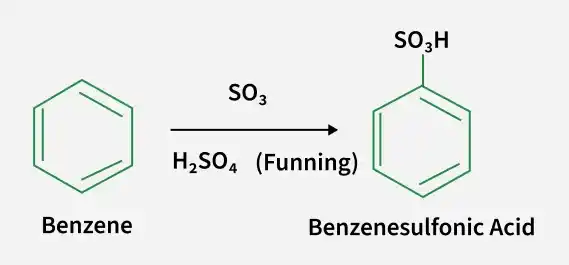
Sulphonation of benzene is an electrophilic substitution reaction in which a hydrogen atom of the benzene ring is replaced by a sulphonic acid group (–SO3H) to form benzene sulphonic acid. This reaction occurs in the presence of concentrated sulphuric acid or oleum. Like other reactions of benzene, sulphonation proceeds via substitution in order to preserve the aromatic stability of the ring.
Sulphonation of benzene is carried out using concentrated H2SO4, which provides the reacting species needed for the reaction or oleum (H2SO4 + SO3) is stronger because it contains free SO3, so the reaction happens faster.
These reagents are used because:
Benzene is very stable (aromatic), so it does not react easily.
It needs a strong electrophile to react.
These reagents help in forming SO3, which is strong enough to attack benzene.
Chemical Reaction
Sulphonation of benzene involves the reaction of benzene with concentrated sulphuric acid or oleum to form benzene sulphonic acid.
In this reaction, one hydrogen atom of benzene is replaced by a sulphonic acid group (–SO3H).
The product formed is benzene sulphonic acid (C6H5SO3H).
This is an example of an electrophilic substitution reaction, because a substituent replaces hydrogen without disturbing the aromatic ring.
Electrophile Formation
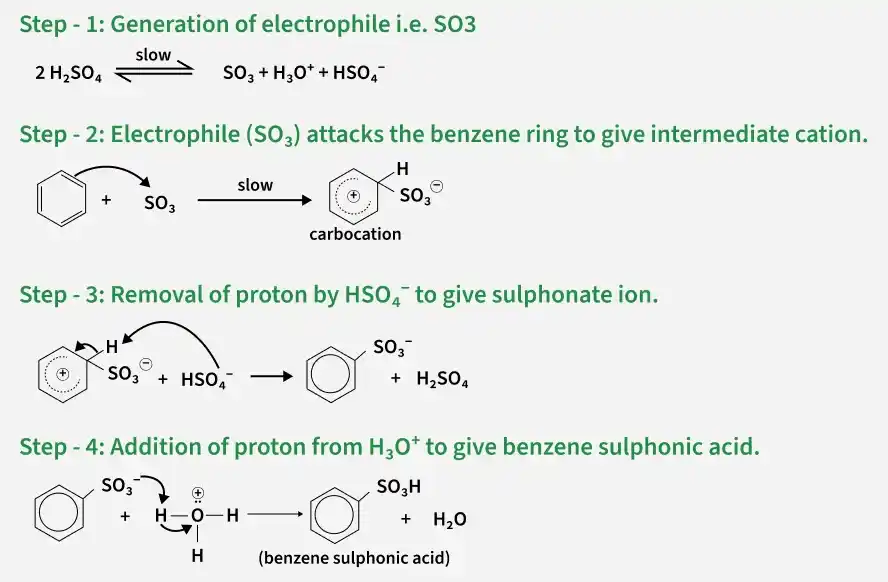
In sulphonation of benzene, the electrophile is sulphur trioxide (SO3). When concentrated sulphuric acid (H2SO4) or oleum is used, it produces SO3 (sulphur trioxide).
SO3 is electron-deficient (especially the sulphur atom).
It has a strong tendency to accept electrons.
Hence, it behaves as an electrophile.
Mechanism of Sulphonation of Benzene
Sulphonation of benzene follows an Electrophilic Aromatic Substitution (EAS) mechanism. It occurs in three main steps: