|
VOOZH | about |
|
VOOZH | about |
Element in chemistry are substances that cannot be broken down into simpler substances by any chemical method by the application of heat or light. For instance, melting a piece of gold still remains the gold element. These substances are composed of a singular type of atoms i.e., they are monoatomic.
Elements are considered to be the building blocks of matter. 118 elements exist in total till now, 94 elements out of these occur in nature whereas the 24 left are prepared artificially. These elements are arranged in a table called the periodic table of elements.
In this article, we will learn about elements in chemistry, the classification of elements, metals, non-metals, and metalloids, etc in detail.
Table of Content
Elements are pure substance that contains only one type of atom that is the building block of all the matter in the universe. Elements can occur in all three states in the matter, that is, solid, liquid or gaseous state. Elements are recognized using chemical symbols and formulae. Elements maintain their homogeneity. For instance, a piece of gold is made up of only gold atoms. Atom is the smallest unit-forming element. It dictates the properties of elements. Elements also possess sharp melting and boiling points.
Elements in chemistry are the building blocks of all the matter in the universe. There are 118 elements known to humans that are arranged in the table called the periodic table. There are 94 elements in the periodic table that are naturally occurring and 24 elements are artificially prepared by humans. Elements are made up of only one similar kind of atoms.
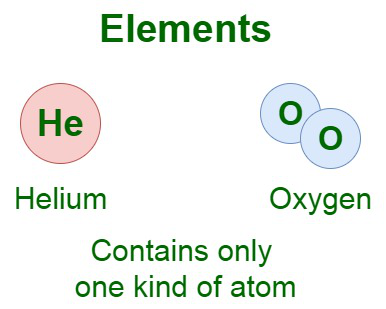
Example: Hydrogen is an example of an element that cannot be split down into two or more substances. The image added below shows the elements of two types.
Here, Helium element contains one single atom arranged infinitely, whereas oxygen atom is formed by two atoms group together.
The going of the elements is linked with the origin of universe. The elements in the universe are from the starting of the time and it is believed that most the elements are created in big bang. The knowledge and use of elements to humans is a relatively new affair.
Metals are known to humans since early days we known the existence of bronze and has used it a lot in a period called Bronze Age in early centuries. Apart form this Gold and Silver is known to each early civilization of human this can be proved very easily. So the question arises when is the first time we started organising and string these metals and study their properties for the betterment of human civilization. The answer to this in since Modern days.
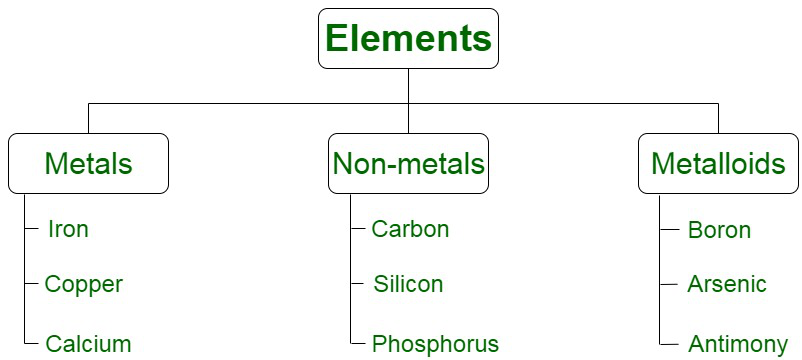
There are various methods of classification of elements based on their various properties, i.e. there valance electrons, physical and chemical properties and others. But the most common way of classifying elements is based on the physical and chemical properties and on this basis the elemts are of three types that include,
Now let's learn about them in detail.
Most of the elements in the periodic table are metals. They form cations, that are positive ions and contain metallic bonds. Metals comprise alkali metals, lanthanides as well as transition metals. Metals are rigid substances possessing a shiny lustrous body and acting as good conductors of heat and electricity. For instance, metal is considered to be a good conductor of electricity. These can be easily hammered to form sheets and drawn into wires. Therefore, the metals are both malleable and ductile. Metals are usually crystalline solids. Metals display high chemical reactivity.
Metals tend losing electrons easily. Metals easily form a lattice of positive ions surrounded altogether by a cloud of delocalised electrons. A metal may be a chemical element, for instance, iron; or an alloy, for instance, stainless steel; or even a molecular compound, for instance, polymeric sulphur nitride.
Various characteristics of metals are,
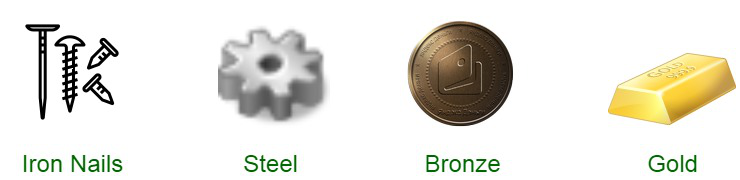
Various examples of metals include, Copper, Iron, Sodium, Calcium, Iron, etc. The image added below shows some commonly used metals.
Various application of metals are,
Metals are the most commonly used materials in the construction sector. Iron and steel are two of the most commonly used metals in the construction of structures and even homes.
Because metals are good conductors of electricity, they are used to build cables and parts for electrically powered equipment and gadgets. Just a few examples include televisions, cellphones, refrigerators, irons, and computers.
Metal elements are needed for a range of processes such as nerve impulse transmission, oxygen movement, enzyme activity, and so on. Several medicines are mixed with metal compounds to treat certain deficits or disorders. Antacids contain elements that are often used in medicine, such as iron, calcium, magnesium, potassium, titanium, and aluminium.
They are frequently used in the manufacture of industrial, agricultural, and farming machines, as well as automobiles such as road vehicles, trains, aeroplanes, and rockets. The most commonly utilised metals in this sector are iron, aluminium, and steel. The bulk of kitchen utensils are made of metals including steel, aluminium, and copper. Metals are selected because of their high temperature resistance.
Nowadays, the majority of furniture is constructed of metal. Metals are also used in the military, where they are used to make weapons and ammunition. Galvanizing prevents the rusting of metals by utilising specific metals.
Non-metals possess qualities differing from those of metals. Non-metals have a dull, coloured or colourless appearance. Non-metals are generally brittle and do not possess the properties of malleability and ductility. They usually generally lack all the characteristics of metals. At room temperature, most of the non-metals are gaseous.
Some of them may be solid. One of the non-metals, bromine is liquid at room temperature. The majority of the non-metals have a dull appearance, except iodine. Certain non-metals can occur in different forms, called allotropes. For example, carbon.
Diamond is one of the allotropes of carbon. It has a very high melting and boiling point and is the hardest naturally occurring substance. Non-metals are generally less dense in comparison to metals. Non-metals are the category of elements that form anions, that is negative ions by accepting or gaining electrons. This is because non-metals possess 4, 5, 6 or 7 electrons in their outermost shell which makes it easy to gain electrons during chemical reactions.
Various characteristics of non-metals are,
Various examples of non-metals are,
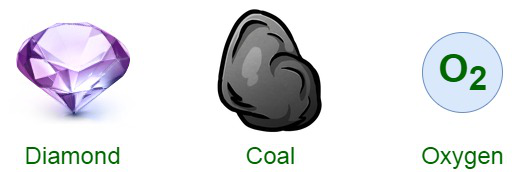
The image added below shows the non-metals that are generally used by us in our daily life.
The applications of non-metals are listed below:
Fertilizers
Fertilizers contain nitrogen. It promotes the development of plants. It accelerates the plant's growth. Non-metallic phosphorus can also help plants. Both of these nonmetals are required for plant growth.
Daily Life
The breathing process is helped by oxygen, which accounts for 21% of the body's volume. It's also used to manufacture steel and keep temperatures high during the metal manufacturing process. Oxygen cylinders are used in hospitals. Chlorine, as a bleaching agent, is good at removing stains and colour patches. Chlorine is utilised in the production of a wide range of polymers and insecticides. It aids in the filtering of water. How? When chlorine is added to drinking water, bacteria are killed. Helium is used as an inert gas in scientific studies. It is also used by weather balloons. Iodine is utilised as an antiseptic in the treatment of wounds and cuts, as well as throat infections.
Learn More, Metals and Non-Metals.
Metalloids are basically the elements possessing intermediate in their properties between metals and nonmetals. They mostly act like non-metals in their physical properties. However, there are certain exceptions. For instance, metalloids are good conductors of electricity. Some of the metalloids contract when they are melted. They also possess a metallic and dull appearance. Boron, germanium, arsenic and antimony are some commonly known metalloids.
The examples of metalloids are Boron, Germanium, Antimony, Arsenic, Bismuth, Silicon, etc.
The comparison between metal, non-metal and metalloids is tabulated below:
| Basis | Metals | Non-Metals | Metalloids |
|---|---|---|---|
| Metallic properties | Possess the highest degree of metallic behaviour. | Possess metallic behaviour. | Possess the metallic properties partially. |
| Location on the periodic table | Left | Right | Between metals and non-metals. |
| Blocks | Located in s, p, d, f, blocks. | Located in s and p blocks. | Located in P Block. |
| Appearance | Lustrous | Possess a dull appearance. | Possess both dull and metallic appearance. |
| Electro-negativity | Low electronegativity. | High electronegativity. | Neither too high nor too low. |
| Conductivity | High thermal and electrical conductivity. | Low thermal and electrical conductivity. | Good thermal and electrical conductivity but less than metals. |
| Ductility | Ductile | Non-ductile | Non-ductile |
| Malleability | Malleable | Non-malleable | Non-malleable |
Read More,