|
VOOZH | about |
|
VOOZH | about |
The CIFAR-100 dataset is a dataset that is widely used in the field of computer vision, serving as a foundational tool for developing and testing machine learning models. This article provides a detailed exploration of the CIFAR-100 dataset and loading process.
Table of Content
Developed by the Canadian Institute for Advanced Research (CIFAR), the CIFAR-100 dataset consists of 60,000 color images partitioned into 100 classes, with each class holding 600 images. The dataset is further divided into 50,000 training images and 10,000 testing images. Each image in the CIFAR-100 dataset is a 32x32 color image, which poses a substantial challenge due to its low resolution.
Unlike its simpler counterpart, CIFAR-10, which contains 10 classes of images, CIFAR-100 is structured around 100 fine classes. These classes are grouped into 20 superclasses. Each superclass encompasses five classes that are semantically related. For instance, the "Aquatic mammals" superclass includes classes like beaver, dolphin, otter, seal, and whale.
Here's a glimpse into some of the superclasses and their corresponding classes:
This hierarchical structure with superclasses and classes allows for more nuanced tasks in machine learning, including fine-grained classification, superclass classification, and hierarchical classification tasks.
The CIFAR-100 dataset was created as an extension of the CIFAR-10 dataset, which contains the same number of total images but fewer classes (10 classes instead of 100). It was developed to provide a more challenging dataset that could help advance the development of more sophisticated image recognition technologies. The CIFAR datasets were created by Alex Krizhevsky, Vinod Nair, and Geoffrey Hinton and have been widely used in academic and research settings since their introduction.
In computer vision, the CIFAR-100 dataset plays a critical role in the development and evaluation of machine learning models. Its complexity, due to the high number of classes and the granularity of images, provides a robust platform for testing the efficacy of algorithms. It is commonly used in benchmarking studies that compare the performance of various architectures and learning techniques, such as convolutional neural networks (CNNs), on a controlled set of data.
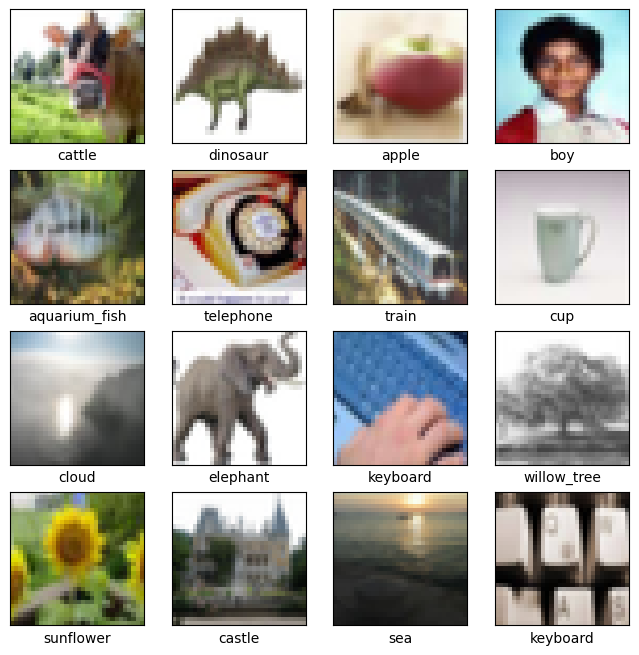
We will load the CIFAR-100 dataset using TensorFlow and plot a 4x4 grid of sample images with their class labels.
The dataset is loaded and unpacked into training and test sets. A function `plot_images` is defined to display images in a grid format, and class names for CIFAR-100 are listed. Finally, the function is called to visualize a 4x4 grid of images from the training set with their corresponding class labels.
Output:
| Feature | CIFAR-10 | CIFAR-100 |
|---|---|---|
| Number of Classes | 10 | 100 |
| Class Labels | Airplane, Automobile, Bird, Cat, Deer, Dog, Frog, Horse, Ship, Truck | Apple, Aquarium Fish, Baby, Bear, Beaver, Bed, Bee, Beetle, Bicycle, Bottle, etc. (total 100 classes) |
| Number of Images | 60,000 (50,000 training + 10,000 test) | 60,000 (50,000 training + 10,000 test) |
| Image Dimensions | 32x32 pixels | 32x32 pixels |
| Color Channels | 3 (RGB) | 3 (RGB) |
| Data Format | 32x32x3 numpy arrays | 32x32x3 numpy arrays |
| Train/Test Split | 50,000 training images / 10,000 test images | 50,000 training images / 10,000 test images |
| Per-Class Samples | 6,000 images per class | 600 images per class |
| Dataset Size | ~163 MB | ~163 MB |
| Dataset Creator | Alex Krizhevsky, Vinod Nair, and Geoffrey Hinton | Alex Krizhevsky, Vinod Nair, and Geoffrey Hinton |
| Year of Release | 2009 | 2009 |
| Applications | Image classification, object recognition, machine learning benchmarks | Fine-grained image classification, object recognition, machine learning benchmarks |
The CIFAR-100 dataset is primarily used in machine learning and computer vision research for object recognition and classification tasks. It serves as a benchmark dataset to develop and test algorithms that can recognize and classify objects within an image. Applications include: