|
VOOZH | about |
|
VOOZH | about |
Linear regression is a statistical method used for predictive analysis. It models the relationship between a dependent variable and one or more independent variables by fitting a linear equation to the data. Multiple Linear Regression specifically extends this concept to include two or more independent variables.
Steps to perform multiple linear regression are similar to that of simple linear Regression but difference comes in the evaluation process. We can use it to find out which factor has the highest influence on the predicted output and how different variables are related to each other. Equation for multiple linear regression is:
Where:
The goal of the algorithm is to find the best fit line equation that can predict the values based on the independent variables. A regression model learns from the dataset with known X and y values and uses it to predict y values for unknown X.
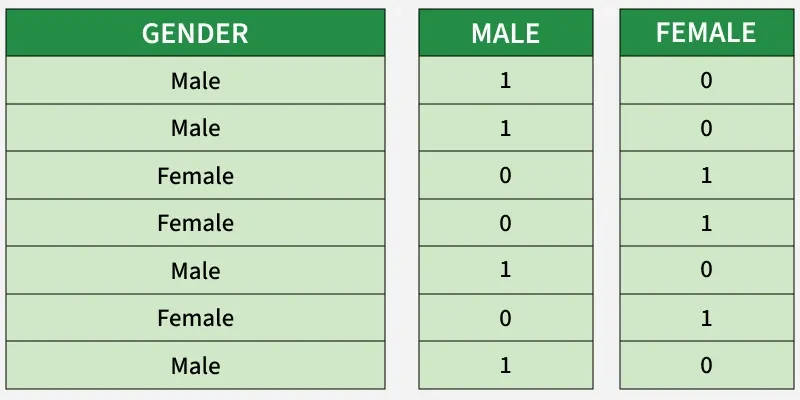
In multiple regression model we may encounter categorical data such as gender (male/female), location (urban/rural), etc. Since regression models require numerical inputs then categorical data must be transformed into a usable form. This is where Dummy Variables used. These are binary variables (0 or 1) that represent the presence or absence of each category. For example:
In the case of multiple categories we create a dummy variable for each category excluding one to avoid multicollinearity. This process is called one-hot encoding which converts categorical variables into a numerical format suitable for regression models.
Multicollinearity arises when two or more independent variables are highly correlated with each other. This can make it difficult to find the individual contribution of each variable to the dependent variable.
To detect multicollinearity we can use:
Similar to simple linear regression we have some assumptions in multiple linear regression which are as follows:
We will use the California Housing dataset which includes features such as median income, average rooms and the target variable, house prices.
We will be using numpy, pandas, matplotlib and scikit learn for this.
X and the target i.e house prices is stored in y.Choose two features MedInc (median income) and AveRooms (average rooms) to simplify visualization in two dimensions.
We will use 80% data for training and 20% for testing.
Create a multiple linear regression model using LinearRegression from scikit-learn and train it on the training data.
After training the model, we can access the intercept and coefficients of the regression equation.
Output:
Intercept: 0.5972677793933272
Coefficients: [ 0.43626089 -0.04017161]
Using the trained model to predict house prices on the test data.
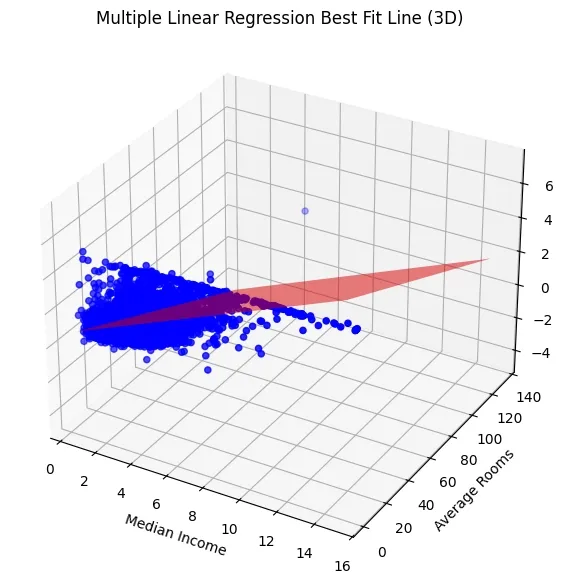
Plot a 3D graph where blue points represent actual house prices based on MedInc and AveRooms and the red surface shows the best-fit plane predicted by the model. This visualization helps us to understand how these two features influence the predicted house prices.
Output:
Multiple Linear Regression effectively captures how several factors together influence a target variable which helps in providing a practical approach for predictive modeling in real-world scenarios.
You can download the complete source code from here.