|
VOOZH | about |
|
VOOZH | about |
Precision-Recall Curve (PR Curve) is a graphical representation that helps us understand how well a binary classification model is doing especially when the data is imbalanced which means when one class is more dominant than other. In this curve:
Unlike theROC curve which looks at both positives and negatives the PR curve focuses only on how well the model handles the positive class. This makes it useful when the goal is to detect important cases like fraud, diseases or spam messages.
Before understanding the PR curve let’s understand:
It refers to the proportion of correct positive predictions (True Positives) out of all the positive predictions made by the model i.e True Positives + False Positives. It is a measure of the accuracy of the positive predictions. The formula for Precision is:
A high Precision means that the model makes few False Positives. This metric is especially useful when the cost of false positives is high such as email spam detection.
It is also known as Sensitivity or True Positive Rate where we measures the proportion of actual positive instances that were correctly identified by the model. It is the ratio of True Positives to the total actual positives i.e True Positives + False Negatives. The formula for Recall is:
A high Recall means the model correctly identifies most of the positive instances which is critical when False Negatives are costly like in medical diagnoses.
To better understand Precision and Recall we can use a Confusion Matrix which summarizes the performance of a classifier in four essential terms:
The PR curve is created by changing the decision threshold of your model and checking how the precision and recall change at each step. The threshold is the cutoff point where you decide:
By default this threshold is usually 0.5 but you can move it up or down.
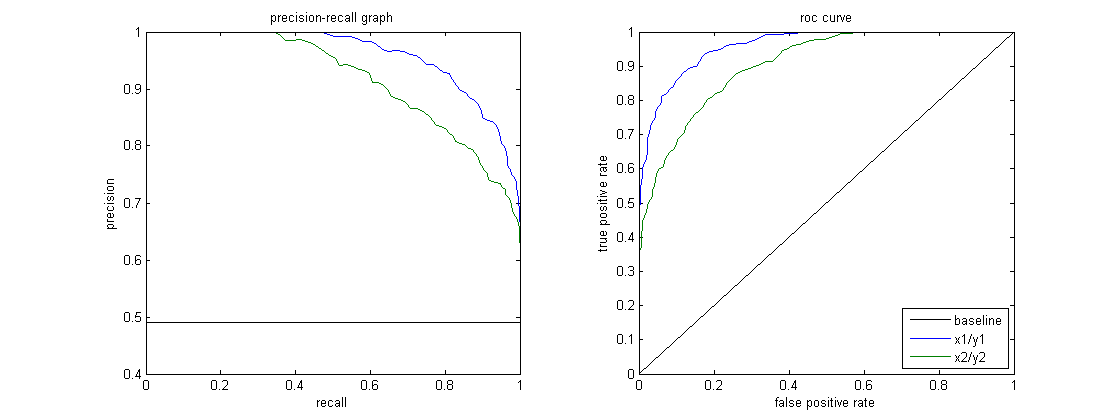
A PR curve is useful when dealing with imbalanced datasets where one class significantly outnumbers the other. In such cases the ROC curve might show overly optimistic results as it doesn’t account for class imbalance as effectively as the Precision-Recall curve. The figure below shows a comparison of sample PR and ROC curves. It is desired that the algorithm should have both high precision and high recall. However most machine learning algorithms often involve a trade-off between the two. A good PR curve has greater AUC (area under the curve).
👁 ImageIn the figure above the classifier corresponding to the blue line has better performance than the classifier corresponding to the green line. It is important to note that the classifier that has a higher AUC on the ROC curve will always have a higher AUC on the PR curve as well.
Consider an algorithm that classifies whether or not a document belongs to the category "Sports" news. Assume there are 12 documents with the following ground truth (actual) and classifier output class labels.
| Document ID | Ground Truth | Classifier Output |
|---|---|---|
| D1 | Sports | Sports |
| D2 | Sports | Sports |
| D3 | Not Sports | Sports |
| D4 | Sports | Not Sports |
| D5 | Not Sports | Not Sports |
| D6 | Sports | Not Sports |
| D7 | Not Sports | Sports |
| D8 | Not Sports | Not Sports |
| D9 | Not Sports | Not Sports |
| D10 | Sports | Sports |
| D11 | Sports | Sports |
| D12 | Sports | Not Sports |
Now let us find TP, TN, FP and FN values.
Given these counts: TP=4,TN=3,FP=2,FN=3
Finally precision and recall are calculated as follows:
It follows that the recall is 4/7 when the precision is 2/3. All the cases that were anticipated to be positive, two-thirds were accurately classified (precision) and of all the instances that were actually positive, the model was able to capture four-sevenths of them (recall).
Choosing between ROC and Precision-Recall depends on the specific needs of the problem, understanding data distribution and the consequences of different types of errors.
We will generate precision-recall curve with scikit-learn and visualize the results with Matplotlib.
This code generates a synthetic dataset for a binary classification problem using scikit-learn's make_classification function.
The train_test_split function in scikit-learn is used to split dataset into training and testing sets.
Here we are using Logistic Regression to train the model on the training data set. A popular algorithm for binary classification. It is implemented by the scikit-learn class LogisticRegression.
We will calculate Precision and Recall which will be used to draw a precision-recall curve and then we will calculate AUC for the precision-recall curve.
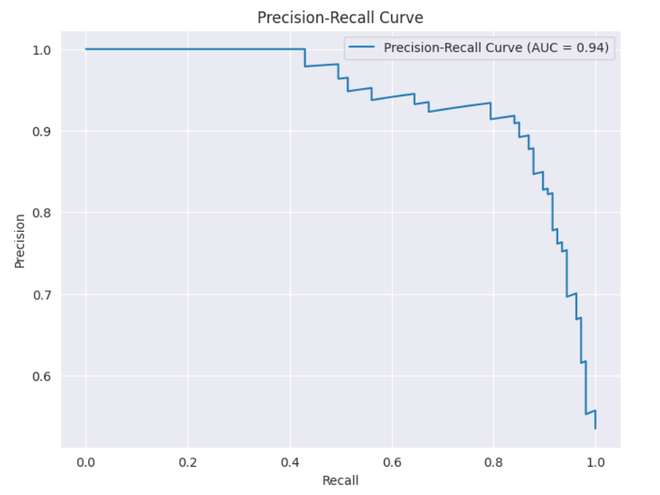
It visualizes the precision-recall curve and evaluate the precision vs recall trade-off at various decision thresholds.
Output:
This curve shows the trade-off between Precision and Recall across different decision thresholds. The Area Under the Curve (AUC) is 0.94 suggesting that the model performs well in balancing both Precision and Recall. A higher AUC typically indicates better model performance.