|
VOOZH | about |
|
VOOZH | about |
Agglomerative clustering, also known as hierarchical clustering, is one of the most popular clustering techniques in data analysis and machine learning. It builds a hierarchy of clusters through a bottom-up approach, where each data point starts as its own cluster, and pairs of clusters are merged at each iteration based on their similarity until a desired cluster structure is formed.
In this article, We will cover all the relevant theoretical concepts and provide practical examples to ensure a deep understanding of this topic.
Table of Content
Agglomerative clustering is a type of hierarchical clustering method, where the algorithm starts with each data point as its own individual cluster. The clusters are then merged iteratively based on a specific criterion, such as distance or linkage method, until a certain stopping criterion (e.g., number of clusters) is reached.
Key Features of Agglomerative Clustering:
The agglomerative clustering process generally follows these steps:
We will use the scipy.cluster.hierarchy module to implement agglomerative clustering. This module provides various functions for hierarchical clustering and allows for the visualization of the dendrogram, a tree-like diagram representing the merging of clusters.
Step 1: Import Required Libraries
Step 2: Generate Sample Data
Step 3: Compute the Linkage Matrix
The linkage function is used to compute the hierarchical clustering based on the data. You can specify the linkage method (e.g., 'single', 'complete', 'average', or 'ward').
Step 4: Visualize the Dendrogram
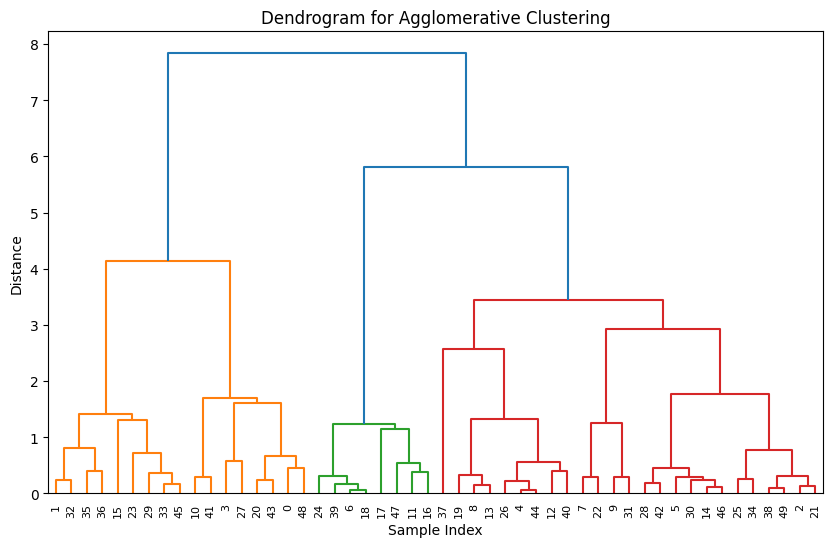
A dendrogram is useful to visualize the hierarchical relationships between clusters. You can use the dendrogram function from SciPy to create the plot.
Output:
The dendrogram represents the hierarchical relationships between clusters. Each leaf in the dendrogram corresponds to a single data point, and the merging of clusters is represented by vertical lines. The height of each vertical line represents the distance at which the clusters are merged. Important Concepts in Dendrograms:
Step 5: Form Clusters Based on a Distance Threshold
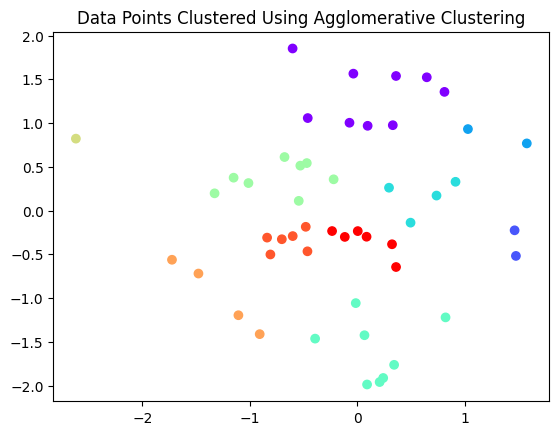
You can cut the dendrogram at a certain distance to form clusters. The fcluster function can be used to achieve this.
Output:
Agglomerative clustering is a powerful and flexible method for hierarchical clustering that builds a hierarchy of clusters in a bottom-up approach. Using the SciPy library, we can easily implement and visualize this clustering method through the use of functions like linkage, dendrogram, and fcluster. Although the algorithm can be computationally expensive for large datasets, its interpretability and flexibility make it an excellent choice for many real-world applications.