|
VOOZH | about |
|
VOOZH | about |
In this section, we explore Chapter 10 of the Class 9 NCERT Mathematics textbook, which focuses on Circles. This chapter introduces students to the fundamental properties and theorems related to circles, such as the different types of chords, tangents, and the angles formed within and outside a circle. Understanding these concepts is crucial for mastering more advanced geometric topics in future studies.
This section provides comprehensive solutions for Chapter 10 of the Class 9 NCERT Mathematics textbook. These solutions are designed to help students grasp the essential concepts related to circles, including important theorems and their applications, ensuring a solid foundation in geometry.
The NCERT Class 9 Maths Chapter 10 Circles covered a variety of issues, including how to determine the separation between equal chords from the centre and the angles that a chord at a location subtended. There are also studies of cyclic quadrilaterals and their properties, as well as the angles that a circle's arc subtends.
| Exercises under NCERT Solutions for Class 9 Maths Chapter 10 Circles |
|---|
| NCERT Maths Solutions Class 9 Exercise 10.1 – 2 Questions & Solutions (2 Short Answers) |
| NCERT Maths Solutions Class 9 Exercise 10.2 – 2 Questions & Solutions (2 Long Answers) |
| NCERT Maths Solutions Class 9 Exercise 10.3 – 3 Questions & Solutions (3 Long Answers) |
| NCERT Maths Solutions Class 9 Exercise 10.4 – 6 Questions & Solutions (6 Long Answers) |
| NCERT Maths Solutions Class 9 Exercise 10.5 – 12 Questions & Solutions (12 Long Answers) |
| NCERT Maths Solutions Class 9 Exercise 10.6 – 10 Questions & Solutions (10 Long Answers) |
(i) The centre of a circle lies in ____________ of the circle. (exterior/ interior)
Answer: Interior.
(ii) A point, whose distance from the centre of a circle is greater than its radius lies in ______________ of the circle. (exterior/ interior)
Answer: Exterior.
(iii) The longest chord of a circle is a ______________ of the circle.
Answer: Diameter.
(iv) An arc is a _____________ when its ends are the ends of a diameter.
Answer: Semicircle.
(v) Segment of a circle is the region between an arc and _____________ of the circle.
Answer: Chord.
(vi) A circle divides the plane, on which it lies, in _______________ parts.
Answer: Three.
(i) Line segment joining the centre to any point on the circle is a radius of the circle.
Answer: True, Any line segment drawn from the centre of the circle to any point on it is called radius of the circle and will be of equal length.
(ii) A circle has only finite number of equal chords.
Answer: False, There can be infinite number of equal chords in a circle.
(iii) If a circle is divided into three equal arcs, each is a major arc.
Answer: False, When the arcs are not equal we will have major and minor arc, equal arcs cannot be classified as a major arc or a minor arc.
(iv) A chord of a circle, which is twice as long as its radius, is a diameter of the circle.
Answer: True, Diameter is the longest chord of the circle and the length of the longest chord in a circle is twice the length of radius of the circle.
(v) Sector is the region between the chord and its corresponding arc.
Answer: False, Sector is defined as the region between the arc and 2 radii of the circle.
(vi) A circle is a plane figure
Answer: True, A circle is a 2D figure which can be drawn on a plane.
Solution:
Given:
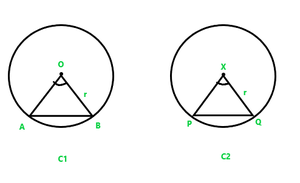
Two Congruent Circles C1 and C2
AB is the chord of C1
and PQ is the chord of C2
AB = PQ
To Prove: Angle subtended by the Chords AB and PQ are equal i.e. ∠AOB = ∠PXQ
Proof:
In △AOB & △PXQ
AO = PX (Radius of congruent circles are equal)
BO = QX (Radius of congruent circles are equal)
AB = PQ (Given)
△AOB ⩭ △PXQ (SSS congruence rule)
Therefore, ∠AOB = ∠PXQ (CPCT)
Solution:
Given:
Two Congruent circles C1 and C2
AB is the chord of C1 and PQ is chord of C2
& ∠AOB = ∠PXQ
To prove :
In △AOB and △PXQ ,
AO = PX (Radius of congruent circles are equal)
∠AOB = ∠PXQ (Given)
BO = QX (Radius of congruent circles are equal)
△AOB ⩭ △PXQ (SAS congruence rule)
Therefore, AB = PQ (CPCT)
Solution:
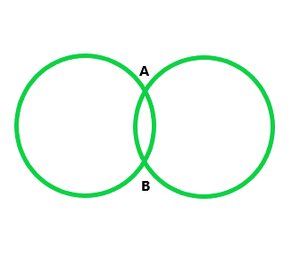
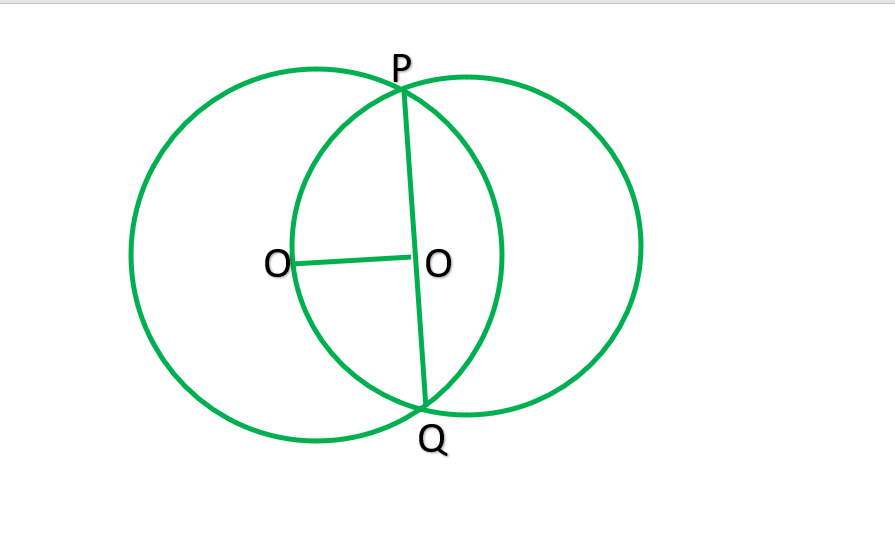
(i) Two points common
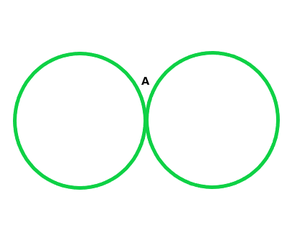
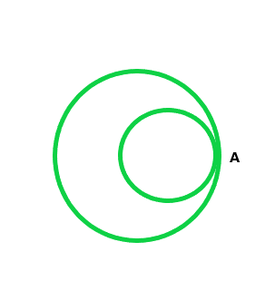
(ii) One point common
(iii) One point common
(iv) No point common
(v) No point common
As we can analyse from above, two circles can cut each other maximum at two points.
Solution:
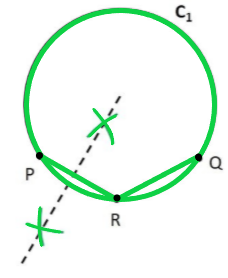
Let the circle be C1
We need to find its centre.
Step 1: Take points P, Q, R on the circle
Step 2: Join PR and RQ.
We know that perpendicular bisector of a chord passes through centre
So, we construct perpendicular bisectors of PR and RQ
Step 3: Take a compass. With point P as pointy end and R as pencil end of the compass, mark an arc above and below PR. Do same with R as pointy end P as pencil end of the compass.
Step 4: Join points intersected by the arcs.
The line formed is the perpendicular bisector of PR.
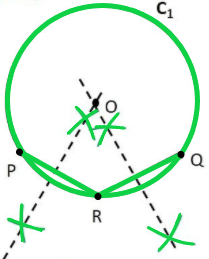
Step 5: Take compass, with point R as pointy end and Q as pencil end of the compass mark an arc above and below RQ.
Do the same with Q as pointy end and R as pencil end of the compass
Step 6: Join the points intersected by the arcs.
The line formed is the perpendicular bisector of RQ.
Step 7: The point where two perpendicular bisectors intersect is the centre of the circle. Mark it as point O.
Thus, O is the centre of the given circle.
Solution:
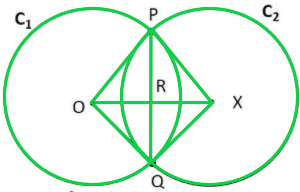
Given,
Let circle C1 have centre O and circle C2 have centre X, PQ is the common chord.
To prove: OX is the perpendicular bisector of PQ i.e.
1. PR = RQ
2. ∠PRO = ∠PRX = ∠QRO = ∠QRX = 90°
Construction:
Join PO, PX, QO, QX
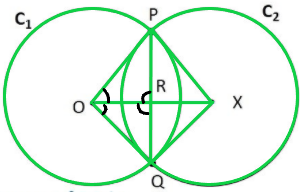
Proof:
In △POX and △QOX
OP = OQ (Radius of circle C1)
XP = XQ (Radius of circle C2)
OX = OX (Common)
∴ △POX ≅ △QOX (SSS Congruence rule)
∠POX = ∠QOX (CPCT) ----(1)
Also,
In △POR and △QOR
OP = OQ (Radius of circle C1)
∠POR = ∠QOR ( From (1))
OR = OR (Common)
∴ △OPX ≅ △OQX (SAS Congruence Rule)
PR = QR (CPCT)
& ∠PRO = ∠QRO (CPCT) ----(2)
Since PQ is a line
∠PRO + ∠QRO = 180° (Linear Pair)
∠PRO + ∠PRO= 180° ( From (2))
2∠PRO = 180°
∠PRO = 180° / 2
∠PRO = 90°
Therefore,
∠QRO = ∠PRO = 90°
Also,
∠PRX = ∠QRO = 90° (Vertically opposite angles)
∠QRX = ∠PRO = 90° (Vertically opposite angles)
Since, ∠PRO = ∠PRX = ∠QRO = ∠QRX = 90°
∴ OX is the perpendicular bisector of PQ
Solution:
Given: OP=4cm, AP=3cm, QR=5cm
To find: In ∆APO:
AO²=5²=25
OP²=4²=16
AP²=3²=9
OP²+AP²=AO²
BY converse of Pythagoras theorem
ΔAPO: is a right ∠D=P
Now, in the bigger circle OP is perpendicular AB
AP=½AB ----------------(perpendicular from the center of circle to a chord bisect the chord )
3=½AB
6=AB
∴Therefore the length of common chord is 6cm.
Solution:
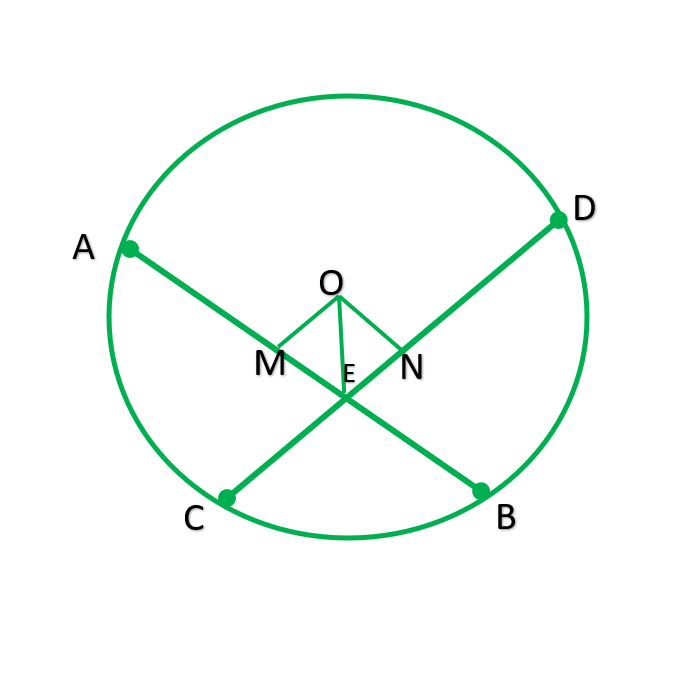
Given: Equal chord AB & CD intersect at P.
To find: AP=PD and PB=PC
Construction: Draw OM perpendicular AB ,ON perpendicular CD and join OP.
Because perpendicular from center bisect the chord
∴AM=MB=½AB also CN=ND=½CD
AM=MB=CN=ND ------------------1
Now, In ∆OMP and ∆ONP
ANGLE M=ANGLE N [90° both]
OP=OP [COMMON]
ON=OM [equal chords are equilateral from center]
∴∆OMP≅∆ONP
Therefore MP=PN (C.P.C.T.) ------------------2
i)from 1 and 2
AM+MP=ND+AN
AP=PD
ii)MB-MP=CN=PN
PB=PC
Solution:
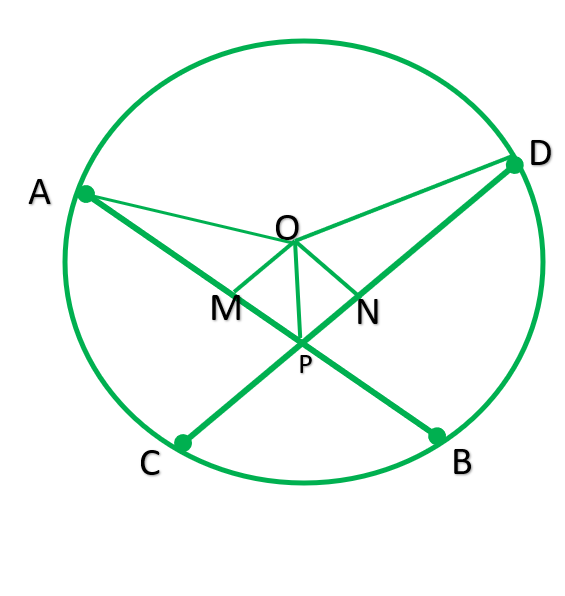
Given: Equal chords AB and CD intersect at P.
To prove: angle1=angle=2
Construction: Draw OM perpendicular AB & ON perpendicular CD.
Solution: In ∆OMP & ∆ONP
Angle M= Angel N [90 ° each]
OP=OP [common]
OM=ON ---------------[ Equal chords are equal distant from center]
∴∆OMP≅∆ONP ----------[R.H.S]
∴∠1=∠2 -----------[C.P.C.T]
Solution:
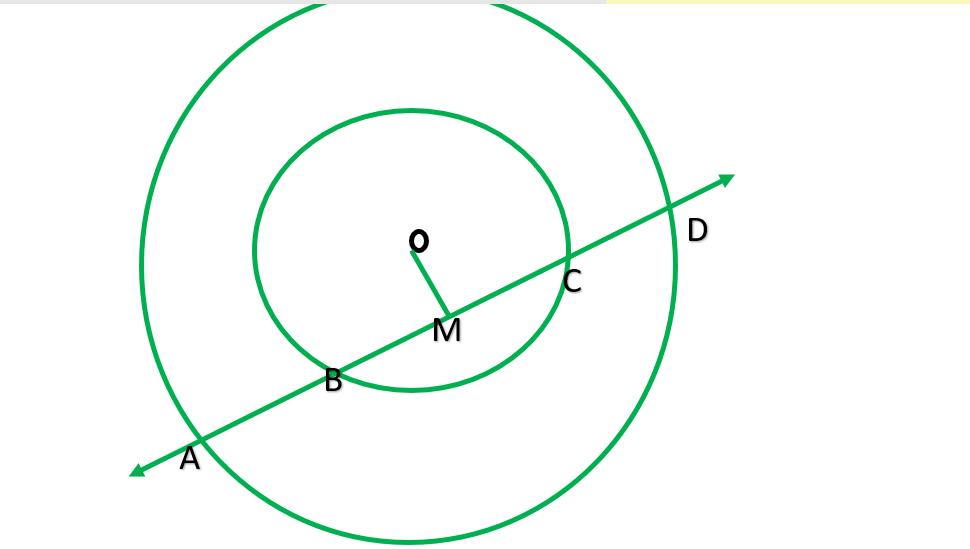
Given : two concentric circle with O. A line intersect them at A, B, C , and D
To prove: AB=CD
construction: Draw OM ⊥ AD ,In bigger circle AD is chord OM ⊥ AD.
∴AM=MD ----------------[⊥ from center of circle of a circle bisects the chord] __________ 1
The smaller circle :
BC is chord OM ⊥ BC
BM=MC -------------------[⊥ from center of circle of a circle bisects the chord] __________ 2
subtracting 1-2
AM-BM=MD-MC
AB=CD
Solution:
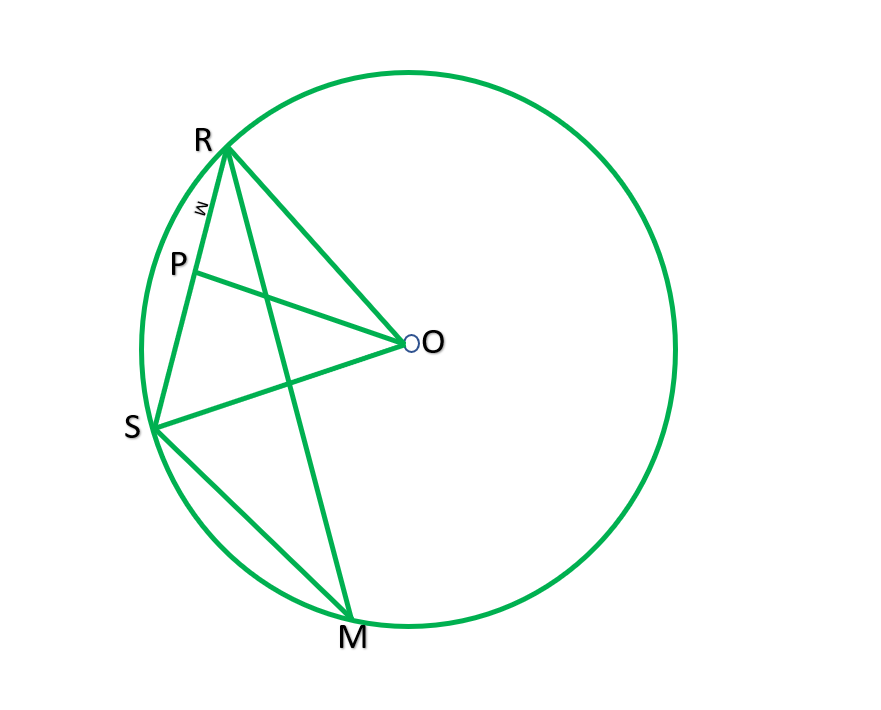
To find RM=?
Let Reshma, Salma and Mandip be R,S,M
Construction: Draw OP ⊥ RS join OR and OS.
RP=½RS ___________[⊥ from center bisects the chord]
RP=½*6=3m
In right ΔORP
OP²=OR²- PR²
OP= √ 5² -3²
=√259 =√16 =4
Area of ΔORS=½*RS*OP
=½*6*4=12m² -----------------1
Now, ∠N=90°
Area of ΔORS=½*SO*RN
=½*SO*RN -------------------2
Above ,1=2
12=½*5*RN
12/5*2=RN
RN=4.8
RM=2*RN _________________[⊥ from center bisects the chord]
=2*4.8
9.6m
Solution:
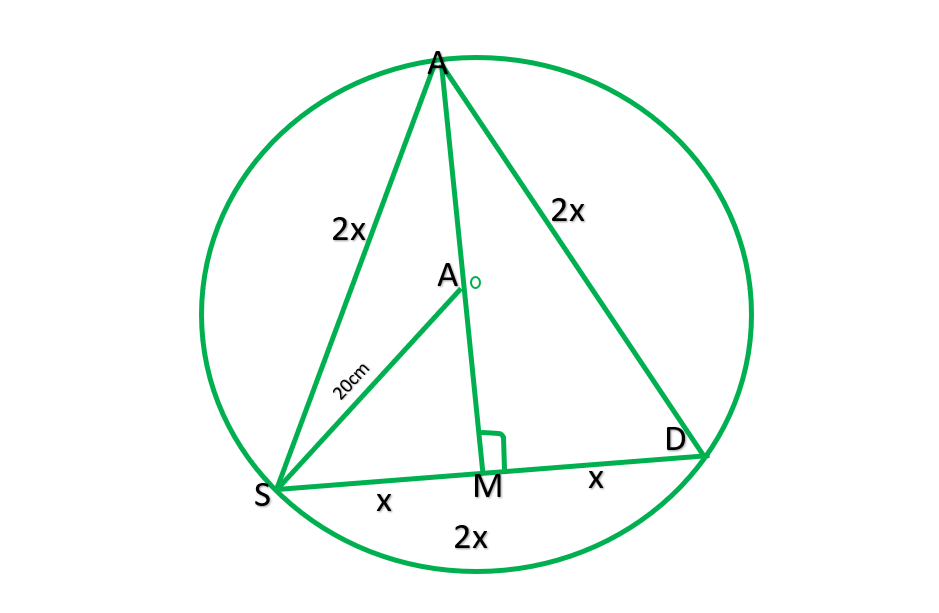
Draw AM⊥SD
AS=SD=AD
∴ASD is the equilateral Δ
Let each side of Δ-2xm
SM=2x/2=x
Now in Δ DMS, by the Pythagoras theorem
AM²+SM²=AS²
AM²= AS²- SM²
AM=√(2x²+x² )
==√(3x² )
AM =√3x
OM=AM-AO
OM=√3x-20
Now in right ΔOMS
OM²+SM²=SO²
(√3x-20)²+2x²+x²=20²
20²+400-40√3x+x^2=400
4x²=40√3x
4xx=40√3x
X=(40√3)/4
X=10√3x
Length of each string =2x
=2*10√3xm
Solution:
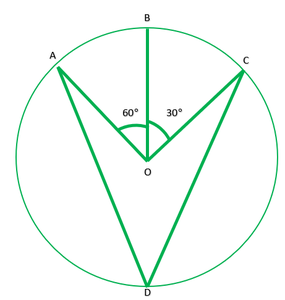
Given: ∠BOC=30° and ∠AOB=60°
To find: ∠ADC
Solution: ∠AOC=2∠ADC ---------[The angle subtended by an arc at the centre is double the angle the angle subtended by it any point on the remaining part of the circle.]
∠AOB+∠BOC=2∠ADC
60°+30°=2∠ADC
90+30=2∠ADC
90/2=∠ADC
45=∠ADC
Solution:
Given: PQ=OP
To find: Angle on major arc is ∠A=?
Angle on the minor arc is ∠B=?
Since, =PO=OQ
∴∠POQ=60°
∠POQ=2∠PAQ [The angle subtended by an arc at the centre is double the angle subtended by it any point on the remaining point of the circle]
Reflex ∠POQ=360°-60°
Reflex ∠POQ=300°
Reflex ∠POQ=2∠POQ
300°=2∠PBQ
300°/2=∠PBQ
150°=∠PBQ
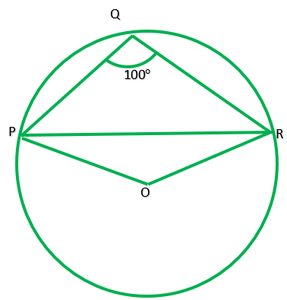
Solution:
Given: ∠PQR=100°
To find: ∠OPR=?
Reflex ∠POR=2∠PQR --------[ The angle subtended by an arc at the centre is double the angle subtended by it any point on the remaining point of the circle]
Reflex ∠PQR=2*100
=200°
∠POR=360°-200°
Now in ∆POR,OP=QR [ Radii of same circle]
∠P=∠R and let each =x.
∴∠P+∠O+∠R=180° [angle sum property of ∆]
x+160°+x=180°-160°
2x+160°=180°
x=20°/2=10°
∴∠OPR=10°
Solution:
Given: ∠ABC=69°,∠ACB=31°
To find: ∠BDC=?
Solution: In ∆ABC
∠A+∠B+∠C=180° ---------[Angle sum property of ∆]
∠A+69°+31°=180°
∠A=180°-100°
∠A=80°
∠A and ∠D lie on the same segment therefore,
∠D=∠A
∠D=80°
∠BDC=80°
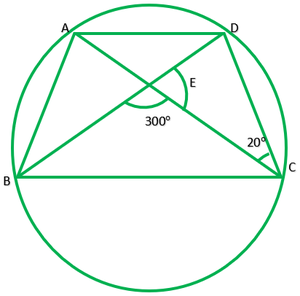
Solution:
Given: ∠BEC=130°,∠ECD=20°
To find: ∠BAC?
Solution: In ∆EDC
∠E=180°-130° ---------[linear pair]
∠E=50°
∠E+∠C+∠D=180° ------[angle sum property of triangle]
50°+20°+∠D=180°
70°+∠D=180°
∠D=180/70=110°
Since, ∠A and ∠D line in the same segment
∴∠A=∠D
∠A=110°
∠BAC=110°
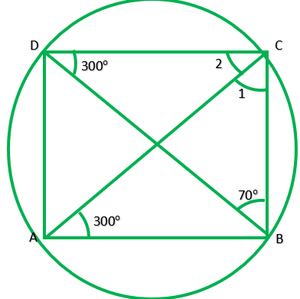
Solution:
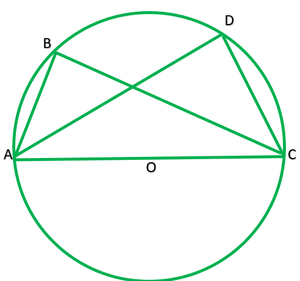
Given: ABCD is a cyclic quadrilateral diagonal intersect at E ∠DBC=70°, ∠BAC is 30°. If AB=BC.
To find: ∠BCD and ∠ECD
∠BDC=∠BAC=30° -------[angle in the same segment]
In ∆BCD,
∠B+∠C+∠D=180° --------[angle sum property of triangle]
∠C+100°=180°
∠C=180°-100°=80°
∴∠BCD=80°
If AB=BC,
Then, ∠BAC=∠BCA
30°=∠BCA
Now, ∠BCA+∠ECD=∠BCD
30°+∠ECD=80°
∠ECD=80°-30°
∴∠ECD=50°
Solution:
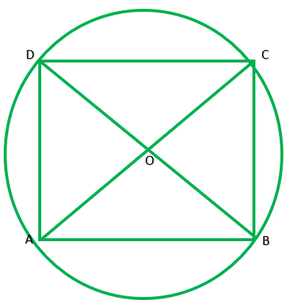
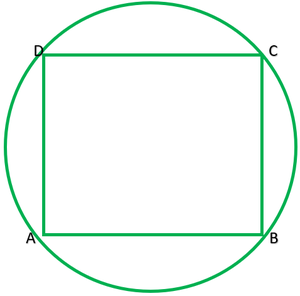
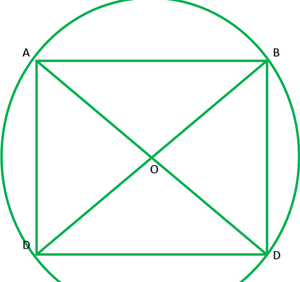
Given: ABCD is a cyclic quadrilateral. Diagonals of ABCD are also diameters of circle.
To prove: ABCD is a rectangle
AC=BD ----------[diameters of same circle]
OA=OA ---------[radii of the same circle]
OA=OC=1/2AC ---------2
OB=OD=1/2BD ----------2
From I and 2 diagonals are equal and bisect each other
∴ABCD is a rectangle
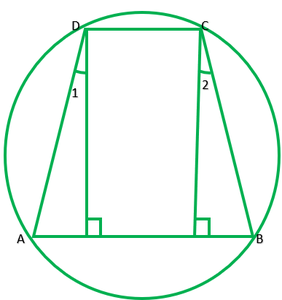
Solution:
Draw DL perpendicular AB and EF perpendicular AB
In ∆DEA and ∆CEB
∠E=∠F --------[each 90°]
AD=BC --------[given]
DE=CF --------[distance between || lines is same every line]
∴∆DEA≅∆CFB --------[R.H.S]
∠A=∠B ---------[by c.p.c.t.] 1
∠1=∠2 (from 1)
Adding 90° on each sides
∠1+90°=∠2+90°
∠1+∠EDC=∠2+FCD
∠ADC=∠BCD
∠D=∠C 2
Now,
∠A+∠A+∠C+∠C=360°
2∠A+2∠C=360°
2(∠A+∠C)=360°
∠A+∠C=360°/2=190°
Because sum of opposite angles is 180°.
ABCD is parallelogram.
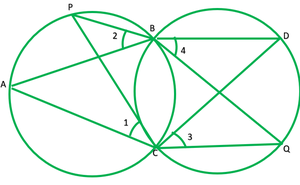
Solution:
To prove: ∠ACP=∠QCD or ∠1=∠2
∠1=∠2 ------ [angles in the same segment are equal] 1
∠ 3=∠ 4 ------- [angles in the same segment are equal] 2
∠2=∠4 ------- [vertically opposite angles] 3
From 1 2 and 3
∠1=∠3
∴∠ACP=∠QCB
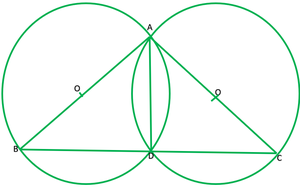
Solution:
Given: ABC is ∆ and AB and AC are diameters of two circles
To prove: Point of intersection is D, lies on the BC.
Construction: Join AD
∠ADB=90° -------[angles in semicircle] 1
∠ADC=90 ° ------[angles in semicircle] 2
Adding 1 and 2
∠ADB+∠ADC=90°+90°
∠BDC=180°
BDC is a straight line therefore D lies on BC.
Solution:
Given: ABC and ADC are two right angle triangles with common hypotenuse AC.
To prove: ∠ADB=∠CBD
Solution: ∠ABC=∠ADC=90°
Circle drawn by taking AC as diameter passes through B and D.
For chord CD
∠CAD=∠CBD -------[angle in the same segment]
Solution:
Given: ABC is a cyclic ||gm
To prove: ABCD is a rectangle.
Because ABCD is a cyclic ||gm
∴∠A+∠C=180°
∠A=∠C [opposite angle of ||gm]
∴∠A=∠C=(180°)/2=90°
∠A=90°
∠C=90°
Similarly,
∠B+∠D=180°
∴∠B=∠D =(180°)/2=90° ----------[opposite of a ||gm]
Each angle of ABCD is 90°
∠B=90°
∠D=90°
Thus, ABCD is a rectangle.
Solution:
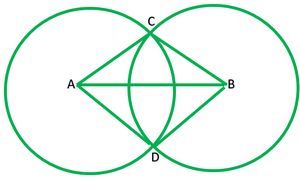
Given: Two circles with Centre A and B circle intersects at C and D.
To prove: ∠ACB=∠ADB
Construction: Join AD,BC and BD
Proof: In ∆ACB and ∆ADB
AC=AD --------[radii of the same circle]
BC=BD ---------[radii of the same circle]
AB=AB --------[common]
∴∆ACB≅∆ADB --------- [by S.S.S]
∠ACB=∠ADB --------[c.p.c.t.]
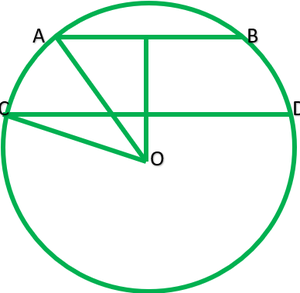
Solution:
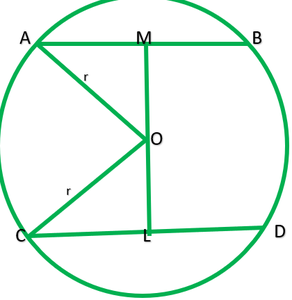
Let O be the centre of circle and be r cm
Given: AB=5cm, CD =11cm
Construction: Draw OM perpendicular AB and OL perpendicular CD.
Because OM perpendicular AB and OL perpendicular CD and AB||CD.
∴Points O,L, and M are collinear, than ∠M=6cm
Let OL=x
Then OM=6=x
Join AO and CO
OA=OC =r
OL=1/2CD=1/2*11=5.5cm -----[perpendicular from bisects the chord]
AM=1/2AB=1/2*5=2.3cm -----[perpendicular from bisects the chord]
Now, In right ∆DLC
r2=(OL)2+(CL)2
r2=x2+(5.5)2
r2=x2+30.25 -----------1
Now in right ∆OMA
r2=(OM)2+(MA)2
r2=(6-x)2+(2.5)2
r2=36+x2=12x+6.25
r2=x2-12x+42.25 -----------2
Now equating equation 1 and 2
X2+30.25=x2-12x+30.25
12x=42.25-30.25
X=12/12=1
Putting value of x in equation 1
r2=x2+30.25
r2=(1)2+30.25
r2=31.25
r=√31.25=5.6 (approx.)
Radius of circle is 5.6cm.
Solution:
Let AB and CD are|| chord of circle with centre O which AB=6cm and CD=8cm and radius of circle =r cm.
Construction: Draw OP perpendicular AB and OM perpendicular CD.
Because AB||CD and OP perpendicular AB and OM perpendicular CD therefore. Point O, M and P are collinear.
Clearly, OP=4cm ----------[According to question]
OM=to find?
P is midpoint of AB.
∴AP=1/2 AB=1/2*6=3cm
M is midpoint of AB.
CM=1/2 CD=1/2*8cm=4cm
Join AO and CO
Now in Right ∆OPA,
r2=AP2+PO2
r2=32+42
r2=9+16=25
Now in ∆OMC
r2=CM2+MO2
25=42+MO2
25-16=MO2
9=MO2
√9=MO
3=MO
∴Therefore distance of the other chord from the centre is 3cm
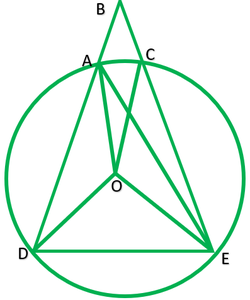
Solution:
Give: Vertex B of ∆ABC lie outside the circle,chord AD=CE
To prove: ∠ABC=1/2(∠DOE-∠AOC)
Construction: Join AE
Solution: Chord DE subtends ∠DOE at the center and ∠DAE at point A on the circle.
∴∠DAE=1/2∠DOE ----------1
chords AC subtends ∠AOC at the centre and ∠AEC at point
∴∠AEC=1/2∠AOC ---------2
In ∆ ABE,∠DAE is exterior angle
∠DAE=∠ABC +∠AEC
1/2∠DOE=∠ABC+1/2∠AOC
½(∠DOE-∠AOC)= ∠ABC
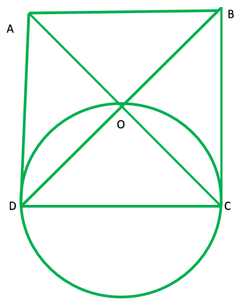
Solution:
Given: A rhombus ABCD in which O is intersecting point of diagonals AC and BD.
A circle is drawn taking CD as diameter.
To prove: circle points through O or Lies on the circles.
Proof: In rhombus ABCD,
∠DOA=90° --------[diagonals of rhombus intersect at 90°] 1
In circle:
∠COD=90° --------[angle made in segment O is right angle] 2
From 1 and 2
O lies on the circle.
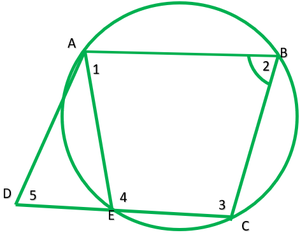
Solution:
ABCD is a ||gm. The circle through A,B and C intersect at E.
To prove: AE=AD
Proof: Here ABCE is a cyclic quadrilateral
∠2+∠4=180° -----[sum of opposite is of a cyclic quadrilateral is 180°]
∠4=180°-∠1 -------1
Now ∠4+∠6=180°-∠6 ---------2
From 1 and 2
180°-∠2=∠180°-∠6
∠2=∠6 -----------3
Also ∠2=∠5 ---------[opposite angles of ||gm are equal] -----4
From 3 and 4
∠5=∠6
Now, In ∆ADE,
∠5=∠6
∴AE=AD ------[sides apposite to equal angles in a∆ are equal]
Solution:
Given: Two chords AC and BD bisects each other i.e OA=OC,OB=OD
To prove: In ∆AOB and COB
AO=CO -------[given]
∠AOB=∠COD ------[vertically opposite angle]
OB=OD --------[give]
∴∆AOB≅∆COB ------[s.s.s]
AB=CD ------[C.P.C.T.] 1
similarly ∆AOD≅∆COB (S.A.S)
AD=CD (C.P.C.T.) 2
From 1 and 2 ABCD is a ||gm
Since, ABCD is cyclic quadrilateral
∴∠A+∠C=180°
∠B+∠B=180°
2∠B=180°
∠B=180°/2
∠B=90°
∴ ∠A and ∠B lies in a semicircle
→ AC and BD are diameter of circle.
ii) Since ABCD is a ||gm and ∠A=90°
∴ ABCD is a rectangle.
Solution:
Given:∆ABC and it circum-circle AD,BE and CF are bisectors of ∠A,∠B and ∠C
Respectively.
To proof:∠ D=90°-1/2∠A , ∠E=90°-1/2∠B , ∠F=90°-1/2∠C
Construction: Join AE and AF.
Solution: ∠ADE=∠ABE ----------1 [angle in the same segment are equal]
∠ADF=∠ACF -----------2 [angle in the same segment are equal]
Adding 1 and 2
∠ADE+∠ABF=∠ABE+∠ACF
∠D=1/2∠B+1/2∠C ------[BC and CF are bisector of ∠B & ∠c]
∠D=1/2(∠B+∠C)
∠D=1/2(180°-∠A)
∠D=1/2(180°-∠A)
∠D=90°-1/2∠AC
Solution:
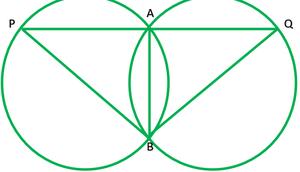
Given: two congruent circles which intersect at A and B.
PAB is a line segment
To prove: BA=BQ
Construction: join AB
Proof: AB is a common chord of both the congruent circle.
Segment of both circles will be equal
∠P=∠Q
Now, in ∆ BPQ,
∠P=∠Q
BP=BQ ------[sides opposite to equal angles are equal]
Solution:
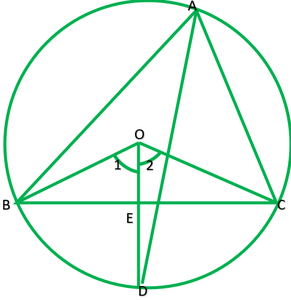
Given: A ∆ABC, in which AD is angle bisector of ∠A and OD is ⊥ bisector of BC.
To prove: D lies on circumcircle.
Construction: Join OB and OC
Proof: Since BC subtends ∠BAC at A on the remaining of the circle.
∠BOC=2∠BAC -------1
Now, In ∆BOE and ∆ COE
BO=OE --------(radii of the same circle)
BE=CE -----(give)
∴∆BOE≅COE -------(S.S.S)
∠1=∠2 -------(c.p.c.t)
Now,
∠1+∠2=∠BOC
2∠1=∠BOC
2∠1=2∠BAC ---------- (from 1)
∠1=∠BAC
∠BOE=∠BAF
∠BOD=∠BAC
∠BOD=2∠BAD [AD is bisector of ∠BAC]
This is possible only if BD is chord of the circle.
D lies on the circle.
By utilizing the class 9 questions with solutions on circles, students can reap various advantages that would aid their academic growth. Firstly, these comprehensive resources enable students to improve their scores significantly while simultaneously enhancing their understanding of the subject matter. Moreover, what further adds to their accessibility is the fact that these helpful PDF files are conveniently available free of charge. Therefore, students have the flexibility to choose between a soft copy or a hard copy, based on their personal preference and convenience.
Also Check: