Software applications are an essential part of daily life, so ensuring their quality is very important. Software testing helps identify defects and improve product reliability. Along with formal test cases, testers also use experience-based techniques like error guessing.
Software testing ensures the application is error-free and meets user expectations.
Testers go beyond written test cases and use experience to find hidden bugs.
Error guessing is an informal technique where testers predict defects based on intuition and past experience.
Process of Error Guessing
The process of Error Guessing involves identifying potential defect-prone areas in an application and designing test cases based on experience and intuition rather than formal rules.
Understanding the application requirements and functionality.
Using tester experience to identify areas where errors are likely to occur.
Thinking about possible mistakes made by developers or users (e.g., invalid inputs, missing values, boundary conditions).
Creating test cases based on these guessed error scenarios.
Executing the test cases on the application.
Observing results and identifying unexpected behavior or defects.
Reporting the found issues for fixing.
Error Guessing Techniques
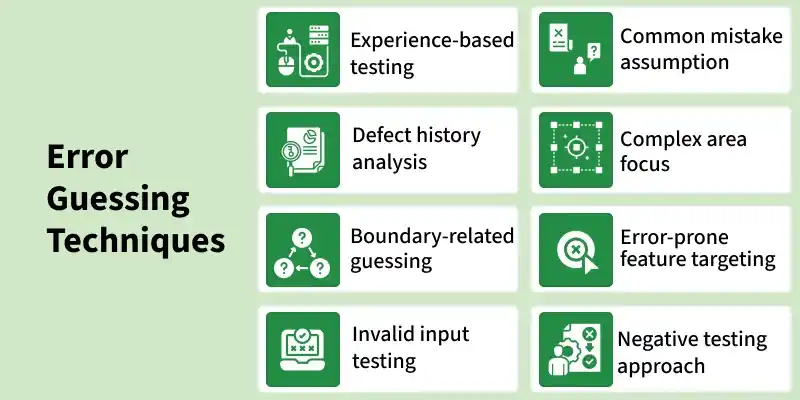
Error Guessing is based on experience and intuition, but testers use some common techniques to improve its effectiveness:
Experience-based testing: Using past project knowledge and previously found defects to predict new ones.
Defect history analysis: Studying old bug reports to identify frequently occurring issues.
Boundary-related guessing: Testing extreme values, limits, and edge cases where errors are common.
Invalid input testing: Providing wrong, unexpected, or random inputs to check system behavior.
Common mistake assumption: Thinking like a developer or user and guessing typical human errors.
Complex area focus: Targeting highly complex modules or logic-heavy parts of the application.
Error-prone feature targeting: Focusing on frequently used or recently modified features.
Negative testing approach: Intentionally testing scenarios where the system should fail or handle errors gracefully.
Factors Considered in Error Guessing
Error Guessing depends on several important factors that help testers predict possible defects in software. These factors include:
Tester’s experience and domain knowledge
Past defects and historical bug data
Lessons learned from previous projects or releases
Common mistakes found in similar applications
Complexity of the application or module
User behavior and frequently used features
Production issues and customer-reported problems
Test execution results and failure patterns
Application of Error Guessing in Software Testing
Error Guessing is commonly used along with black-box testing techniques such as Boundary Value Analysis and Equivalence Partitioning, especially when formal methods do not cover all possible error-prone scenarios.
It is best applied in the following situations
Time and Resource Constraints: Helps quickly identify critical defects when time for detailed test design is limited.
Agile Environments: Supports fast and iterative testing during continuous development cycles.
Complex or Unfamiliar Systems: Useful when documentation is limited and testers rely on experience.
Unclear or Incomplete Specifications: Helps identify missing or incorrect requirements.
High-Risk Modules: Focuses on areas where failures can cause major functional or business impact.
Error Guessing complements structured testing by covering real-world, experience-based scenarios that formal techniques may miss.
Advantages of Error Guessing
Helps find hidden and unexpected defects
Very simple and easy to apply
Requires no formal test design technique
Based on real experience and practical knowledge
Effective for finding critical and high-risk bugs
Can be used along with other testing techniques
Useful when time is limited for testing
Helps in exploratory and ad-hoc testing
Limitations of Error Guessing
Depends heavily on tester experience and intuition
No formal structure or documented procedure
Cannot guarantee complete test coverage
May miss defects if tester lacks domain knowledge
Highly unpredictable and subjective approach
Not suitable for large or complex systems alone
Difficult to repeat or measure results consistently
Effectiveness varies from tester to tester
Best Practices for Effective Error Guessing
Gain strong knowledge of application requirements and functionality
Use past experience from previous projects and defect history
Focus on error-prone and complex areas of the application
Think like a developer and end user to predict mistakes
Pay attention to boundary values and invalid inputs
Perform negative testing to check system behavior under wrong inputs
Prioritize recently changed or frequently used features
Keep a checklist of common defects and mistakes
Combine Error Guessing with formal testing techniques for better coverage
Continuously improve skills through practice and learning from bugs