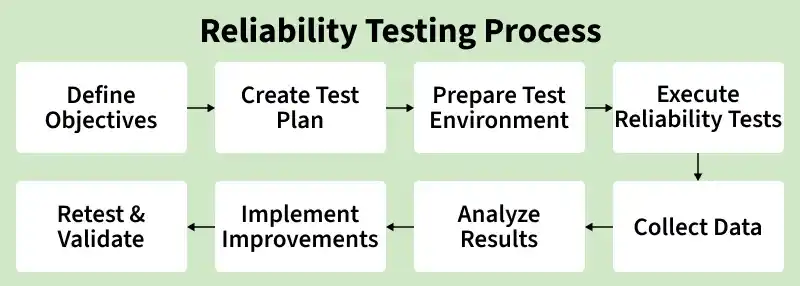
Reliability Testing is a type of software testing that verifies whether an application can perform its intended functions consistently without failures over a specified period of time and under specific conditions. It helps ensure that the software is stable, dependable, and suitable for long-term use.
Ensures the software operates without failures for a defined duration.
Identifies issues such as crashes, memory leaks, and performance degradation.
Improves system stability, availability, and user confidence.
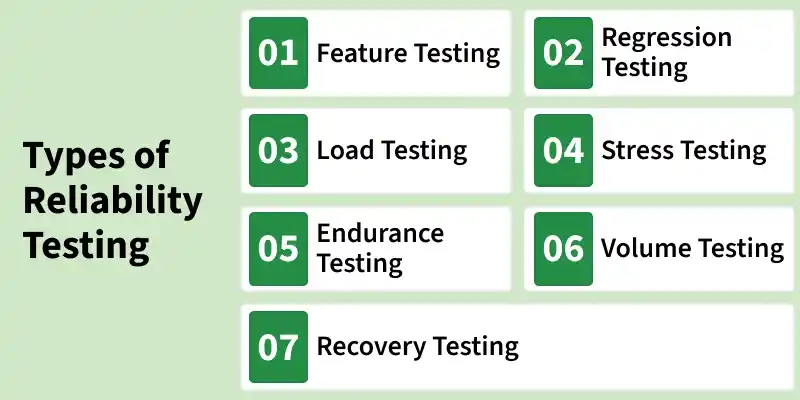
Types of Reliability Testing
Here are the Types of Reliability Testing are follows:
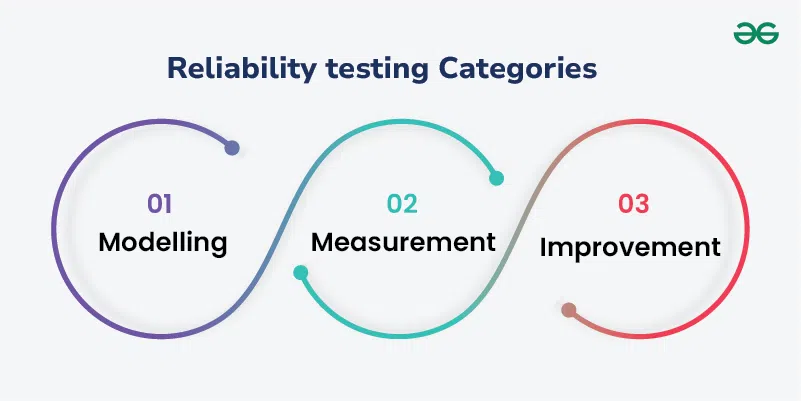
Modelling: Uses mathematical and statistical techniques to predict the reliability and failure behavior of a system before actual testing. Example: Estimating the lifespan of a software application based on historical failure data.
Measurement: Involves executing tests and collecting data to evaluate the actual reliability of the software under different conditions. Example: Monitoring system failures and uptime during testing.
Improvement: Focuses on analyzing reliability issues and implementing changes to enhance system stability and reduce failures. Example: Fixing memory leaks or optimizing code to improve long-term performance.
Measurement of Reliability Testing
Measurement is the process of collecting and analyzing data to evaluate how reliably a software system performs under specific conditions. It helps determine the system's failure rate, availability, and overall stability
Mean Time Between Failures (MTBF): The average time a repairable system operates successfully between two consecutive failures. It is a key measure of system reliability.
Mean Time To Failure (MTTF): The average operating time of a system or component before a failure occurs. It represents the expected time between failures.
Mean Time To Repair (MTTR): The average time required to diagnose, fix, and restore a failed system to normal operation.
Formula:
MTBF = MTTF + MTTR
Challenges of Reliability Testing
Reliability Testing can be challenging because it requires significant time, resources, and effort to accurately evaluate a system's long-term stability and dependability.
Time-Consuming: Reliability testing often requires running tests for extended periods to identify long-term issues.
High Cost: Setting up realistic test environments and maintaining testing infrastructure can be expensive.
Complex Test Environments: Replicating real-world operating conditions accurately can be difficult.
Large Data Requirements: Reliability testing may require large volumes of test data to produce meaningful results.
Resource Intensive: Continuous testing consumes considerable hardware, software, and human resources.
Difficult Failure Prediction: Some failures occur rarely and may be difficult to reproduce during testing.
Changing Requirements: Frequent software updates can affect reliability results and require repeated testing.
Specialized Tools Needed: Advanced monitoring and analysis tools are often required to measure reliability metrics effectively.