Exploratory Testing is a type of software testing where testers actively explore the application without predefined test cases. It combines learning, test design, and execution at the same time. This approach is useful for quickly identifying defects and understanding system behavior.
No predefined test cases; testing is based on tester’s knowledge and intuition.
Helps in discovering unexpected bugs and edge cases.
Flexible and suitable for early-stage or rapidly changing applications.
Exploratory Testing Process
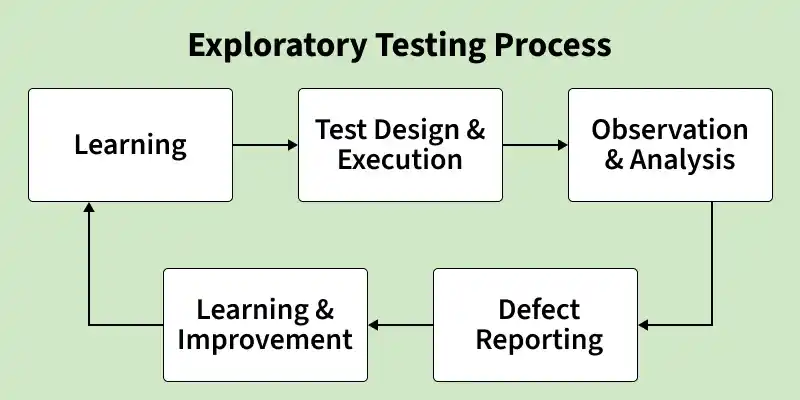
Exploratory Testing follows an iterative and flexible process where learning, test design, and execution happen simultaneously. The tester continuously explores the application to discover defects and improve understanding.
Involves testing with some guidelines, such as checklists, risks, or specific areas to focus on.
Follows a defined strategy or testing checklist.
Focuses on high-risk or critical system functionalities.
More structured than freestyle testing but still flexible.
Example: Testing only the payment module using a checklist.
4. Session-Based Exploratory Testing
Involves testing within a fixed time session with clear objectives and documentation.
Testing is performed within a defined time limit (sessions).
Each session has specific goals and scope.
Results, observations, and defects are documented during the session.
Example: Testing the login module for 1 hour with a focus on security and usability.
5. Charter-Based Exploratory Testing
Involves testing based on a predefined charter that defines the scope, objectives, and focus areas of testing.
Testing is driven by a clearly defined charter statement.
Focuses on specific features, functionalities, or risk areas.
Provides direction while still allowing flexibility in execution.
Example: Charter: “Test login functionality with invalid inputs.” The tester explores different invalid cases such as wrong passwords, empty fields, and special characters.
6. Time-Boxed Exploratory Testing
Involves performing testing within a fixed time limit to ensure focused and efficient exploration.
Conducted within a strict time limit (e.g., 30–60 minutes).
Helps maintain focus and avoid unnecessary exploration.
Often used in combination with session-based testing.
Example: Tester explores the payment module for 45 minutes to identify usability and functional issues
Techniques Used in Exploratory Testing
Exploratory testing uses various techniques to help testers effectively explore the application, find defects, and improve test coverage.
Error Guessing: Involves predicting possible defects based on tester’s experience and intuition, without any formal rules, focusing on common problem areas.
Boundary Value Analysis (BVA): Involves testing values at the boundaries of input ranges where defects are most likely to occur.
Equivalence Partitioning: Involves dividing input data into valid and invalid groups and testing one representative value from each group.
Checklist-Based Testing: Involves using a predefined checklist to ensure all important functionalities are covered during testing.
Mind Mapping: Involves creating a visual map of features and test ideas to organize testing and improve coverage.
Session-Based Testing: Involves testing within a fixed time session with defined goals and scope, and documenting the results.
Pair Testing: Involves two testers working together where one performs testing and the other observes, analyzes, and records defects.
Best Practices for Exploratory Testing
Encourages structured exploration using charters, time-boxing, and documentation to improve effectiveness and defect discovery.
Understand the customer: Approach the software from different user perspectives and expectations.
Clear testing objectives: Know what to test and why; maintain focused notes during testing.
Proper documentation: Record test coverage, risks, execution logs, and issues systematically.
Track issues: Keep a clear record of questions and defects discovered during testing.
Advantages of Exploratory Testing
Exploratory Testing offers several benefits that make it highly effective for quickly identifying defects and improving software quality.
Minimal preparation: No need for extensive test planning or scripts.
Quickly finds critical defects: Helps uncover major issues early.
Improves productivity: Testers use their skills and experience to explore more test scenarios and enhance software quality.
Encourages creativity: Promotes intuition and generates new ideas during testing.
Limitations of Exploratory Testing
Exploratory testing has some limitations and challenges due to its unstructured and experience-based nature.
Difficult to track test coverage and ensure all areas are tested.
Hard to reproduce defects due to lack of predefined test cases.
Relies heavily on tester’s skill, experience, and intuition.
Challenging to maintain proper documentation of all actions.
Exploratory Testing Vs Automated Testing
Below are the differences between exploratory testing and automated testing:
Parameter
Exploratory Testing
Automated Testing
Documentation
Minimal or no documentation needed
Requires detailed documentation
Test Cases
Created during testing
Prepared in advance
Reproducibility
Only defects can be reproduced
Tests can be fully reproduced
Investment
Low initial effort in documentation
High initial effort for scripts and tools
Spontaneity
Flexible and guided by tester’s exploration
Structured and planned based on requirements
Cost
Low initial cost, may rise with long-term manual testing
High initial cost, but saves time in long-term execution
Skills Required
Relies on tester’s intuition, experience, and creativity
Requires technical expertise for scripting and maintenance