|
VOOZH | about |
|
VOOZH | about |
In today's rapidly evolving software development landscape, automating API testing is an essential task for ensuring the quality and reliability of web services. REST Assured is one of the most powerful tools available for this purpose. It is a Java-based library designed to simplify API automation testing by offering a clean and intuitive approach to writing test cases.
REST Assured is a Java library designed to test and validate RESTful APIs. Unlike GUI-based tools like Postman, REST Assured integrates directly into your codebase, providing greater flexibility and control over your tests. It offers a Domain-Specific Language (DSL) that allows you to write tests for APIs in a simple, readable manner.
given, when, and then pattern for defining API tests.REST Assured offers code-based flexibility, which means you can include it directly in your test automation code. This has several advantages:
Unlike some commercial tools, REST Assured is open-source, meaning there are no subscription costs or licensing limitations. This makes it an ideal choice for teams of all sizes, from startups to large enterprises.
REST Assured is highly capable of handling various complex API testing scenarios:
Before you can start testing with REST Assured, you need to set up your project with the required dependencies. Below are the steps to set up REST Assured in your Java project.
For Maven:
Add the following dependency to your pom.xml file:
For Gradle:
For Gradle projects, add the following line to your build.gradle:
testImplementation 'io.rest-assured:rest-assured:5.0.0'REST Assured uses a straightforward syntax following the given-when-then pattern:
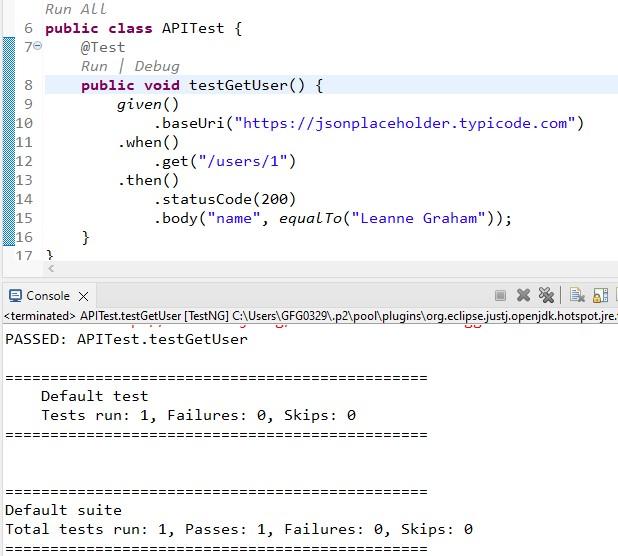
Here’s a basic test to validate a simple GET request:
Output:
Explanation:
given(): Specifies the base URI of the API.when(): Makes a GET request to /users/1.then(): Verifies that the status code is 200 and the "name" field in the response body equals "Leanne Graham".REST Assured can validate that the API response matches a predefined schema, ensuring that the response adheres to the expected structure.
.body(matchesJsonSchemaInClasspath("schema.json"));This checks if the JSON response matches the schema defined in schema.json.
REST Assured supports various authentication mechanisms. For example, to use Basic Authentication:
given()
 .auth()
 .basic("username", "password")
.when()
 .get("/secure-endpoint")
.then()
 .statusCode(200);
You can extract data from the API response, such as specific fields in the response body:
String userName =
 given()
 .baseUri("https://jsonplaceholder.typicode.com")
 .when()
 .get("/users/1")
 .then()
 .extract()
 .path("name");
This extracts the "name" from the JSON response.
REST Assured also supports performance testing by validating the response time of an API:
.time(lessThan(2000L)); // Response should be under 2 secondsREST Assured offers a clean, DSL-style syntax that is simple to learn and use, especially for developers familiar with Java.
REST Assured integrates seamlessly with testing frameworks like JUnit, TestNG, and Cucumber. It also works well with CI/CD pipelines, making it an essential tool in continuous testing environments.
REST Assured is ideal for both small projects and large-scale API testing efforts. Its flexibility allows you to scale tests as your application grows.
Being an open-source tool, REST Assured benefits from a large and active community. The tool has extensive documentation, forums, and resources to help developers resolve issues and improve their tests.