E-Commerce websites handle thousands of customer interactions and online transactions every day, making quality and reliability extremely important. Proper testing helps ensure smooth shopping experiences, secure payments, and uninterrupted business operations.
E-Commerce Website Testing covers
Verifying important features such as product search, shopping cart, and checkout process
Ensuring website performance and stability under heavy user traffic
Protecting customer and payment data from security threats and vulnerabilities
Key Areas to Test on an E-Commerce Website
Before understanding different testing types, it is important to identify the major areas where defects commonly occur in an e-commerce system:
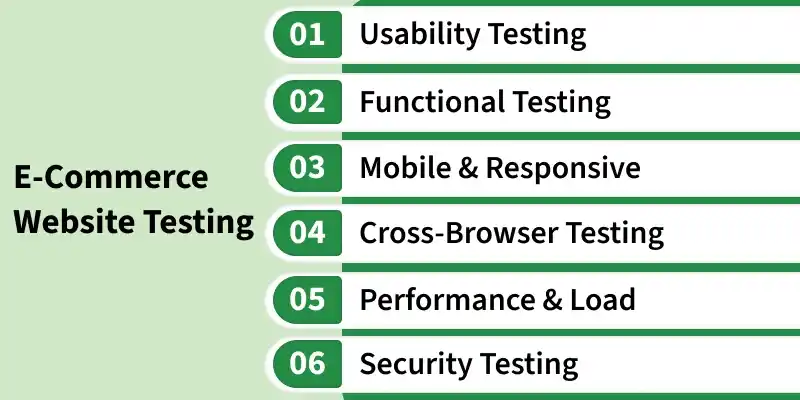
Usability Testing: Evaluates the overall user experience. Can a first-time visitor find a product and check out without friction? Poor usability can negatively impact customer experience and conversions.
Functional Testing: Validates that every feature works as expected — from adding a product to cart to completing a payment. It's the foundation of all e-commerce QA.
Mobile & Responsive Testing: Confirms the site looks and functions correctly across all screen sizes and devices — phones, tablets, and desktops.
Cross-Browser Testing: Ensures consistent behavior across Chrome, Firefox, Safari, and Edge. A broken layout in a browser like Safari can result in poor user experience and customer loss.
Performance & Load Testing: Simulates heavy traffic to identify bottlenecks. Critical before sales events, product launches, or seasonal peaks like festivals and holidays.
Security Testing: Checks for vulnerabilities like SQL injection, XSS attacks, and weak authentication. Ensures payment data and user information are fully protected.
E-Commerce Testing Tools
Selenium: An open-source automation tool used for functional and regression testing of e-commerce applications across multiple browsers.
Cypress: A modern end-to-end testing tool that simplifies testing of user workflows, forms, and checkout processes.
JMeter: An open-source performance testing tool used to simulate heavy user traffic and measure website performance under load.
Postman: Tests and validates APIs that power product listings, payments, and orders.
OWASP ZAP: A free security testing tool that identifies common web vulnerabilities like SQL injection and XSS attacks.
BrowserStack: A cloud-based platform used to test websites across different real browsers, devices, and operating systems.
Google Lighthouse: A browser-based auditing tool used to measure website performance, accessibility, SEO, and best practices.
Playwright: A powerful automation framework that supports reliable cross-browser testing for modern web applications.
Best Practices for E-Commerce Testing
Write a comprehensive test plan covering all user journeys before development ends.
Automate regression tests so every new release is validated against existing features.
Always test in a staging environment that closely mirrors the production environment before deployment.
Integrate testing into your CI/CD pipeline for continuous quality assurance.
Perform load testing well before peak traffic events — not the night before.
Validate all third-party integrations such as payment gateways, shipping APIs, and analytics tools independently.