A Test Harness is a framework that contains test scripts, tools, and test data to support the automated execution of test cases. It creates a controlled environment for validating application behavior.
Supports automated execution of test cases
Uses drivers, stubs, and test data during testing
Improves test reliability and efficiency
Components of Test Harness
The components of a Test Harness work together to execute test cases, provide input data, and verify software behavior during testing.
Test Scripts: Automated instructions that execute test cases and validate application behavior. They help reduce manual testing effort.
Test Data: Input values used to test different conditions and scenarios. They ensure accurate and reliable test execution.
Drivers: Programs that invoke and control the component under test by simulating higher-level modules.
Stubs: Temporary modules that imitate unavailable or incomplete components. They return predefined responses for testing purposes.
Test Tools: Software utilities used for execution, monitoring, and result analysis. They improve testing speed and efficiency.
Working of Test Harness
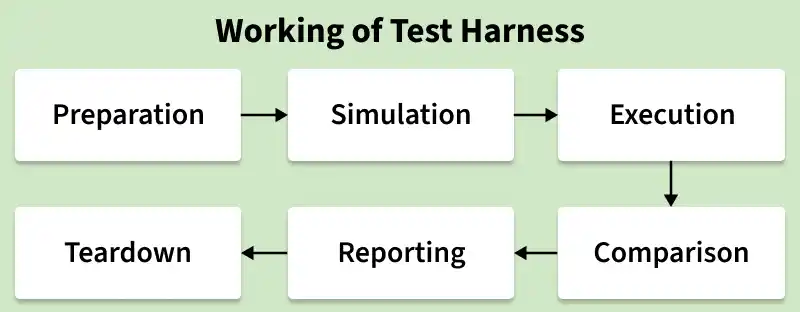
A Test Harness works by providing test data, executing test scripts, and comparing actual results with expected outcomes. It creates a controlled environment that helps testers validate software functionality efficiently.
Preparation: Test scripts and required test data are prepared before execution. This ensures the testing environment is ready.
Simulation: Drivers and stubs simulate dependent or unavailable modules. This helps isolate the component being tested.
Execution: Test cases are executed manually or using automation tools, and system behavior is observed.
Comparison: Actual results are compared with expected outcomes. This helps determine whether the test passes or fails.
Reporting: Test results, logs, and detected defects are recorded. Reports help monitor testing progress and issues.
Teardown: The environment and resources are cleaned after testing. This prevents one test from affecting another.
Principles of a Well-Designed Harness
A well-designed test harness operates seamlessly and becomes noticeable only when failures occur. Four principles guide its construction.
Isolation First: Each test should run independently without shared state or leftover data. This prevents one test from affecting another.
Determinism Over Speed: A test harness should produce consistent and repeatable results every time. Reliable results are more important than faster execution.
Observability by Default: The harness should provide detailed logs, inputs, outputs, and error information. This helps quickly identify failures and defects.
Seams, Not Surgery: The harness should interact through defined interfaces or dependency injection points. Avoiding internal implementation details improves stability and maintainability.
Test Harness Tools
Test Harness tools are software utilities used to automate test execution, manage test data, simulate components, and generate test reports. They help improve testing accuracy, speed, and efficiency.
Selenium: Automates web application testing across multiple browsers
JUnit: Supports unit testing and test execution in Java applications
TestNG: Provides advanced testing features such as parallel execution and reporting.
PyTest: A Python testing tool used for writing simple and scalable test cases.
Apache JMeter: Used for load testing and performance measurement of applications.
Postman: Tests APIs by sending requests and validating responses
Benefits of Test Harness
Increases Productivity: Automation of testing activities helps save time and improve overall productivity.
Automates Testing Process: A test harness supports automatic execution of test cases and reduces manual effort.
Supports Code Debugging: Drivers and stubs help developers identify and debug errors efficiently.
Early Bug Detection: Identifies defects early in development, reducing future issues.
Improves Software Quality: Continuous and accurate testing helps enhance overall software reliability and performance.
Helps Measure Code Coverage: Developers can evaluate how much of the application code is tested during development.
Covers Complex Test Scenarios: It supports testing of complex conditions that are difficult to handle manually.
Improves Application Reliability: Thorough testing increases confidence in the stability and robustness of the application.
Limitations of Test Harness
No Record-and-Playback Support: Most test harness tools do not provide built-in record-and-playback features.
Programming Knowledge Required: Testers need knowledge of programming languages such as Java, Python, or .NET.
Higher Development Cost: Creating and maintaining automated test scripts may require skilled developers and additional resources.
Time-Consuming Setup: Designing and configuring a test harness can take significant initial effort and time.
Maintenance Effort: Test scripts and configurations must be updated regularly when application requirements change.
Limited Flexibility: Some test harnesses are designed for specific environments or technologies and may not support all platforms.
Test Harness vs Test Framework
Parameters
Test Harness
Test Framework
Definition
A Test Harness is a collection of drivers, stubs, test scripts, and supporting tools used to execute tests automatically.
A Test Framework is a structured set of guidelines, processes, and tools used to design and organize automated tests.
Composition
Includes test scripts, test data, drivers, stubs, and execution tools required for testing.
Includes test libraries, coding standards, automation tools, reporting systems, and reusable components.
Purpose
Focuses on executing tests and validating results.
Focuses on creating, managing, and maintaining test cases efficiently.
Record and Playback Feature
Usually does not provide record-and-playback functionality directly.
Some frameworks support record-and-playback features through integrated tools.
Examples
Commonly used in automation testing and integration testing.
Used in data-driven, keyword-driven, behavior-driven, and hybrid testing.