Electron gain enthalpy is the energy change that occurs when an isolated gaseous atom gains an electron to form a negatively charged ion (anion). It is negative when energy is released (exothermic) and positive when energy is absorbed (endothermic) during the process.
👁 enthalpyMathematical Representation
Electron gain enthalpy can be represented by a chemical equation that shows a neutral atom in the gaseous state gaining an electron to form a negative ion (anion). This representation helps describe the energy change that occurs during the process.
When an electron is added to an isolated gaseous atom, the reaction can be written as:
X(g) + e- → X - (g)
Where,
- X(g) represents a neutral atom in the gaseous state
- e⁻ represents the incoming electron
- X⁻(g) represents the negative ion (anion) formed
Factors Affecting Electron Gain Enthalpy
Electron gain enthalpy depends on several factors related to the structure of an atom. These factors influence how easily an atom can accept an electron and form a negative ion.
1. Atomic Size
- Atomic size plays an important role in electron gain enthalpy.
- When the size of an atom is small, the incoming electron is closer to the nucleus and experiences a stronger attraction.
- As a result, more energy is released and the electron gain enthalpy becomes more negative.
When the atomic size is large, the electron is farther from the nucleus and the attraction is weaker, so less energy is released.
Example: Chlorine (Cl) has a more negative electron gain enthalpy than iodine (I) because chlorine has a smaller atomic size.
2. Nuclear Charge
- Nuclear charge refers to the number of protons present in the nucleus.
- A higher nuclear charge increases the attraction between the nucleus and the incoming electron.
- This makes it easier for the atom to gain an electron, resulting in a more negative electron gain enthalpy.
Example: Across a period from carbon (C) to fluorine (F), the nuclear charge increases, so the electron gain enthalpy becomes more negative.
3. Electronic Configuration
- The arrangement of electrons in an atom also affects electron gain enthalpy.
- Atoms with stable electronic configurations (such as completely filled or half-filled subshells) are less likely to accept an additional electron.
Example: Nitrogen (N) has a half-filled p subshell, which is stable. Therefore, it does not easily gain an extra electron, and its electron gain enthalpy is less negative.
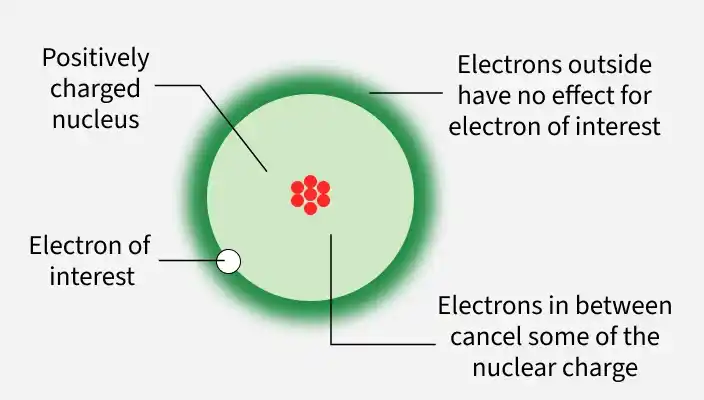
4. Shielding Effect
- The shielding effect occurs when inner electrons reduce the attraction between the nucleus and the incoming electron.
- Greater shielding decreases the nuclear attraction, making it harder for the atom to gain an electron.
Example: In larger atoms such as iodine (I), inner electron shells shield the nucleus more, so the electron gain enthalpy is less negative.
Trends in Periodic Table
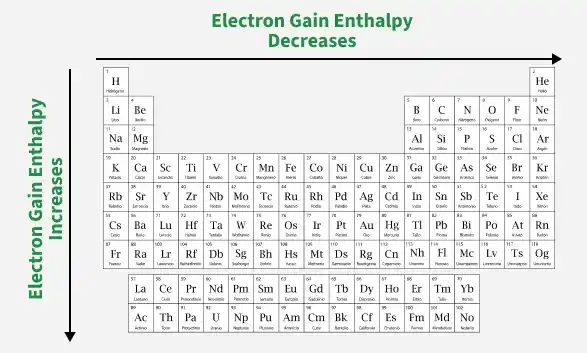
Electron gain enthalpy shows regular patterns in the periodic table when moving across a period or down a group. These patterns help explain how easily atoms gain electrons.
👁 file1. Across a Period
- When moving from left to right across a period, electron gain enthalpy generally becomes more negative.
- This means atoms release more energy when they gain an electron.
- This happens because the nuclear charge increases across a period.
- As the number of protons increases, the attraction between the nucleus and the incoming electron becomes stronger.
- As a result, the atom gains the electron more easily.
Example: Across the second period, the electron gain enthalpy becomes more negative from carbon (C) to fluorine (F). Fluorine has a strong attraction for an additional electron, so it releases more energy when gaining one.
2. Down a Group
- When moving from top to bottom in a group, electron gain enthalpy generally becomes less negative.
- This means atoms release less energy when they gain an electron.
- This occurs because the atomic size increases down the group.
- The added electron enters an orbital that is farther from the nucleus, and the attraction between the nucleus and the incoming electron becomes weaker.
- The shielding effect of inner electrons also increases.
Example: In the halogen group, the electron gain enthalpy becomes less negative when moving from fluorine (F) to iodine (I).
Exceptions
Although electron gain enthalpy generally becomes more negative across a period and less negative down a group, some elements do not follow this regular trend. These exceptions occur mainly because of stable electronic configurations, very small atomic size, and electron–electron repulsion.
1. Exception between Fluorine and Chlorine
- According to the general trend, fluorine should have the most negative electron gain enthalpy because it is smaller and has a higher nuclear charge.
- However, chlorine actually has a more negative electron gain enthalpy than fluorine.
- This happens because fluorine is a very small atom and the added electron enters a compact 2p orbital, where there is strong electron–electron repulsion.
- In chlorine, the electron enters the larger 3p orbital, where repulsion is less.
2. Exception in Group 15 Elements
- Elements in group 15 such as nitrogen (N), phosphorus (P), and arsenic (As) have half-filled p orbitals (p³ configuration), which are relatively stable.
- Because of this stability, these atoms do not easily accept an extra electron.
- Adding an electron would disturb the stable half-filled configuration, so their electron gain enthalpy is less negative than expected.
Example: Nitrogen (N) has a much less negative electron gain enthalpy compared to oxygen (O).
3. Noble Gases
- Noble gases such as helium (He), neon (Ne), and argon (Ar) have completely filled electron shells, which makes them very stable.
- Because of this stable configuration, they do not easily gain electrons.
- As a result, their electron gain enthalpy values are positive or nearly zero.
Example: Neon (Ne) does not gain an electron easily because its outer shell is already complete
Related Articles: