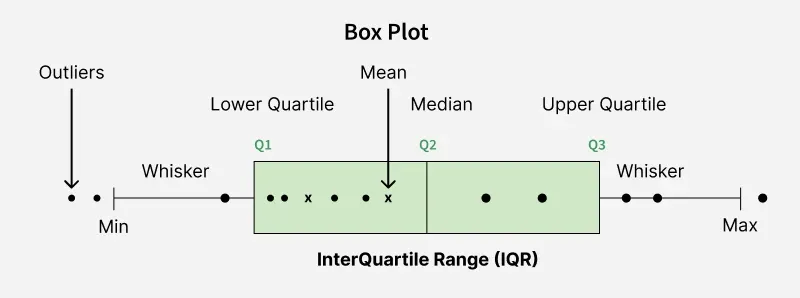
A Box and Whisker Plot is also called as a Box Plot which is a graphical representation of a dataset based on its five-point summary. It displays the distribution of data using a rectangular box and two whiskers making it easy to understand the spread, central tendency and presence of extreme values in a dataset. The box plot is made up of the following components:
Box: The box extends from the first quartile (Q1) to the third quartile (Q3). It represents the middle 50% of the data, also known as the Interquartile Range (IQR).
Whiskers: The whiskers extend from Q1 to the minimum value and from Q3 to the maximum value, showing the range of most of the data.
Median Line: A line inside the box represents the median (Q2), dividing the dataset into two equal halves.
Outliers: Data points that lie beyond the whiskers are treated as outliers and are usually shown as individual points.
To create a Box and Whisker Plot, we need to calculate the quartiles (Q1 and Q3) and the median (Q2).
Q1 (the first quartile) is the median of the lower half of the data (78, 85, 90, 92, 95, 96) = 91
Q2 (the median) is the median of the entire dataset = 97
Q3 (the third quartile) is the median of the upper half of the data: (98, 99, 100, 105, 110, 120) = 102.5
Step 2: Determine Whiskers
To find the whiskers, calculate the minimum and maximum values within the dataset, excluding potential outliers.
Minimum = 78, Maximum = 120
The required five-number summary is 78, 91, 97, 102.5, 120.
Step 3: Plot the Box and Whiskers
Now, we can create the Box and Whisker Plot:
Draw a box from Q1 (91) to Q3 (102.5).
Draw a line inside the box at Q2 (97).
Extend the left whisker from the minimum (78) to Q1 (91).
Extend the right whisker from Q3 (102.5) to the maximum (120).
Step 4: Identify Outliers
Any data points that fall outside the whiskers are considered outliers. In this case, we do not have any outliers.
This Box and Whisker Plot gives a visual rundown of the grades, showing the middle (Q2) at 97
The interquartile range (IQR) from Q1 to Q3 (91 to 102.5) and the shortfall of exceptions.
It successfully outlines the focal propensity, spread and dissemination of the dataset.
Uses of Box and Whisker Plot
Visualizing Data Distribution: Box plots provide a clear picture of how data is spread, showing the center, range and overall distribution in a compact visual form.
Comparing Multiple Groups: They are useful for comparing different datasets side by side, such as student scores across classes or sales across regions.
Detecting Outliers: Box plots make it easy to spot unusual or extreme values that lie far from the rest of the data.
Understanding Skewness: By observing the position of the median and the length of whiskers, one can determine whether data is symmetric or skewed.
Supporting StatisticalAnalysis: They provide a quick summary of key statistics, helping analysts decide which statistical methods or tests to apply.
Quality Control and Monitoring: In manufacturing and business processes, box plots help track variations and identify when results fall outside acceptable limits.