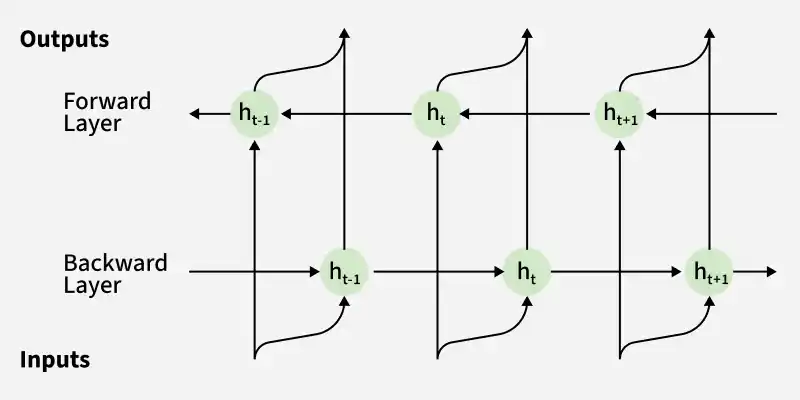
Bidirectional Recurrent Neural Networks (BRNNs) are an advanced form of RNNs that process sequential data in both forward and backward directions. This allows the network to use both past and future context, improving understanding and prediction accuracy.
Processes sequences in forward and backward directions
Captures both past and future context
Improves prediction accuracy over traditional RNNs
Helps understand contextual meaning more effectively
Used in NLP, speech recognition, and sequence analysis
Example: In the sentence “I like apple. It is very healthy.”, a BRNN can identify that “apple” refers to the fruit using future context from the second sentence.
Working of Bidirectional Recurrent Neural Networks (BRNNs)
BRNNs process sequential data in both forward and backward directions to capture complete contextual information from a sequence.
Step 1: Input Sequence
A sequence of data points is provided as input, where each element is represented as a vector.
Step 2: Dual Direction Processing
The sequence is processed in two directions
Forward direction: uses current input and previous hidden state
Backward direction: uses current input and next hidden state
Step 3: Hidden State Computation
Hidden states are computed using weighted inputs and activation functions, allowing the network to retain sequence information.
Step 4: Output Generation
The outputs are generated from the hidden states and can be used directly for prediction or passed to additional layers for further processing.
Implementation of Bi-directional Recurrent Neural Network
This implementation uses a Bidirectional RNN with Keras and TensorFlow for sentiment analysis on the IMDb dataset.
1. Loading and Preprocessing Data
The IMDb dataset is loaded and preprocessed by padding sequences to ensure uniform input length.
2. Defining the Model Architecture
A Bidirectional RNN model is created using Keras for binary sentiment classification.
Embedding() converts input words into 128-dimensional dense vectors
Bidirectional(SimpleRNN(hidden)) adds a bidirectional RNN layer with 64 hidden units
Dense(1, activation='sigmoid') creates the binary output layer
model.compile() configures the model using Adam optimizer, binary cross-entropy loss, and accuracy metric
3. Training the Model
After preparing the data and compiling the model, the Bidirectional RNN is trained on the dataset.
batch_size=32 sets the number of samples processed in one iteration
epochs=5 defines the number of training cycles over the dataset
model.fit() trains the model and validates it using validation data