|
VOOZH | about |
|
VOOZH | about |
The tf.keras.layers.LSTM layer is a built-in TensorFlow layer designed to handle sequential data efficiently. It is widely used for applications like:
Long-Short Term Memory (LSTMs) address the limitations of standard Recurrent Neural Networks (RNNs) by incorporating gates (forget, input, and output gates), which help in retaining important information over long sequences.
tf.keras.layers.LSTM(
units,
activation='tanh',
recurrent_activation='sigmoid',
return_sequences=False,
return_state=False,
dropout=0.0,
recurrent_dropout=0.0,
stateful=False,
unroll=False
)
Parameters of tf.keras.layers.LSTM:
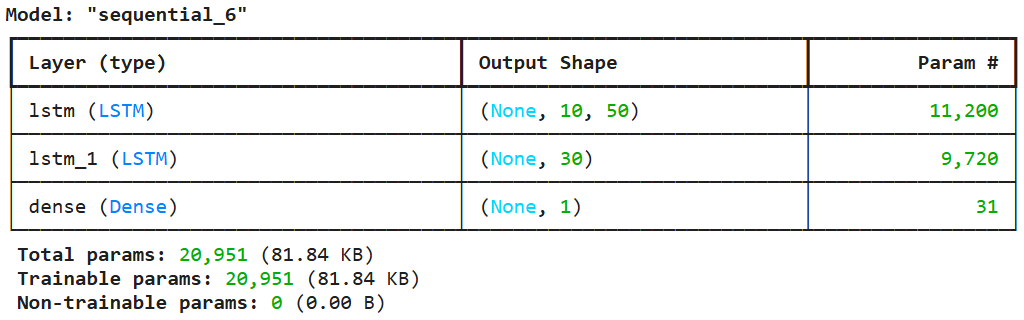
Let's learn to use LSTMs in TensorFlow, covering key parameters like return_sequences and return_state. You'll also understand how LSTMs process sequences and retain long-term dependencies through hidden and cell states.
Output:
Output:
Epoch 1/10
7/7 ━━━━━━━━━━━━━━━━━━━━ 4s 14ms/step - accuracy: 0.5260 - loss: 0.6946
.
.
.
Epoch 10/10
7/7 ━━━━━━━━━━━━━━━━━━━━ 0s 14ms/step - accuracy: 0.5830 - loss: 0.6830
<keras.src.callbacks.history.History at 0x7968ee53b250>
Understanding return_sequences and return_state
Example:
Output:
(5, 10, 50) (5, 50) (5, 50)
This means:
TensorFlow’s tf.keras.layers.LSTM is a powerful tool for handling sequential data, providing flexibility with return states, bidirectional processing, and dropout regularization. Whether you're working on NLP, finance, or speech recognition, LSTMs are essential for capturing long-term dependencies.