|
VOOZH | about |
|
VOOZH | about |
When working with PostgreSQL databases in Python, one common task is to retrieve metadata about database tables, such as column names and their types. This information can be crucial for dynamically generating queries, validating data, or understanding the structure of our database. The psycopg2 library provides a powerful way to interact with PostgreSQL databases from Python, including retrieving metadata about tables.
Before diving into the examples, ensure we have the following prerequisites:
Install psycopg2 using pip:
pip install psycopg2Let's us see a few examples of how we can get column name and column type with Python psycopg2.
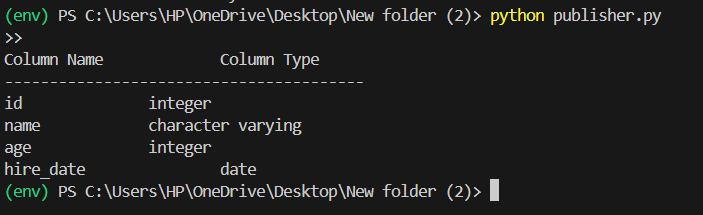
Below code connects to a PostgreSQL database, creates a table with specified columns, and then closes the connection. After reconnecting, it retrieves the column names and data types for the created table by querying the information_schema.columns, and then prints the results. Finally, it closes the cursor and connection again.
Output
The information_schema is a standardized set of read-only views that provide metadata about the objects (such as tables, columns, and constraints) in a relational database.
The information_schema acts as a database within the database, allowing users to query metadata just like they would query regular data.
Here, we will use this information_schema database to fetch column name and column type of the table we created.
Output
Below code connects to the PostgreSQL database, retrieves column names and data types from the information_schema.columns for a specified table, and prints them. It then closes the cursor and database connection.
Output
Output
Retrieving column names and types from a PostgreSQL database using Python and psycopg2 is a straightforward process that can be extremely valuable in various scenarios, from dynamic query generation to data validation. By following the examples provided, we can efficiently interact with PostgreSQL to obtain the metadata we need for our applications.