Spring Boot - Introduction to RESTful Web Services
Last Updated : 27 Apr, 2026
RESTful Web Services provide a standard way to build scalable and stateless web APIs using HTTP. In modern applications, REST APIs allow different systems such as web apps, mobile apps, and microservices to communicate efficiently.
Spring Boot simplifies the creation of REST APIs using annotations and minimal configuration.
REST services exchange data in formats such as JSON and XML, with JSON being the most widely used format.
What is REST?
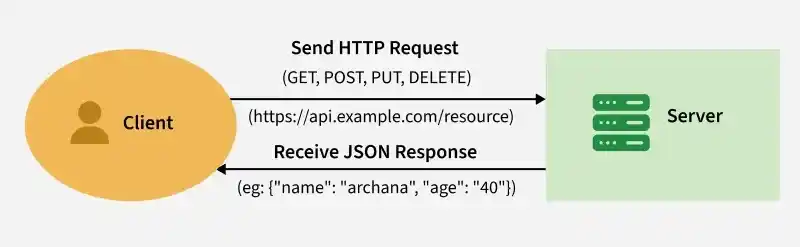
REST (Representational State Transfer) is an architectural style used for designing network-based applications. It allows different systems to communicate over HTTP using standard methods such as GET, POST, PUT, and DELETE.
Introduced by Roy Thomas Fielding to simplify web communication using HTTP protocols.
Widely used for building scalable and stateless web APIs in frameworks like Spring Boot.
A resource is any object, data, or service that can be accessed by a client using a URI (Uniform Resource Identifier).
Example:
/users /products /orders
2. Stateless Communication
REST APIs are stateless, meaning every request from the client must contain all necessary information. The server does not store client session data between requests.
3. Representations
Resources can be represented in multiple formats when returned to the client. Common formats include:
JSON
XML
HTML
PDF
4. HTTP Verbs
REST APIs use standard HTTP methods to perform CRUD operations on resources.
HTTP Methods in REST APIs
The main methods of HTTP we build web services for are.
1. GET – Read Resource
Retrieves data without a request body.
Can fetch a specific resource using an ID or a collection without parameters.
Spring Boot Example:
2. POST – Create Resource
Creates a new resource using a request body.
Spring Boot Example:
3. PUT – Update Resource
Updates an existing resource identified by ID.
Spring Boot Example:
4. DELETE – Remove Resource
Deletes a single or multiple resources based on parameters.
Spring Boot Example:
HTTP Method
Operation
Description
GET
Read
Retrieves existing data
POST
Create
Creates a new resource
PUT
Update
Updates an existing resource
DELETE
Delete
Removes a resource
HTTP Status Codes
REST APIs rely on these codes to communicate the result of client requests.
Status Code
Meaning
200
Request successful
201
Resource created
401
Unauthorized access
404
Resource not found
500
Internal server error
Principles of RESTful Web Services
Resource Identification via URI: Every resource has a unique URI.
Uniform Interface: CRUD operations use standard HTTP methods: GET, POST, PUT, DELETE.
Self-Descriptive Messages: The request and response contain all necessary information.
Stateless Interactions: Each request is independent; no session data is stored on the server.
Cacheable: Responses can be cached when appropriate to improve performance.
Security Best Practices for REST APIs
Authentication and Authorization: Use JWT or OAuth 2.0.
Input Validation: Sanitize requests to prevent SQL injection and XSS attacks.
HTTPS Enforcement: Ensure all communications are encrypted.
Rate Limiting: Protect against abuse by limiting request rates.
Advantages of RESTful Web Services
Simple and Lightweight: Easier to develop and consume compared to SOAP.
Client-Server Decoupling: Enables independent development of client and server.
Scalable: Stateless communication supports horizontal scaling.
Layered System Architecture: Applications can be divided into layers, enhancing modularity and maintainability.
Cacheable: Responses can be cached to improve performance and reduce bandwidth.
Uses of REST with Spring Boot
Spring Boot makes building RESTful APIs fast and efficient by:
Simplifying configuration and setup.
Providing out-of-the-box support for JSON and XML serialization.
Allowing integration with databases, messaging systems, and external APIs.
Supporting advanced features like validation, exception handling, and security.