Spring Security is a framework used to secure Java applications by handling authentication, authorization, and protection against common security threats. It is widely used in Spring-based applications to implement flexible security mechanisms.
Provides authentication and authorization to control access to application resources
Supports integration with JWT, OAuth2, LDAP, and database-based authentication
Helps protect applications from common security vulnerabilities like CSRF and session-related attacks
Spring Security Architecture
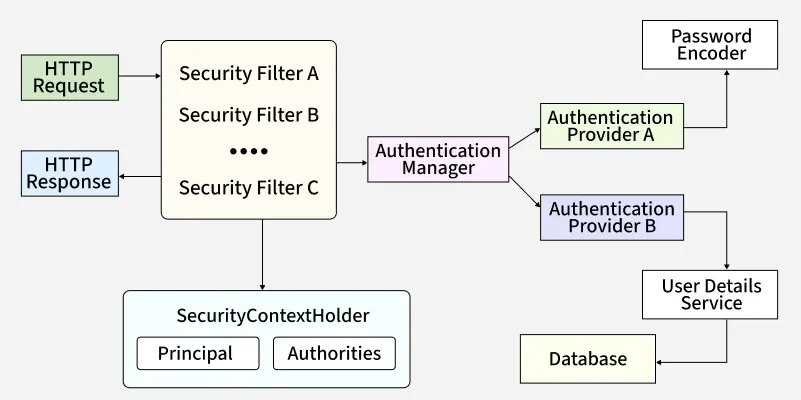
This diagram shows how an HTTP request is processed through the Spring Security filter chain to handle authentication and authorization before returning the response.
Acts as the entry point for all incoming HTTP requests in Spring Security
Every request passes through a chain of filters such as UsernamePasswordAuthenticationFilter and BasicAuthenticationFilter
Handles authentication, authorization, CSRF protection, and session management
Ensures a modular and customizable security flow
Example:
2. Authentication Manager
Core component responsible for handling user authentication
Delegates authentication requests to one or more AuthenticationProvider instances
Follows the Strategy design pattern, allowing multiple authentication mechanisms such as DB, LDAP, JWT, and OAuth2
Example:
3. Authentication Providers
Authentication Providers are the components responsible for validating user credentials
They process authentication requests coming from the AuthenticationManager
Different providers support different authentication mechanisms
Examples:
DaoAuthenticationProvider -> Uses database authentication with UserDetailsService and PasswordEncoder
JwtAuthenticationProvider -> Validates JWT tokens
Note: DaoAuthenticationProvider is most commonly used for database-based authentication It ensures passwords are validated securely using a PasswordEncoder
4. UserDetailsService
Loads user-specific data (username, password, roles) from a data source like a database.
Returns a UserDetails object.
Used primarily by providers like DaoAuthenticationProvider.
Example:
5. Password Encoder
Ensures secure password storage and validation.
Encodes raw passwords into secure hashes before saving/validation.
Example:
6. SecurityContextHolder
Stores the SecurityContext for the current request/thread. And holds the Authentication object, which contains:
Principal: Represents the logged-in user (username or user object).
Authorities: Roles/permissions granted to the user.
Example:
How It Works Internally
A client sends an HTTP request to the application.
The request passes through the Security Filter Chain where multiple security filters are applied.
The Authentication Manager receives the request and delegates authentication to the appropriate Authentication Provider.
The Authentication Provider validates credentials using UserDetailsService and PasswordEncoder (if required).
On successful authentication, user details are stored in SecurityContextHolder.
Authorization is performed using the stored principal and authorities to check access permissions.
If all checks pass, the request reaches the controller and an HTTP response is returned.