|
VOOZH | about |
|
VOOZH | about |
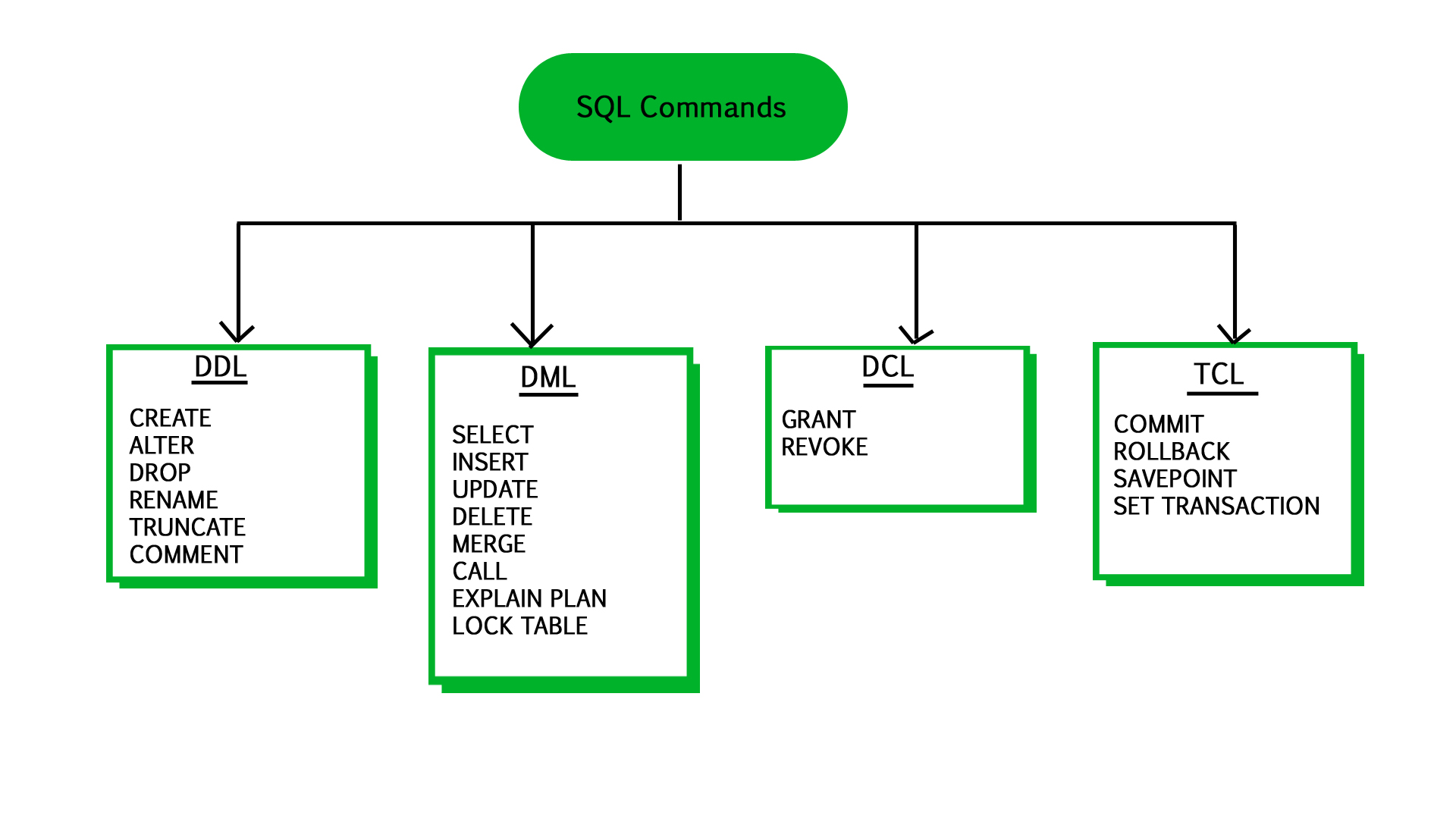
Data Definition Language (DDL), Data Manipulation Language (DML), Transaction Control Language (TCL), and Data Control Language (DCL) form the backbone of SQL. Each of these languages plays a critical role in defining, managing, and controlling data within a database system, ensuring both structural integrity and user access control.
In this article, we will learn about Data Definition Language, Data Manipulation Language, Transaction Control Language and Data Control Language.
👁 ImageData Definition Language is used to define the database structure or schema. DDL command in sql
is also used to specify additional properties of the data. The storage structure and access methods used by the database system by a set of statements in a special type of DDL called a data storage and definition language. These statements define the implementation details of the database schema, which are usually hidden from the users. The data values stored in the database must satisfy certain consistency constraints.
For example, suppose the university requires that the account balance of a department must never be negative. The DDL provides facilities to specify such constraints. The database system checks these constraints every time the database is updated. In general, a constraint can be an arbitrary predicate pertaining to the database. However, arbitrary predicates may be costly to the test. Thus, the database system implements integrity constraints that can be tested with minimal overhead.
Some Commands:
CREATE : to create objects in database
ALTER : alters the structure of database
DROP : delete objects from database
RENAME : rename an objects
Following SQL DDL-statement defines the department table :
create table department
(dept_name char(20),
 building char(15),
 budget numeric(12,2));
Execution of the above DDL statement creates the department table with three columns - dept_name, building, and budget; each of which has a specific datatype associated with it.
DML statements are used for managing data with in schema objects. DML are of two types:
Some Commands:
SELECT: retrieve data from the database
INSERT: insert data into a table
UPDATE: update existing data within a table
DELETE: deletes all records from a table, space for the records remain
Example of SQL query that finds the names of all instructors in the History department :
select instructor.name
 from instructor
 where instructor.dept_name = 'History';
The query specifies that those rows from the table instructor where the dept_name is History must be retrieved and the name attributes of these rows must be displayed.
TransactionControl Language commands are used to manage transactions in the database. These are used to manage the changes made by DML-statements. It also allows statements to be grouped together into logical transactions.
Examples of TCL commands
COMMIT: Commit command is used to permanently save any transaction
 into the database.
ROLLBACK: This command restores the database to last committed state.
 It is also used with savepoint command to jump to a savepoint
 in a transaction.
SAVEPOINT: Savepoint command is used to temporarily save a transaction so
 that you can rollback to that point whenever necessary.
A Data Control Language is a syntax similar to a computer programming language used to control access to data stored in a database (Authorization). In particular, it is a component of Structured Query Language (SQL).
Examples of DCL commands
GRANT: allow specified users to perform specified tasks.
REVOKE: cancel previously granted or denied permissions.
The operations for which privileges may be granted to or revoked from a user or role apply to both the Data definition language (DDL) and the Data manipulation language (DML), and may include CONNECT, SELECT, INSERT, UPDATE, DELETE, EXECUTE and USAGE.
Understanding and utilizing DDL, DML, TCL, and DCL commands are vital for effective database management. These languages collectively enable the creation, modification, and deletion of database structures, facilitate data manipulation, ensure transaction consistency, and manage user permissions, forming the foundation of robust database systems.