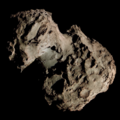
| 👁 Image Comet 240P/NEAT photographed from the Zwicky Transient Facility on 12 December 2018. | |
| Discovery[1] | |
|---|---|
| Discovered by | K. J. Lawrence |
| Discovery site | NEAT–Palomar |
| Discovery date | 7 December 2002 |
| Designations | |
| P/2002 X2, P/2010 P1 | |
| Orbital characteristics[4] | |
| Epoch | 21 November 2025 (JD 2461000.5) |
| Observation arc | 22.99 years |
| Earliest precovery date | 5 October 2002 |
| Number of observations | 3,401 |
| Aphelion | 5.602 AU |
| Perihelion | 2.12163 AU (A)[2] 2.12167 AU (B)[3] |
| Semi-major axis | 3.861 AU |
| Eccentricity | 0.4506 |
| Orbital period | 7.59 years |
| Inclination | 23.54° |
| 74.91° | |
| Argument of periapsis | 352.08° |
| Last perihelion | 15 May 2018 |
| Next perihelion | 19 December 2025 (A+B)[2][3] |
| TJupiter | 2.758 (A+B) |
| Earth MOID | 1.145 AU (A) 1.137 AU (B) |
| Jupiter MOID | 0.242 AU (A) 0.235 AU (B) |
| Physical characteristics[7] | |
Mean radius | 2.665 km (1.656 mi)[5] (original nucleus) |
| Comet total magnitude (M1) | 10.3 |
| 12.0[6] (2025-11-20) | |


240P/NEAT is a Jupiter-family comet with an orbital period of 7.61 years. It was discovered by Near Earth Asteroid Tracking (NEAT) on 7 December 2002.[1]
The comet came opposition on 22 November 2025, and came to perihelion on 19 December 2025 when it was around magnitude 12-13.[8]
Observational history
[edit]The comet at discovery had an apparent magnitude of 18.4, and further observations revealed it had a coma about 8 arcseconds across and a tail 14 arcseconds long.[1] The comet was spotted in prediscovery images dating from 5 October and 6 December by LONEOS and from 5 November by NEAT. Based on these observations it was recognised it is a periodic comet with an orbital period of 8.1 years.[1] The comet was recovered independently by H. Taylor, H. Sato, Leonid Elenin, and T. Yusa on 9, 10, 11, and 11 August 2010 respectively, at an estimated magnitude of around 17.[9][10]
The comet had a close approach to Jupiter on 10 July 2007 at a distance of 0.252 AU (37.7 million km)[7] which reduced the orbital period to 7.6 years and the perihelion distance from 2.5 to 2.1 AU.[11] The comet experienced three events of significant brightening which last for three to six months during its next two perihelia, on March-April 2011, July-August 2018,[12] and on November-December 2018. The events more likely are the result of the warming of previously insulated material due to the reduction of the perihelion distance. The new activity takes place in one or two locations of the nucleus.[13]
240P-B
[edit]_with_its_fragment_%22B%22_-_54950308748.png)

On 3 October 2025 fragment 240P-B was imaged by Kitt Peak and reported by V. Carvajal.[14] 240P-B also came to perihelion on 19 December 2025,[3] about 41 minutes after the main body and about 0.00004 AU (6,000 km; 3,700 mi) farther from the Sun.
| Fragment | Perihelion time | Perihelion distance |
|---|---|---|
| 240P-A[2] | 2025-Dec-19 22:51 | 2.12163 AU (317,391,000 km; 197,218,000 mi) |
| 240P-B[3] | 2025-Dec-19 23:32 | 2.12167 AU (317,397,000 km; 197,222,000 mi) |
References
[edit]- ^ a b c d K. J. Lawrence; R. Bambery; E. Helin; S. Pravdo; M. Hicks; et al. (9 December 2002). D. W. Green (ed.). "Comet P/2002 X2 (NEAT)". IAU Circular. 8029 (1). Bibcode:2002IAUC.8029....1L. ISSN 0081-0304.
- ^ a b c "Horizons Batch for 240P/NEAT (90001204) on 2025-Dec-19" (Perihelion occurs when rdot flips from negative to positive). JPL Horizons. Archived from the original on 3 October 2025. Retrieved 1 March 2026. (Soln.date: 2026-Feb-27)
- ^ a b c d "Horizons Batch for 240P-B (90001205) on 2025-Dec-19" (Perihelion occurs when rdot flips from negative to positive). JPL Horizons. Archived from the original on 1 March 2026. Retrieved 1 March 2026. (Soln.date: 2026-Feb-27)
- ^ "240P/NEAT Orbit". Minor Planet Center. Retrieved 29 September 2025.
- ^ J. M. Bauer; T. Grav; Y. R. Fernández; et al. (2017). "Debiasing the NEOWISE Cryogenic Mission Comet Populations". The Astronomical Journal. 154 (2): 53–62. Bibcode:2017AJ....154...53B. doi:10.3847/1538-3881/aa72df.
- ^ "COBS Observation list: 240P". COBS – Comet OBServation database. Crni Vrh Observatory. Retrieved 21 November 2025.
- ^ a b "240P/NEAT – Small-Body Database Lookup". ssd.jpl.nasa.gov. Jet Propulsion Laboratory. Retrieved 22 August 2025.
- ^ S. Yoshida. "240P/NEAT". www.aerith.net. Retrieved 22 August 2025.
- ^ H. Taylor; H. Sato; L. Elenin; T. Yusa; et al. (August 2010). D. W. Green (ed.). "Comet P/2010 P1 (NEAT)". IAU Circular. 9159 (2). Bibcode:2010IAUC.9159....2T. ISSN 0081-0304.
- ^ K. Kadota; R. Bambery; E. Helin; et al. (12 August 2010). "P/2002 X2 (NEAT) = P/2010 P1". Minor Planet Electronic Circulars. 2010-P51. Bibcode:2010MPEC....P...51K. ISSN 1523-6714.
- ^ K. Kinoshita. "240P/NEAT". jcometobs.web.fc2.com. Retrieved 22 August 2025.
- ^ H. Sato (August 2017). D. W. Green (ed.). "Comet 240P/NEAT". Central Bureau Electronic Telegrams. 4427 (1). Bibcode:2017CBET.4427....1S.
- ^ M. S. P. Kelley; D. Bodewits; Q. Ye; T. L. Farnham; E. C. Bellm; et al. (2019). "Comet 240P/NEAT Is Stirring". The Astrophysical Journal Letters. 886 (1): L16. arXiv:1911.02383. Bibcode:2019ApJ...886L..16K. doi:10.3847/2041-8213/ab53e0.
- ^ V. Carvajal; et al. (6 October 2025). "Comet 240P-B/NEAT". Minor Planet Electronic Circulars. 2025-T124. ISSN 1523-6714.
External links
[edit]- 240P/NEAT-A at the JPL Small-Body Database
- 240P/NEAT-B at the JPL Small-Body Database
- 240P/NEAT at Gideon van Buitenen's website
- 240P/NEAT at the Comet Observations Database
- Fragment 240P-B as seen on 2 October 2025


.png)