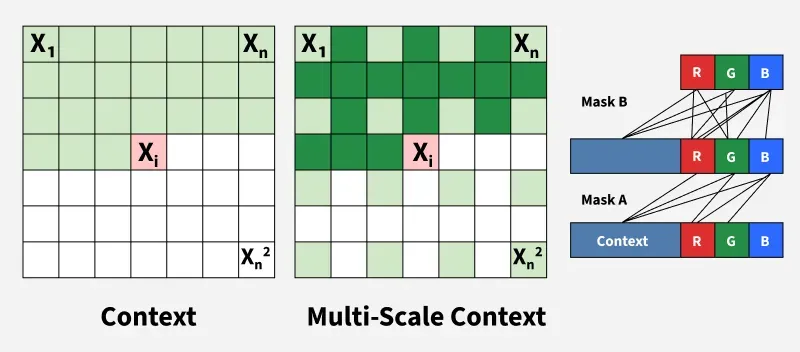
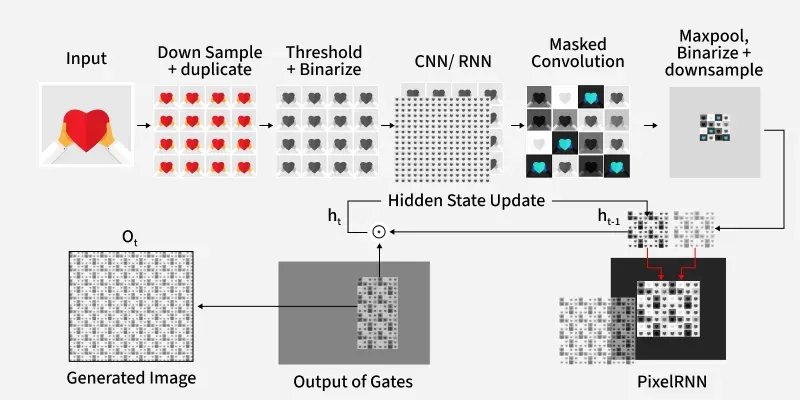
PixelRNN is a deep generative model designed for image generation, particularly pixel-by-pixel modeling of images. The model uses Recurrent Neural Networks, a Deep Learning Technique, to model the conditional distribution of pixels in an image. Unlike CNNs, PixelRNN generates pixel based on dependencies from all of its neighbors, effectively capturing the spatial structure. It is suitable for image generation tasks.
Pixel Conditioning: Each Pixel prediction is conditioned.
Loss Function is calculated based on actual vs predicted value.
Detailed Working
The Pixel Recurrent Neural Network or PixelRNN is a groundbreaking architecture that seeks to model the joint distribution of pixel intensities in a generative framework, adhering to the causal and sequential modeling constraints inherent in natural image generation.
The underpinning hypothesis of the PixelRNN is that each pixel's probability distribution is conditionally dependent on a fixed permutation of all preceding pixels, making it an autoregressive model in the highest-dimensional sense.
Rather than embracing the simplicity of regressing pixel intensities, PixelRNN models each channel as a categorical distribution over 256 possible values. The model is trained based on sequential modelling.
The finally generated image is based on these predictive probabilistic-approach based development.
Strengths of PixelRNN
Captures dependencies effectively.
High-quality image generation.
Flexible generation of images.
Handles variable-length inputs.
Easy to integrate with image inpainting pipelines.
Key Applications of PixelRNN
Handwritten Digit Generation
Image Inpainting
Anomaly Detection
Scene Understanding
Disadvantages of PixelRNN
Slow modelling is a drawback
Doesn't perform well on large image
High Training time
Complex architecture and might be tough to interpret