|
VOOZH | about |
|
VOOZH | about |
Creating visually stunning images by blending the content of one image with the artistic style of another has captivated artists and technologists alike. This technique, known as style transfer, leverages deep learning to transform photographs into masterpieces reminiscent of famous artists like Van Gogh or Picasso. In this article, we'll delve into the concepts and implementation of style transfer using the Fast.ai library, making the complex world of deep learning accessible and efficient.
Table of Content
Style Transfer is a fascinating technique in the field of deep learning that enables the blending of two images: one serving as the content source and the other providing the artistic style. The result is a new image that retains the structural integrity of the content image while adopting the color schemes, textures, and brushstrokes of the style image.
Imagine taking a photograph of a cityscape (content image) and rendering it in the swirling, vibrant style of Van Gogh's "Starry Night" (style image). The resulting image would maintain the recognizable buildings and layout of the city but with the expressive and dynamic aesthetics characteristic of Van Gogh.
Fast.ai is a high-level deep learning library built on top of PyTorch, designed to make complex machine learning tasks more accessible without sacrificing performance. Its strengths include:
For style transfer, Fast.ai streamlines the process by handling many of the underlying complexities, allowing users to focus on the creative aspects of blending content and style.
To implement style transfer effectively, it's crucial to understand its core components and how they interact within the deep learning framework.
The objective is to generate a stylized image that maintains the content of the content image while adopting the style characteristics of the style image.
VGG Networks (VGG16 and VGG19) are convolutional neural networks pre-trained on the ImageNet dataset. They are instrumental in style transfer for the following reasons:
The Gram matrix is a mathematical construct used to capture the style of an image by measuring the correlations between different feature channels. In style transfer:
Two primary loss functions guide the style transfer process:
Combining these losses allows the model to generate images that balance both content fidelity and stylistic resemblance.
Set Up Our Environment:
First, we need to install Fast.ai and other dependencies. If we are using Google Colab, it's even easier since most of the packages come pre-installed. But here's how we can install it:
!pip install fastaiSetting Up CUDA Availability:
This part checks if a CUDA-enabled GPU is available. CUDA is a parallel computing platform that allows software developers to use a GPU for general-purpose processing. If a GPU isn't available, it raises an error to inform the user that they need to run this code in a GPU environment for optimal performance.
Let's break down the implementation into manageable steps, ensuring clarity and understanding at each stage.
The first step involves acquiring the style image
Downloading the Style Image:
With the style image preprocessed, we extract its features using the VGG19 network and compute the Gram matrices necessary for style representation.
forward method computes the losses for the predicted and target images, while the metrics tracking helps monitor the losses over training iterations.FeatureLoss class, passing in the feature extraction function, style loss function, and activation loss function. This sets up the loss calculation for the style transfer model.The Transformer Network processes the content image, applying the style captured by the Gram matrices to generate the stylized image.
ReflectionLayer, ResidualBlock, UpsampleConvLayer, and TransformerNet classes. ReflectionLayer class applies reflection padding before performing a convolution operation. This helps preserve spatial information at the borders of the imageResidualBlock class implements a residual network structure where the input is added back to the output after passing through two reflection layers and normalization. This helps in training deeper networks by allowing gradients to flow through the identity connections.UpsampleConvLayer class allows for upsampling the feature maps using nearest-neighbor interpolation followed by a convolution operation. This is essential for resizing the output image.TransformerNet class is a simple architecture for style transfer. It consists of an initial convolution layer, followed by two residual blocks and an upsampling layer to produce the final stylized image.Next, we will process the acuired image
Preprocessing Function:
The get_style_im function downloads the image, applies necessary transformations, and normalizes it based on ImageNet statistics.
PILImage.create to convert the image into a format suitable for processing.ToTensor(): Converts the image to a PyTorch tensor.IntToFloatTensor(): Converts the integer tensor to a float tensor.Normalize.from_stats(*imagenet_stats): Normalizes the image using statistics from the ImageNet dataset.Extracting Features:
style_im.get_feats('vgg19') is likely a function you defined earlier to extract features from the VGG19 model. This is crucial for style transfer since it captures different layers of the image.Computing Gram Matrices: This line computes the Gram matrices for each of the feature maps extracted from the style image. Gram matrices are essential in style transfer because they capture the correlations between different feature channels.
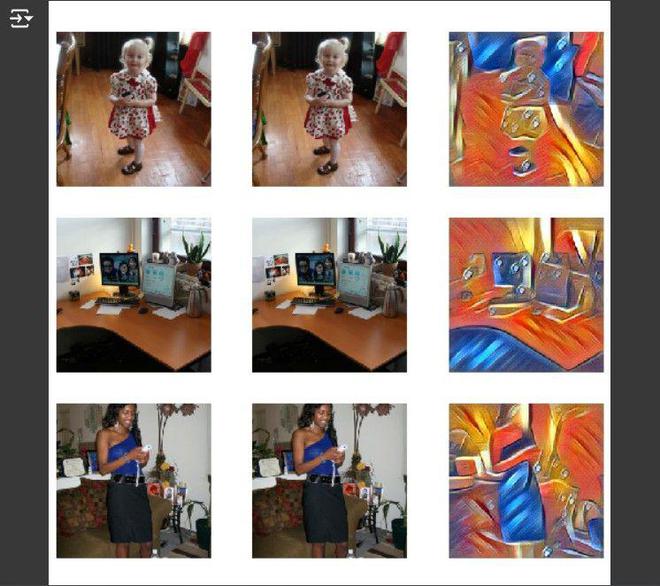
TransformerNet is created and moved to the GPU.Finally, the generated image is converted back to the CPU and displayed using the show() method. TensorImage is likely a utility you defined to help with visualizing images from tensors.
Below is the complete code for implementing style transfer with the necessary steps up to displaying the resulting image:
Output:
In this article, we've explored the captivating technique of style transfer using the Fast.ai library. By understanding the interplay between content and style images, leveraging pre-trained VGG networks for feature extraction, and constructing a Transformer Network, we've successfully blended the structural integrity of one image with the artistic flair of another. Fast.ai's high-level abstractions simplify the intricate processes of deep learning, making advanced techniques like style transfer accessible to enthusiasts and professionals alike.