|
VOOZH | about |
|
VOOZH | about |
FastAI is a deep learning library designed to support both researchers and practitioners. It offers low-level components for developing custom models, as well as high-level abstractions. This dual functionality is achieved without compromising performance or ease of use.
At the core of FastAI’s design is a carefully structured architecture based on independent abstractions. These abstractions capture recurring patterns across deep learning and data processing workflows. Combining the flexibility of the PyTorch framework and the dynamic features of Python, Fastai provides clear, concise implementations of complex behaviors.
FastAI provides three levels of API:
The high-level API provides the highest abstraction, emphasizing simplicity and automation for common tasks, making it ideal for beginners or practitioners who seek a quick and easy solution without delving into detailed configurations.
In high-level API, the DataBlock handles data preprocessing and loading by structuring input data into DataLoaders, while the Learner manages model training, validation and evaluation using that data. Together, they form a streamlined pipeline where DataBlock prepares the data and Learner oversees the learning process, clearly reflecting their roles in different stages of the machine learning workflow.
The mid-level API strikes a balance between abstraction and customization, offering flexibility to customize various components of the training process, such as data processing, model architecture and training loop. It works for users who want more control over specific aspects of their models while still benefiting from higher-level abstractions.
The low-level API provides the lowest abstraction, granting full control over the training process. It is suitable for advanced users or those experimenting with novel architectures and algorithms, allowing for fine-grained customization at every stage:
Several features contribute to the flexibility and control over the training process:
The choice of API level depends on the specific needs, experience level and the degree of control and customization required for machine learning tasks.
Below is an overview of how FastAI applies to each major domain:
FastAI has support for computer vision tasks, making it easy to build models for:
FastAI simplifies NLP workflows by automating tokenization, batching and model training. Supported tasks include:
FastAI provides built-in support for mixed-type tabular data, combining categorical and continuous features. Its capabilities include:
FastAI also supports collaborative filtering for building recommendation systems using user-item interaction data. Features include:
What makes Fastai truly powerful is that it uses the same Learner API across all domains. This consistency allows users to:
To begin, we install the necessary libraries. Fastai is built on top of PyTorch, so installing Fastai will also install the required PyTorch dependencies.
pip install fastai
We start by importing the necessary modules from Fastai:
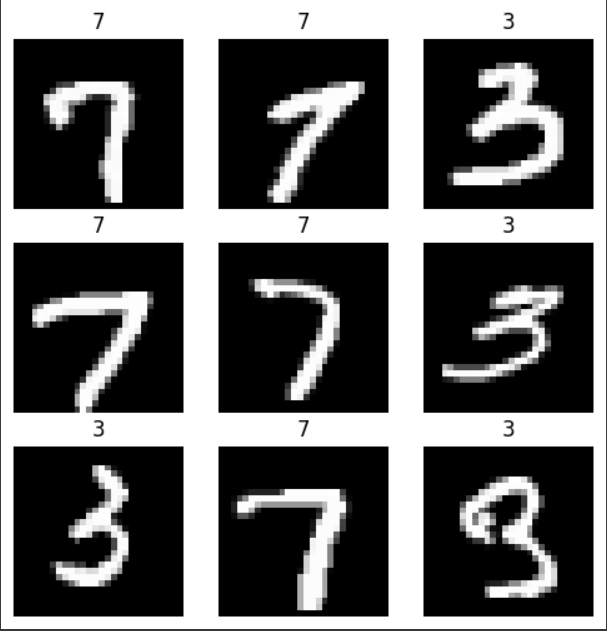
We use Fastai’s built-in method to download and load the MNIST dataset.
Output:
The dataset is already organized into training and validation folders. The data distribution as follows:
Output:
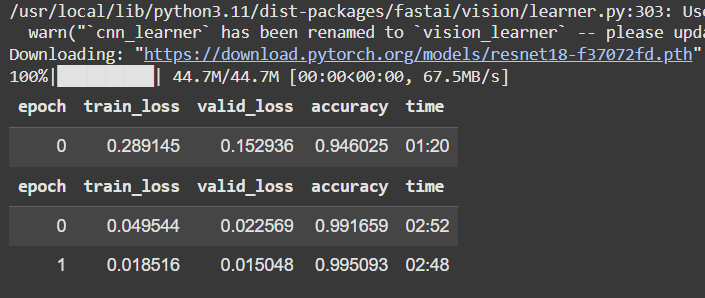
Now, we create and train a CNN using the cnn_learner function with a ResNet-18 backbone.
After training, we evaluate the model using classification metrics and a confusion matrix.
Output:
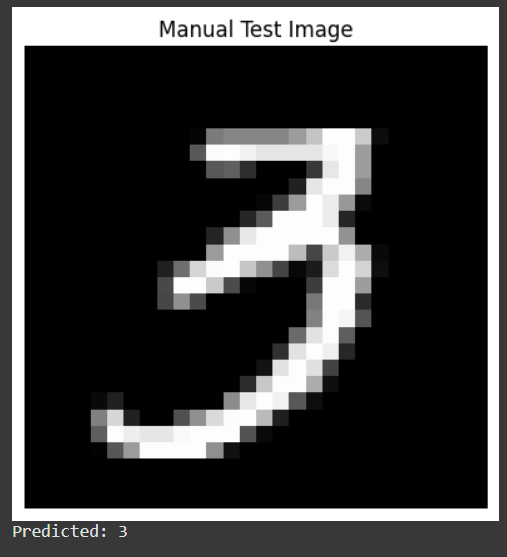
To test the model manually, we select an image from the validation set and make a prediction.
Output:
Since, the image is somewhat representing the form of '3' digit. Hence, it predicted accurately.
Download the code here.
Choosing Fastai for deep learning tasks offers several compelling advantages:
1. API at High Level
With New high-level for data blocks, Fastai reduces the amount of code that is usually involved in deep learning applications. It allows users to concentrate on the essential elements of model construction and training, this abstraction speeds up the development process.
2. Abstractions of Training Loops
The library presents the idea of "Learners", which are objects that combine the model, data and optimization specifics. This method makes deep learning more approachable for beginners by streamlining the training loop and giving seasoned users more customization options for their processes.
3. PyTorch integration
Fastai, which is based on PyTorch, is well-integrated with the popular deep learning framework. Users can take advantage of Fastai's high-level abstractions and PyTorch's functionalities at the same time.
4. APIs Specific to Applications
For a number of disciplines including computer vision, natural language processing and collaborative filtering, Fastai offers specific APIs. These application-specific APIs speed up the creation of models for certain applications by offering pre-built methods and classes suited to typical tasks in each domain.
5. Data Block API
Deep learning requires handling data and Fastai's Data Block API makes this process easier. With clear and expressive code, users may import, preprocess and enhance datasets with ease. This adaptability is especially helpful when working with various data forms and types.
Conclusively, Fastai makes it easy to build and train deep learning models with minimal code while offering the flexibility to customize as needed. This example demonstrates how quickly we can go from data loading to model evaluation using Fastai’s high-level APIs.