|
VOOZH | about |
|
VOOZH | about |
To understand how machine learning models make predictions, it’s important to know the difference between Classification and Regression. Both are supervised learning techniques, but they solve different types of problems depending on the nature of the target variable.
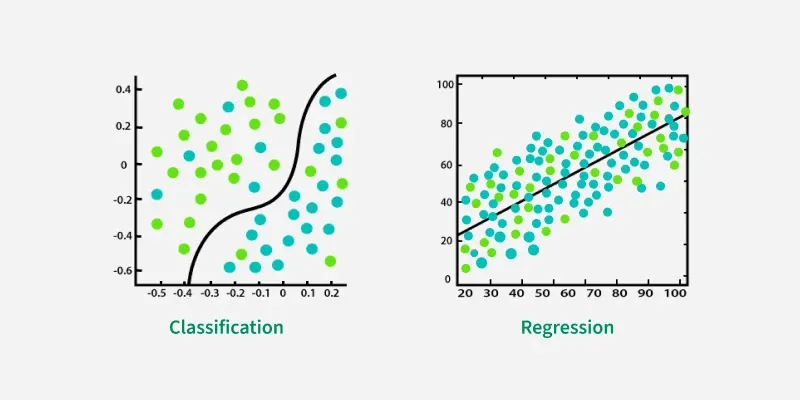
Classification uses a decision boundary to separate data into classes, while regression fits a line through continuous data points to predict numerical values.
Regression analysis determines the relationship between independent variables and a continuous target variable. It identifies trends and patterns in data to make future predictions or estimate unknown values based on learned relationships.
Regression tries to learn a function
where input features are mapped to a continuous output . To achieve this, the model minimizes the error between the predicted value and the actual value using a loss function.
Regression is widely used across various real world domains to predict continuous outcomes.
Classification is used when you want to categorize data into different classes or groups. Classification is used when the output is a label instead of a continuous value.
Classification models learn decision boundaries that separate one class from another. Using activation functions such as
The class with the highest probability is selected as the final prediction.
One of the most important concepts separating regression from classification is the contrast between fitting continuous trends and drawing boundaries between classes.
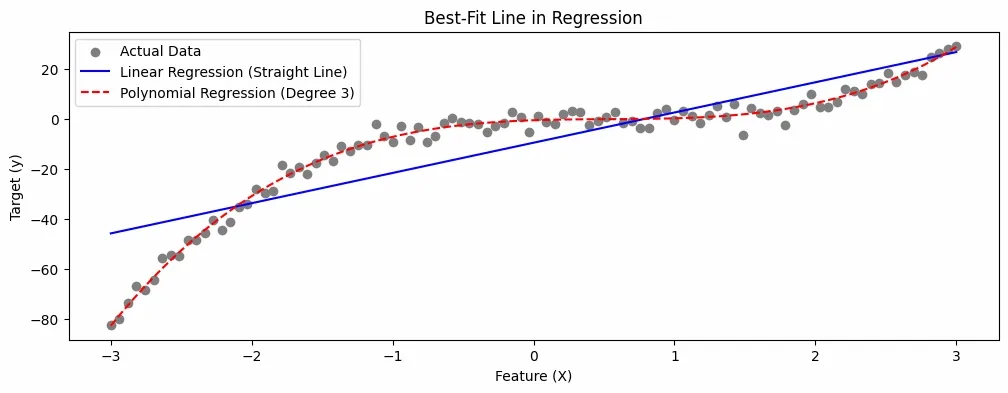
Regression models aim to find a line or curve that best fits the continuous data points. The model minimizes prediction error using metrics like MSE or MAE. Used when the output is numerical.
The plot illustrates Regression, where Linear and Polynomial models fit curves to predict continuous target values from input features.
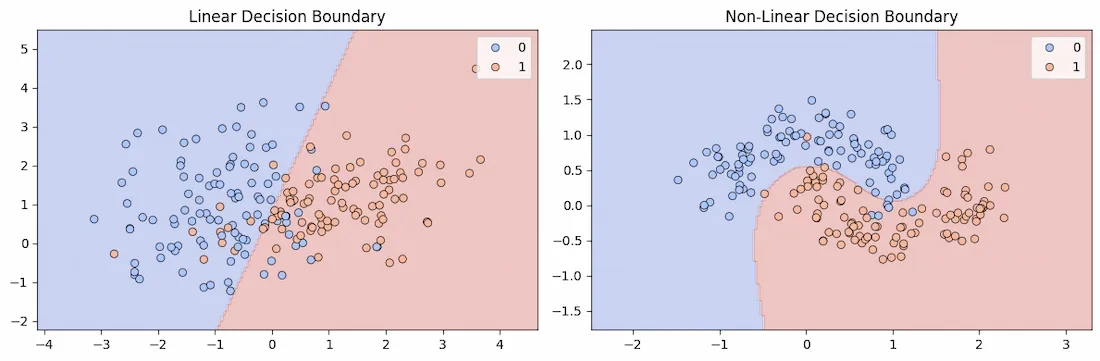
Classification models learn a boundary that separates data into different classes. The boundary can be a straight line, curve or complex shape depending on the algorithm. Used when the output is categorical.
During training, a classifier learns a boundary that partitions the feature space to minimize classification errors. The shape of the decision boundary depends on the classifier used.
Here we compare Regression and Classification in machine learning
Features | Regression | Classification |
|---|---|---|
Output Type | Predicts a continuous numeric value | Predicts a categorical label |
Goal | Fitting the best-fit line or curve | Drawing a decision boundary between classes |
Error Measure | Uses metrics like MSE, MAE, RMSE | Uses metrics like Accuracy, Precision, Recall, F1 Score |
Use Cases | Forecasting, price prediction, risk estimation | Image recognition, sentiment analysis, fraud detection |
Handling Outliers | Highly sensitive | Less sensitive |