Graph Neural Networks (GNNs) are deep learning models designed to work with graph-structured data, where information is represented as nodes and edges. Unlike traditional neural networks that handle fixed-size inputs, GNNs capture relationships, dependencies and interactions between entities.
They operate on graphs made of nodes and edges.
Information is passed between connected nodes (neighbors) through message-passing steps.
Useful for tasks like social network analysis, molecule prediction and recommendation systems.
They learn both node-level and graph-level patterns.
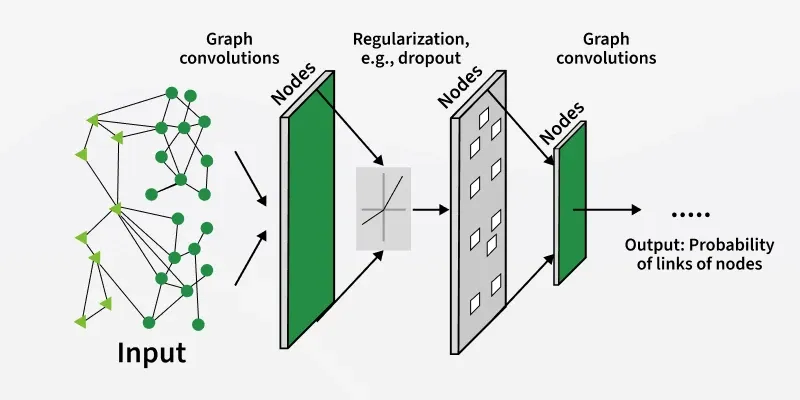
This image shows how a GNN processes a graph node features pass through stacked graph convolution layers with regularization, gradually refining representations until the model outputs predictions such as the probability of links between nodes.
GNN Architectures
Graph Neural Networks can be built in different ways depending on how they aggregate information and update node representations. One of the most commonly used architectures is the Graph Convolutional Network (GCN) which extends the idea of convolution from images to graph structured data.
Graph Convolutional Network (GCN)
A basic GCN for graph classification usually contains three main layers:
Convolutional Layer: Aggregates features from each node neighbors.
Activation Layer: Applies a non linearity like ReLU.
Output Layer: Produces the final prediction for the graph.
GCNs are easy to implement and efficient for large graphs, but they cannot use edge features and do not perform full message passing, limiting their ability to model complex graph relationships.
Message Passing Neural Networks (MPNNs)
MPNNs overcome these limitations by supporting both node and edge features. In each iteration:
Nodes collect messages from their neighbors.
The aggregated information updates each node’s embedding.
The process repeats for multiple rounds.
MPNNs provide richer representations and support node classification, edge classification and link prediction, making them more flexible and expressive than basic GCNs.
GCNs and MPNNs represent two core ways of processing graph data and together they form GNN architectures.
How Do GNN Work
Graph Neural Networks work by allowing nodes in a graph to share information with their neighbors through a process known as message passing. Since graphs are irregular and unstructured, GNNs organize this data so deep learning models can extract meaningful patterns.
Initialization: Each node begins with a feature vector describing its properties such as user attributes or atom characteristics.
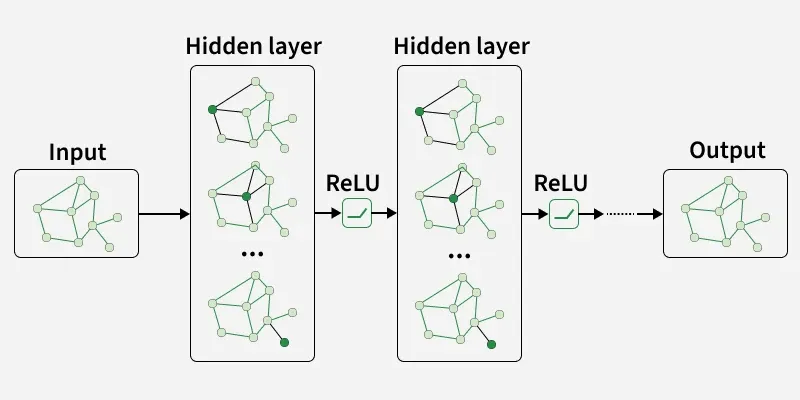
Message Passing: Nodes share information with their neighbors across layers, allowing each node to learn context from the surrounding graph structure.
Update: After aggregation, nodes update their feature vectors using a neural network layer.
GNNs use sparse operations and usually require only a few layers making them efficient for relational and interconnected data.
Types of Graph Neural Networks
Graph Neural Networks come in various forms, each designed to process graph-structured data in a unique way. Different GNN architectures focus on how information is aggregated, propagated or transformed across nodes and edges.
Social Network Analysis: Used to predict user behavior, community detection, friend recommendations and influence modeling.
Molecular Chemistry and Drug Discovery: Helps predict molecular properties, drug target interactions and protein structure by treating molecules as graphs.
Knowledge Graph Completion: Used to infer missing relations between entities in large knowledge bases.
Recommendation Systems: Models user item interactions as graphs for better recommendations.
Traffic and Transportation Networks: Predicts traffic flow, congestion patterns and route optimization using dynamic graph data.
Advantages
Handles Irregular Data: Works naturally with non-Euclidean structures like social networks and molecules.
Learns Node Relationships: Aggregates neighbor information to build meaningful node embeddings.
Scales Across Graph Sizes: Works on small and large graphs without changing the model.
Flexible Predictions: Supports node-level, edge-level and whole-graph prediction tasks.
Great for Semi-Supervised Learning: Performs well even when only a few nodes have labels.
Limitations
High Computational Cost: Large graphs require significant memory and processing power.
Over-Smoothing Problem: When too many GNN layers are stacked, node features become indistinguishable.
Scalability Challenges: Hard to train on extremely large or dynamic graphs without specialized techniques.
Dependency on Graph Quality: Poor or noisy graph structure can lead to incorrect learning.
Long-Range Dependency Modeling: Standard GNNs struggle to capture very distant node relationships without deeper architectures.