VOOZH about

URL: https://www.geeksforgeeks.org/deep-learning/what-is-forward-propagation-in-neural-networks/

⇱ What is Forward Propagation in Neural Networks - GeeksforGeeks


  • Courses
  • Tutorials
  • Interview Prep

What is Forward Propagation in Neural Networks

Last Updated : 12 May, 2026

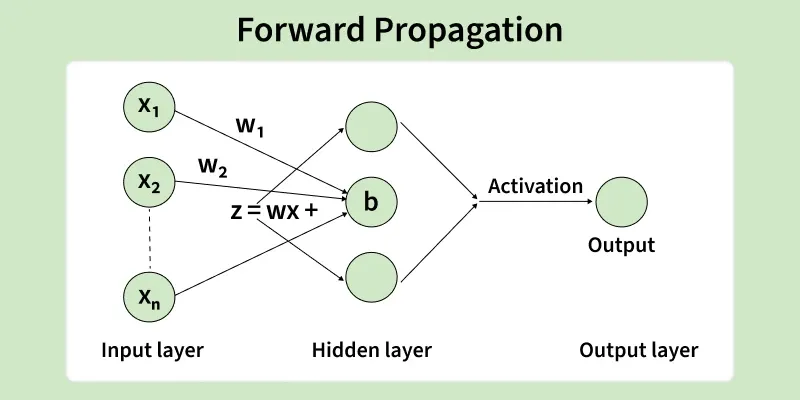
Forward propagation is the process where input data passes through each layer of a neural network to produce an output. It transforms raw inputs into predictions using weights, biases and activation functions.

👁 forward_propagation
Forward Propagation
  • Data flows from input layer to output layer step by step
  • Each neuron computes weighted sums and applies activation functions
  • Used during both training and inference (without updating weights)
  • Determines how well the model captures patterns for accurate predictions

Working

1. Input Layer: Receives raw data where each feature corresponds to a neuron. Data is often normalized or standardized before processing.

2. Hidden Layers: The processed input passes through one or more hidden layers where most of the computation takes place. Each neuron performs a weighted sum of inputs and applies an activation function to capture non-linear patterns. The computation inside each neuron follows

where:

  • represents the weights
  • is the input vector
  • is the bias term

After this, an activation function such as ReLU or sigmoid is applied to produce the neuron’s output, which is then passed forward.

3. Output Layer: The final layer generates the model’s prediction. The choice of activation function depends on the task

  • Softmax : multi-class classification
  • Sigmoid : binary classification
  • Linear : regression

4. Prediction: The network produces its final output using current weights and biases, which is then evaluated against the true value.

  • Generates final prediction from the output layer
  • Compared with actual value using a loss function
  • Loss function calculates the error
  • Error is passed to backpropagation for weight updates

Mathematical Explanation of Forward Propagation

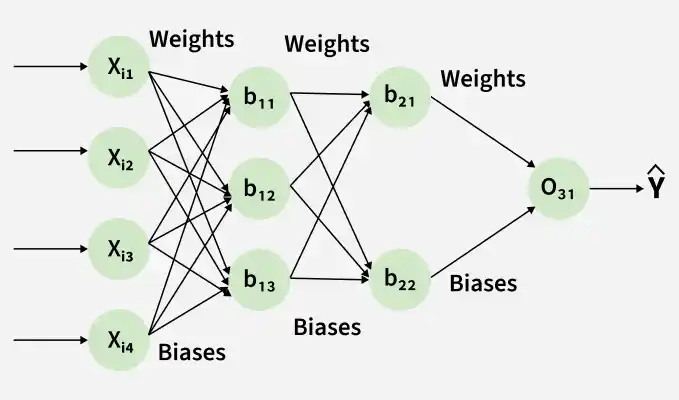
Consider a neural network with one input layer, two hidden layers and one output layer.

👁 architecture-of-a-neural-network
Architecture of a Neural Network

1. Layer 1 (First Hidden Layer)

The transformation is:

where:

  • is the weight matrix,
  • is the input vector,
  • is the bias vector,
  • is the activation function.

2. Layer 2 (Second Hidden Layer)

We can have n number of hidden layers:

3. Output Layer

where is the final output. Thus the complete equation for forward propagation is:

This equation illustrates how data flows through the network:

  • Weights () determine the importance of each input
  • Biases () adjust activation thresholds
  • Activation functions () introduce non-linearity to enable complex decision boundaries.

Implementation

1. Import Required Libraries

Here we will import Numpy and pandas library.

2. Create Sample Dataset

  • The dataset consists of CGPA, profile score and salary in LPA.
  • contains only input features.

3. Initialize Parameters

When initilaizing parameters Random initialization avoids symmetry issues where neurons learn the same function.

4. Define Forward Propagation

  • computes the linear transformation.
  • Sigmoid activation ensures values remain between 0 and 1.

5. Execute Forward Propagation

Here we will execute the process of forward propagation using the above functions we created.

Output:

Final Output:
[[0.40566303]
[0.39810287]
[0.41326819]]

  • Each number represents the model's predicted probability before training for the given input.
  • The values represent the sigmoid activation output which ranges between 0 and 1 indicating a probability like score for classification.

Download full code from here

Comment