|
VOOZH | about |
|
VOOZH | about |
Top-N analysis in SQL refers to the technique of limiting the number of rows returned from a dataset after sorting the data by a specific column, which helps retrieve either the smallest or largest values in a table. It’s an efficient way to identify key data points such as top performers or highest sales. In this article, we will explain how to perform Top-N queries in SQL to extract specific records for analysis.
Top-N queries are designed to simplify retrieving a fixed number of rows, which can be particularly useful for highlighting key records like top-selling products or best-performing agents. Top-N queries help save time and reduce complexity by efficiently selecting specific records for further analysis. This technique is commonly applied in scenarios like finding top products, best-selling agents, or least performing students based on a condition.
For example, using Top-N analysis we can perform the following types of queries:
Syntax
SELECT [column_list], ROWNUM
FROM (
 SELECT [column_list]
 FROM table_name
 ORDER BY Top-N_column
)
WHERE ROWNUM <= N;
Key Terms
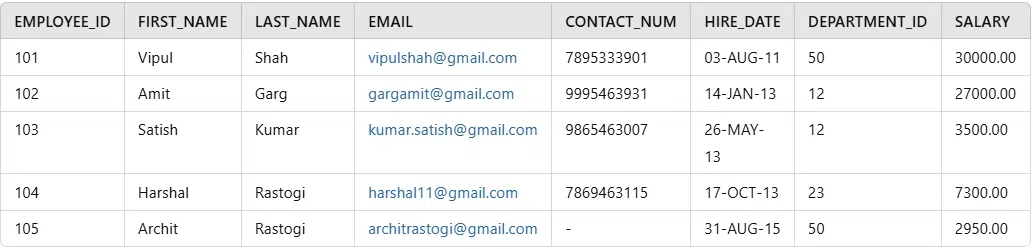
ROWNUM less than or equal to N.Let’s explore how to perform Top-N analysis using SQL with examples based on the Employee table. The following steps will guide us on how to apply this analysis to various scenarios, helping us retrieve the top or bottom N values based on specific criteria.
CREATE TABLE Employee (
 employee_id INT PRIMARY KEY,
 first_name VARCHAR(50),
 last_name VARCHAR(50),
 email VARCHAR(100),
 contact_num VARCHAR(15),
 hire_date DATE,
 department_id INT,
 salary DECIMAL(10, 2)
);
INSERT INTO Employee (employee_id, first_name, last_name, email, contact_num, hire_date, department_id, salary)
VALUES
(101, 'Vipul', 'Shah', 'vipulshah@gmail.com', '7895333901', TO_DATE('03-AUG-11', 'DD-MON-YY'), 50, 30000.00),
(102, 'Amit', 'Garg', 'gargamit@gmail.com', '9995463931', TO_DATE('14-JAN-13', 'DD-MON-YY'), 12, 27000.00),
(103, 'Satish', 'Kumar', 'kumar.satish@gmail.com', '9865463007', TO_DATE('26-MAY-13', 'DD-MON-YY'), 12, 3500.00),
(104, 'Harshal', 'Rastogi', 'harshal11@gmail.com', '7869463115', TO_DATE('17-OCT-13', 'DD-MON-YY'), 23, 7300.00),
(105, 'Archit', 'Rastogi', 'architrastogi@gmail.com', '-', TO_DATE('31-AUG-15', 'DD-MON-YY'), 50, 2950.00);
Employee tableSELECT * FROM Employee;Output
Here, the inner query sorts the employees by their salary in ascending order, while the outer query uses ROWNUM to limit the results to the first 3 rows. The RANK column is assigned sequential numbers to indicate the ranking.
Query:
SELECT ROWNUM as RANK, first_name, last_name, employee_id, salary
FROM (SELECT salary, first_name, last_name, employee_id
 FROM Employee
 ORDER BY salary)
WHERE ROWNUM<=3;
Output
Explanation:
In the above SQL statement, the required fields are displayed for employees with top 3 lowest salaries. The result is displayed in increasing order of their salaries.
In this Example, ORDER BY hire_date orders the employees by their hire date, and ROWNUM limits the result to the top 3.
Query:
SELECT ROWNUM as RANK, first_name, employee_id, hire_date
FROM (SELECT first_name, employee_id, hire_date
 FROM Employee
 ORDER BY hire_date)
WHERE ROWNUM<=3;
Output
| RANK | FIRST_NAME | EMPLOYEE_ID | HIRE_DATE |
|---|---|---|---|
| 1 | Vipul | 101 | 03-AUG-11 |
| 2 | Amit | 102 | 14-JAN-13 |
| 3 | Satish | 103 | 26-MAY-13 |
Explanation:
In the above SQL statement, the required fields are displayed for those 3 employees who were hired earliest. The result is displayed in increasing order of their hire date.
The classic Top-N style query uses an ordered inline view to force the data into the correct order which then finally uses the ROWNUM check to limit the data returned.
SELECT first_name, last_name
FROM (SELECT first_name, last_name
 FROM Employee
 ORDER BY salary DESC)
WHERE ROWNUM<=4;
Output
| FIRST_NAME | LAST_NAME |
|---|---|
| Vipul | Shah |
| Amit | Garg |
| Harshal | - |
| Satish | Kumar |
Explanation:
This query will return the top 4 highest-paid employees, sorted in descending order by salary. The altering is done by ORDER BY clause
This method can be useful for paging through data, particularly in web reports where you might want to retrieve specific pages of results.
SELECT employee_id, first_name, salary
FROM (SELECT employee_id, first_name, salary, rownum AS rnum
 FROM (SELECT employee_id, first_name, salary
 FROM Employee
 ORDER BY salary)
 WHERE rownum<=4)
WHERE rnum>=2;
Output
| EMPLOYEE_ID | FIRST_NAME | SALARY |
|---|---|---|
| 103 | Satish | 3500 |
| 104 | Harshal | 7300 |
| 102 | Amit | 27000 |
Explanation:
The inner query first orders the employees by salary and limits them to the top 4. The outer query filters out the first result, returning only rows 2, 3, and 4. This query will return the second, third, and fourth highest-paid employees from the ordered result.
The RANK() function assigns a unique rank to each distinct value, which is useful when we need to handle duplicates in your data.
SELECT dpartment_id, first_name
FROM (SELECT dpartment_id, first_name,
 RANK() OVER (ORDER BY dpartment_id DESC) AS rnum
 FROM Employee)
WHERE rnum<=3;
Output
| DEPARTMENT_ID | FIRST_NAME |
|---|---|
| 50 | Vipul |
| 50 | Archit |
| 23 | Harshal |
Explanation:
In the above SQL statement, RANK() function also acts as a virtual field whose value is restricted at the end. RANK() function doesn't give us the top N rows or the top N distinct values. The number of rows returned is dependent on the number of duplicates in the data.
The DENSE_RANK analytic function is similar to RANK() function. The difference is that the ranks are compacted due to which there are no gaps.
SELECT dpartment_id, first_name
FROM (SELECT dpartment_id, first_name,
 DENSE_RANK() OVER (ORDER BY dpartment_id DESC) AS rnum
 FROM Employee)
WHERE rnum<=3;
Output
| DPARTMENT_ID | FIRST_NAME |
|---|---|
| 50 | Vipul |
| 50 | Archit |
| 23 | Harshal |
12 | Amit |
12 | Satish |
Explanation:
The DENSE_RANK() function assigns ranks to employees but ensures that if there are ties, no gaps occur in the ranking sequence. This query will return the top 3 employees in departments with no gaps in the ranking sequence.
The ROW_NUMBER analytic function is similar to ROWNUM virtual column but like all analytic functions its action can be limited to a specific output of data based on the order of data.
SELECT dpartment_id, first_name
FROM (SELECT dpartment_id, first_name,
 ROW_NUMBER() OVER (ORDER BY dpartment_id DESC) AS rnum
 FROM Employee)
WHERE rnum<=4;
Output
| DPARTMENT_ID | FIRST_NAME |
|---|---|
| 50 | Vipul |
| 50 | Archit |
| 23 | Harshal |
| 12 | Amit |
Explanation:
The ROW_NUMBER() function assigns a unique row number, and the query filters out all rows except the top 4. This query will return the top 4 employees based on their department_id, ensuring a unique row number even with duplicates.
Top-N analysis in SQL is a valuable technique for retrieving the smallest or largest values from ordered datasets, helping streamline data analysis and decision-making processes. By utilizing various methods like ROWNUM, RANK(), DENSE_RANK(), and ROW_NUMBER(), we can efficiently filter and retrieve the most relevant data from our tables for reporting and further analysis.