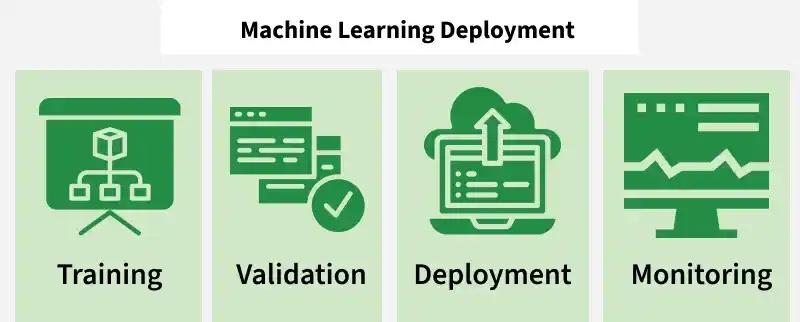
Machine learning deployment is the process of integrating a trained model into a real-world environment so it can generate predictions on live data and deliver practical value. It transforms models from experimental setups into scalable, reliable systems while also ensuring continuous monitoring and updates for long-term performance.
Enables real-time or batch predictions by integrating models into applications or APIs
Ensures scalability, reliability and smooth handling of real-world data
Supports monitoring, versioning and retraining to maintain accuracy over time
Step 1: Develop and Create a Model in a Training Environment
Build your model in an offline training environment using training data. ML teams often create multiple models, but only a few make it to deployment.
Step 2: Optimize and Test Code
Ensure that your code is of high quality and can be deployed. Clean and optimize the code as necessary and test it thoroughly to ensure it functions correctly in a live environment.
Step 3: Prepare for Container Deployment
Containerize your model before deployment. Containers are predictable, repeatable and easy to coordinate making them ideal for deployment. They simplify deployment, scaling, modification and updating of ML models.
Step 4: Plan for Continuous Monitoring and Maintenance
After your model is running keep checking if it’s working well. Make sure it still gives good answers and works fast. If the data changes or it starts making mistakes, fix it. Also update the model often with new information to keep it useful.
Deployment Strategies
Mainly we used to need to focus these strategies:
Shadow Deployment: It involves running the new model alongside the existing one without affecting production traffic. This allows for a comparison of their performances in a real-world setting. It helps to ensure that new model meets the required performance metrics before fully deploying it.
Canary Deployment: This means slowly giving the new model to a small group of users while most people keep using the old model. This way you can watch how the new model works and find any problems before making it available to everyone.
A/B Testing: It show different versions of the model to different groups of users and comparing how well each one works. This helps you decide which version is better before using it for all users.
Tools and Platforms for Model Deployment
Here are some popular tools that help you put your machine learning models to work:
Kuberneteshelps manage and run your models inside containers. It makes sure your model runs smoothly can handle lots of users and automatically adjusts resources when needed.
Kubeflowis built on Kubernetes and is made especially for machine learning. It gives you easy-to-use tools to deploy and manage your ML models in a production environment.
MLflowis an open-source tool that helps you to manage the whole machine learning process. It keeps track of experiments, organizes your code and helps to manage different versions of your models.
TensorFlow Serving is a system designed to run TensorFlow models in production. It makes it easy to deploy models as small services that can handle many requests at once and can grow to handle more users.
Best Practices for Deployment
Automated Testing: Always test your model automatically before you release it.
Version Control: Keep track of model versions and changes in code/data.
Security Measures: Protect your model and data from unauthorized access or attacks.