|
VOOZH | about |
|
VOOZH | about |
NCERT Solutions for Class 10 Maths Chapter 13 - Surface Areas and Volumes- This article contains detailed NCERT Solutions for Class 10 Maths Chapter 13 Surface Areas and Volumes. It has been developed by the team of experts at GFG as a tool to help students in answering questions from the NCERT textbook.
All of the problems in the exercises included in Class 10 Maths Chapter 13 Surface Areas and Volumes from the NCERT textbook have been covered in the NCERT Solutions for Class 10 Maths.
Class 10 Maths NCERT Solutions Chapter 13 Surface Areas and Volumes Exercises |
|---|
|
|
|
|
|
This chapter covers important topics related to calculating the surface area and volume of different geometric solids, including :
Additionally, the chapter includes the conversion of units for length, area, and volume.
Solution:
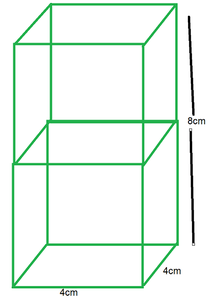
Volume of cube=64cm3 = (side)3
(Side)3 = 64
Side = (64cm3) 1/3
= (2*2*2*2*2*2 cm3)1/3
= 2*2
= 4 cm
Hence, now
Length = 8 cm
breadth = 4 cm
Height = 4 cm
Surface area of cuboid=2(lb+bh+hl)
=2(8*4+4*4+4*8)
=2(32+16+32)
=2(80)
=160cm2
👁 NCERT Solutions for Class 10 Maths Chapter 13 Surface Areas and Volumes
Solution:
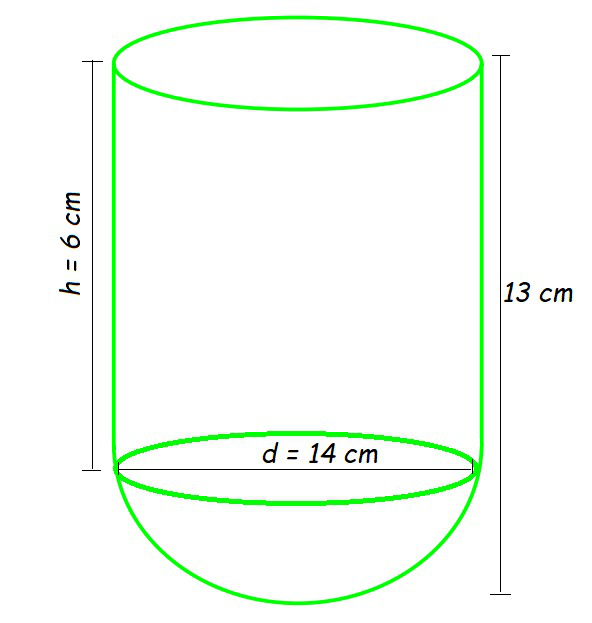
Height of cylinder = 13-7 = 6 cm
Inner surface area of vessels=C.S.A of cylinder+ C.S.A of Hemisphere
=2πrh+2πr2
=2πr(h+r)
=2*22/7*7(6+7)
=44(13)
=572cm2
👁 NCERT Solutions for Class 10 Maths Chapter 13 Surface Areas and Volumes
Solution:
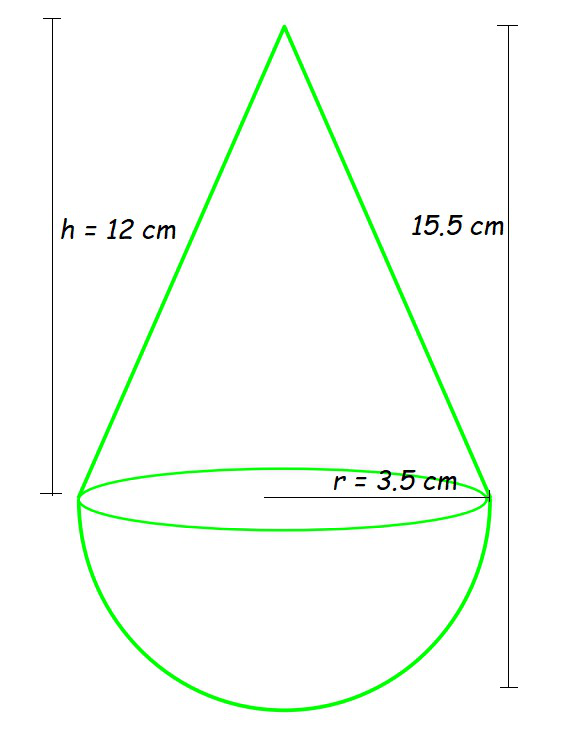
Height of cone(h)=15.5-3=12cm
l=√(h2+r2)
l=√(122+3.52)
l=√(144+12.25)
=√256.25
=12.5cm
Total surface area of toy=C.S. A of cone+ C.S.A of hemisphere
=πrl+2πr2
=πr(l+2r)
=22/7*3.5(12.5+2(3.5))
=11(12.5*7)
=11(19.5)
=214.5cm2
👁 NCERT Solutions for Class 10 Maths Chapter 13 Surface Areas and Volumes
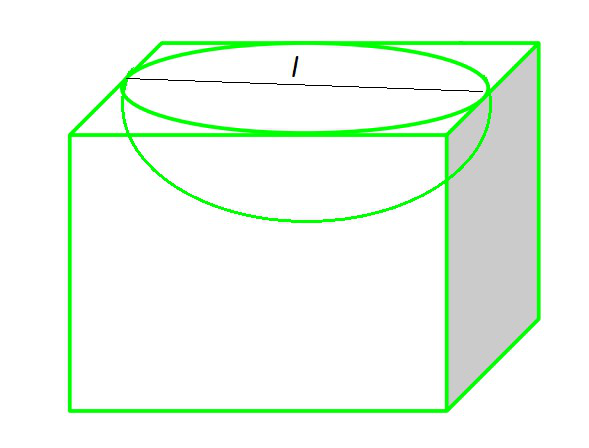
Solution:
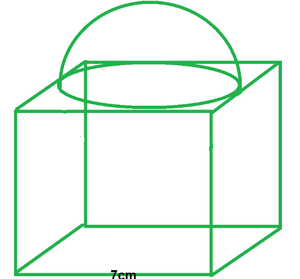
Surface area of solid=T.S.A of cube-Area of circle+ C.S.A of hemisphere
=6*side*side-πr2+2πr2
=6*side*side+πr2
=6*7*7+22/7*7/2*7/2
=294+72/2
=294+38.5
=332.5cm2
👁 NCERT Solutions for Class 10 Maths Chapter 13 Surface Areas and Volumes
Solution:
Surface area remaining solid=T.S.A of cube -Area of circle+ C.S.A of hemisphere
=6*side*side- πr2+2πr2
=6*l*l- πr2
=6l2-πr2
=6l2 - π(l/2)2
=6l2 - πl2/4
=(24l2+ πl2)/4
=l2(24+π)/4
👁 NCERT Solutions for Class 10 Maths Chapter 13 Surface Areas and Volumes
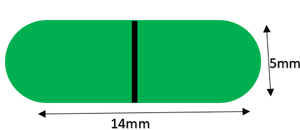
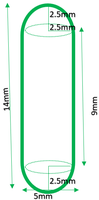
Solution:
D=5mm r=5/2mm
h=14-5=9
Surface area of cylinder=C.S. A of cylinder+ C.S.A of 2 Hemisphere
=2πrh+2πr2*2
=2πr(h+2r)
=2*22/7*5/2(9+2*5/2)
=110/7(9+5)
=110/7*14
=220mm2
👁 NCERT Solutions for Class 10 Maths Chapter 13 Surface Areas and Volumes
👁 NCERT Solutions for Class 10 Maths Chapter 13 Surface Areas and Volumes
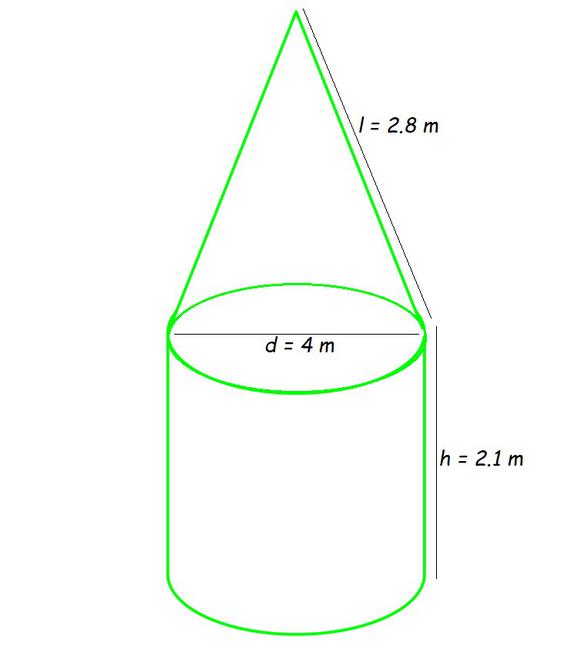
Solution:
i) d=4m r=4/2=2m
Area of canvas =C.S.A of cone+ C.S.A of cylinder
=πrl+2πrh
=πr(l+2h)
=22/7(2.8+2*2.1)
=44(2.8+4.2)/7
=44×7/7
=44m2
ii) cost of canvas=Area×rate
=44m2×Rs. 500/m2
=Rs. 22,000
👁 NCERT Solutions for Class 10 Maths Chapter 13 Surface Areas and Volumes
Solution:
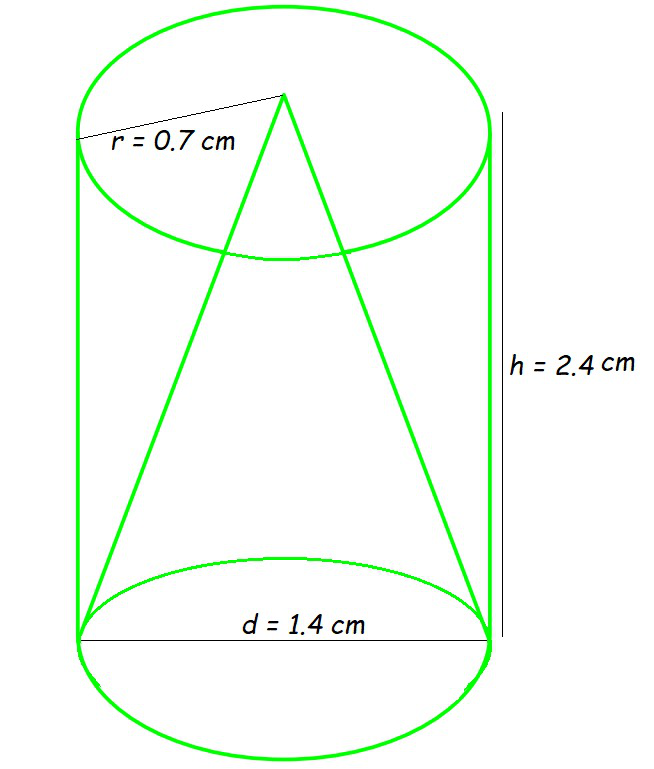
D=1.4 cm, r=1.4/2=14/20=7/10=0.7
l= √(h2+r2)
= √((2.4)2+(0.7)2)
= √(5.76+0.49)
= √6.25
= 2.5cm2
Total surface area of remaining solid=C.S.A of cylinder+ C.S.A of cone+ Area of circular base
= 2πrh+πrl+πr2
= πr(2h+l+r)
= 22/7*7/10(2(2.4)+2.5+0.7)
= 22(4.8+2.5+0.7)/10
= 22(8)/10
= 176/10
= 17.6cm2
Nearest ten=18cm2
👁 NCERT Solutions for Class 10 Maths Chapter 13 Surface Areas and Volumes
Solution:
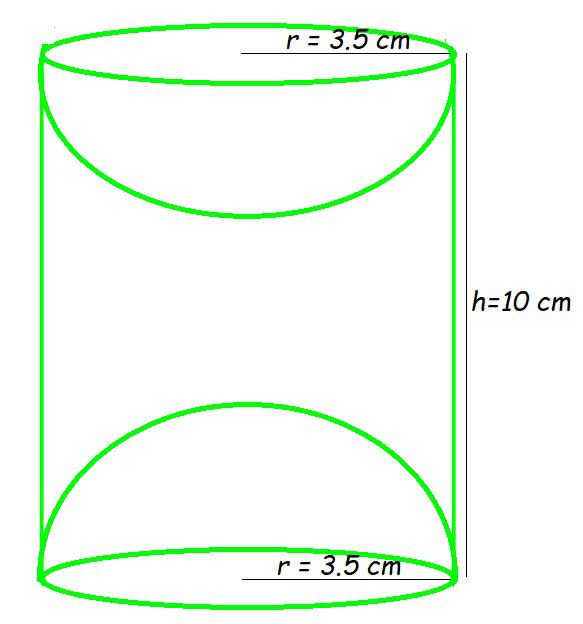
Total surface area of article=C.S.A of cylinder+2*C.S.A of hemisphere
=2πrh+2*2πr2
=2πr(h+2r)
=2*22/7*3.5(10+2(3.5))
=22(10+7)
=22(17)
=374cm2
👁 NCERT Solutions for Class 10 Maths Chapter 13 Surface Areas and Volumes
Solution:
Given:
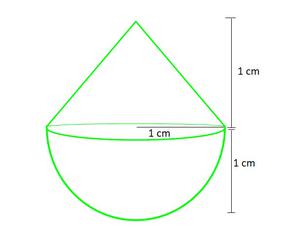
Height of cone (h)= 1 cm
Radius of hemisphere (r) = 1 cm
👁 NCERT Solutions for Class 10 Maths Chapter 13 Surface Areas and Volumes
Total Volume = Volume of cone + Volume of Hemisphere
= πr2h + πr3
= πr2(h+2r)
= × π × 1 × 1 × (1+2)
= π cm3
Solution:
Given:
Radius of cone and cylinder (r) = cm
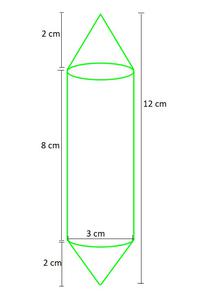
Height of cone (h) = 2 cm
Height of cylinder (H) = 12- (2+2) = 8 cm
👁 NCERT Solutions for Class 10 Maths Chapter 13 Surface Areas and Volumes
Total Volume = Volume of two cones + Volume of cylinder
= πr2h + πr2h + πr2H
= πr2h + πr2H
= πr2(()h+H)
= (taking π=)
=
=
= 66 cm3
Solution:
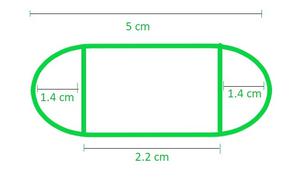
Given,
For 1 gulab jamun,
Height of cylindrical part (H)= 5-(2.8) = 2.2 cm
Radius of cylindrical and hemispherical part (r)= = 1.4 cm
👁 NCERT Solutions for Class 10 Maths Chapter 13 Surface Areas and Volumes
Total Volume of one gulab jamun = Volume of two Hemisphere + Volume of cylinder
= πr3 + πr3 + πr2H
= πr2 (r + H)
= (taking π=)
= 25.05 cm3
Hence, volume of 45 gulab jamun = 45 × Volume of 1 gulab jamun
= 45 × 25.05
= 1127.28 cm3
As, gulab jamun contains sugar syrup up to about 30% of its volume
Sugar syrup in 45 gulab jamun = 30% of its total volume
= × 1127.28
=
= 338.184 cm3
Solution:
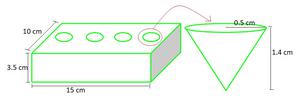
Given:
Length of cuboid (l) = 15 cm
Breadth of cuboid (b) = 10 cm
Height of cuboid (h) = 3.5 cm
Radius of conical part (r) = 0.5 cm
Height of conical part (H) = 1.4 cm
👁 NCERT Solutions for Class 10 Maths Chapter 13 Surface Areas and Volumes
Total Volume wood in the entire stand = Volume of Cuboid - Volume of four conical part
= (l × b × h) - 4 × (πr2H)
= (15 × 10 × 3.5) - (4 × × 0.5 × 0.5 × 1.4) (taking π=)
= 525 - (1.466)
= 523.5333 cm3
Solution:
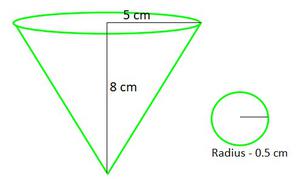
Given:
Height of cone (h) = 8 cm
Radius of cone (r) = 5 cm
Radius of sphere (R)= 0.5 cm
Let, No. of sphere in cone = n
👁 NCERT Solutions for Class 10 Maths Chapter 13 Surface Areas and Volumes
Volume of water = Volume of cone
= πr2h
= × π × 5 × 5 × 8
= cm3
Volume of water flows out = (total volume of water)
=
= cm3
Hence, the volume of n spheres = cm3
Volume of each sphere = πr3
= × π × 0.5 × 0.5 ×0.5
= cm3
Hence, n =
n =
n = 100 spheres
Solution:
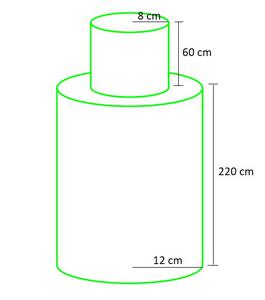
Given:
Height of large cylinder (H)= 220 cm
Radius of large cylinder (R)= = 12 cm
Height of small cylinder (h)= 60 cm
Radius of small cylinder (r)= 8 cm
👁 NCERT Solutions for Class 10 Maths Chapter 13 Surface Areas and Volumes
Total Volume = Volume of large cylinder + Volume of small cylinder
= πR2H + πr2h
= π (R2H + r2h)
= 3.14 × ((12 × 12 × 220) + (8 × 8 × 60)) (taking π=3.14)
= 3.14 (31680 + 3840)
= 111532.8 cm3
As given, Mass of 1cm3 = 8 g
Mass for 111532.8 cm3 = 8 × 111532.8 g
= 892,262.4 grams
= 892.2624 kg
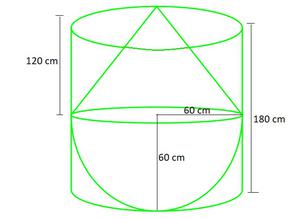
Solution:
Given:
Height of cylinder (H)= 180 cm
Height of cone (h)= 180 - 60 = 120 cm
Radius of cone, cylinder and hemisphere (r) = 60 cm
👁 NCERT Solutions for Class 10 Maths Chapter 13 Surface Areas and Volumes
Volume of water left in the cylinder = Volume of cylinder - (Volume of cone + Volume of hemisphere)
= πr2H - (πr2h + πr3)
= πr2 (H - h + r)
= (taking π=)
= × 60 × 60 × (100)
= 1131428.571 cm3
= 1.131 m3
Hence, the volume of water left in the cylinder = 1.131 m3
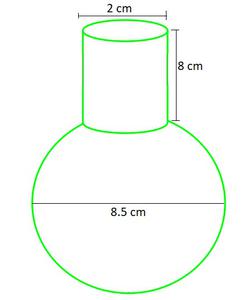
Solution:
Given:
Height of cylinder (h)= 8 cm
Radius of cylinder (r) = 2/2 = 1 cm
Radius of sphere (R) = cm
👁 NCERT Solutions for Class 10 Maths Chapter 13 Surface Areas and Volumes
Amount of water it can hold = Total Volume of this vessel
= Volume of cylinder + Volume of sphere
= πr2h + πR3
=
= 8π + 102.35π
= 110.35π (taking π=3.14)
= 346.499 cm3
Volume measured by child = 345 cm3, which is INCORRECT
Correct volume = 346.5 cm3
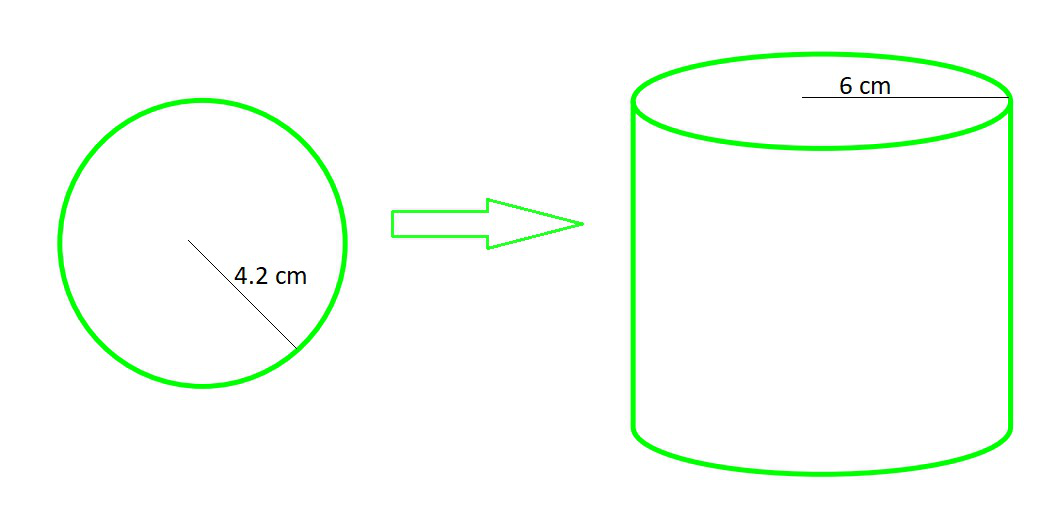
Solution:
👁 NCERT Solutions for Class 10 Maths Chapter 13 Surface Areas and Volumes
Radius of sphere (R)= 4.2 cm
Radius of cylinder (r)= 6 cm
In recasting process the volume will be same, so
Volume of cylinder = Volume of sphere
πr2h = πR3
π(6)2h = π(4.2)3 (cancel π from both side)
36h = (4.2 × 4.2 × 4.2)
h = (cm)
h = 1.4 × 1.4 × 1.4 (cm)
h = 2.74 cm
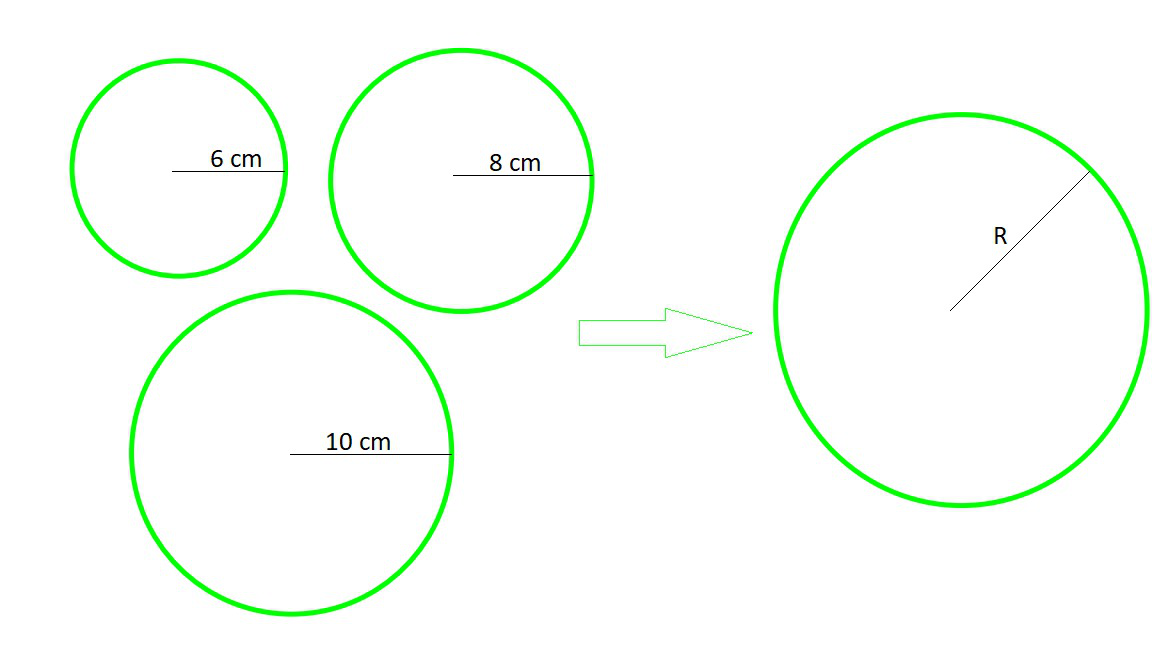
Solution:
👁 NCERT Solutions for Class 10 Maths Chapter 13 Surface Areas and Volumes
Radius of sphere 1 (r1)= 6 cm
Radius of sphere 2 (r2)= 8 cm
Radius of sphere 3 (r3)= 10 cm
Let Radius of resulting sphere = R
In recasting process the volume will be same, so
Volume of Resulting sphere = Volume of sphere 1 + Volume of sphere 2 + Volume of sphere 3
π(R)3 = π(r1)3 + π(r2)3 +π(r3)3 (cancel π from both side)
R3 = (r1)3 + (r2)3 + (r3)3
R3 = (6)3 + (8)3 + (10)3
R3 = 216 + 512 + 1000
R3 = 1728
R = (1728) 1/3
R = 12 cm
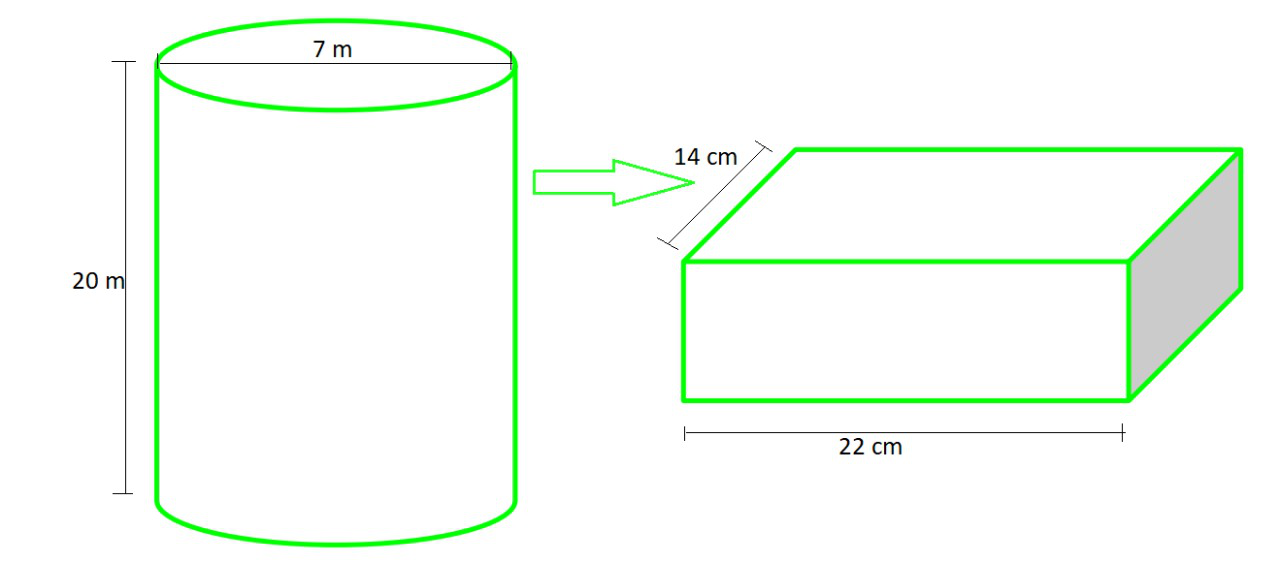
Solution:
👁 NCERT Solutions for Class 10 Maths Chapter 13 Surface Areas and Volumes
So basically here, the digging of cylindrical shape is changed to cuboidal shape
Given values,
Diameter of cylinder = 7 m
Radius of cylinder (r)= m
Height of cylinder (H)= 20 m
Length of Cuboid (l) = 22 m
Breadth of Cuboid (b) =14 m
Let Height of Cuboid = h
In this process the volume will be same, so
Volume of Cuboid = Volume of Cylinder
l × b × h = πr2H
22 × 14 × h = π × × 20
h = m (taking π =)
h = m
h = 2.5 m
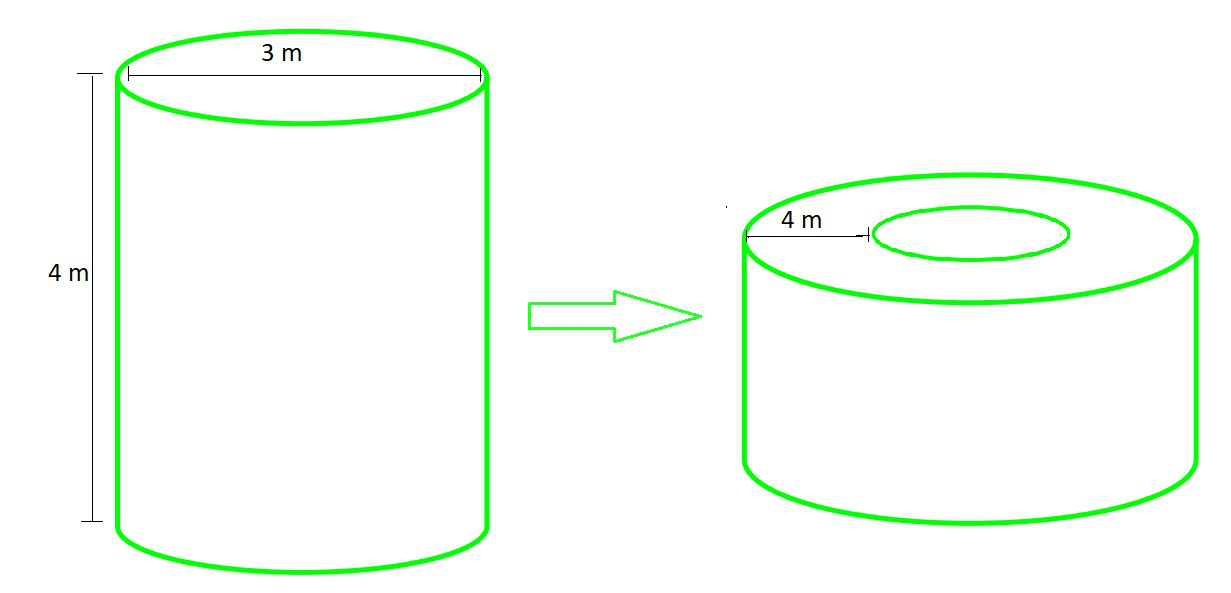
Solution:
👁 NCERT Solutions for Class 10 Maths Chapter 13 Surface Areas and Volumes
So basically here, the digging of cylindrical shape is changed to another Hollow cylindrical shape
Given values,
Diameter of cylinder = 3 m
Radius of cylinder (r) = m
Height of cylinder (h) = 14 m
Width of embankment = 4 m
Outer Radius of embankment R1= radius of cylinder + width = 3/2 + 4 = m
Inner Radius of embankment R2= radius of cylinder = m
Height of embankment = H
In this process the volume will be same, so
Volume of Embankment = Volume of Cylinder
(πR12H) - (πR22H) = πr2h
(R12 -R22)H = ()2× 14 (cancel π from both side)
H =
H =
H =
H =
H =
H = m
H = 1.125 m
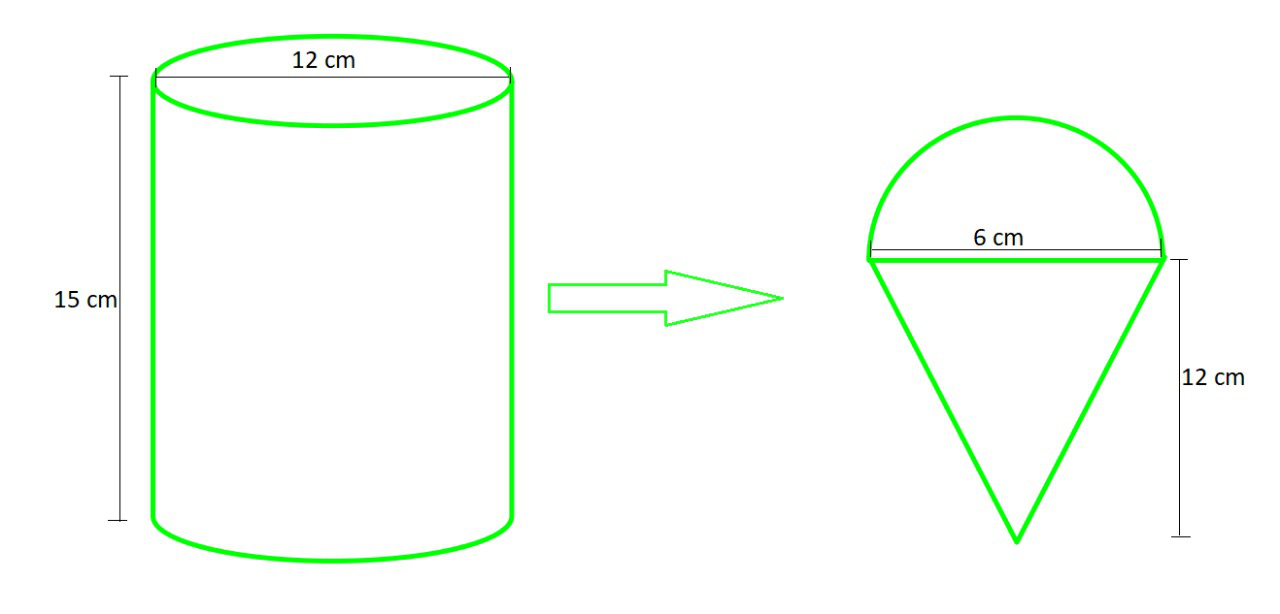
Solution:
👁 NCERT Solutions for Class 10 Maths Chapter 13 Surface Areas and Volumes
Given values,
Radius of cylinder (r) = 6 cm
Height of cylinder (h) = 15 cm
Radius of each cone (R) = 3 cm
Height of each cone (H) = 12 cm
Let n be the total number of ice creams
In this process the volume will be same, so
n × (Volume of each Cone + Volume of each hemisphere) = Volume of Cylinder
n × (πR2H + πR3) = πr2h
n = (cancel π from both side)
n =
n =
n =
n = 10
Hence, 10 numbers of cones filled with ice-cream.
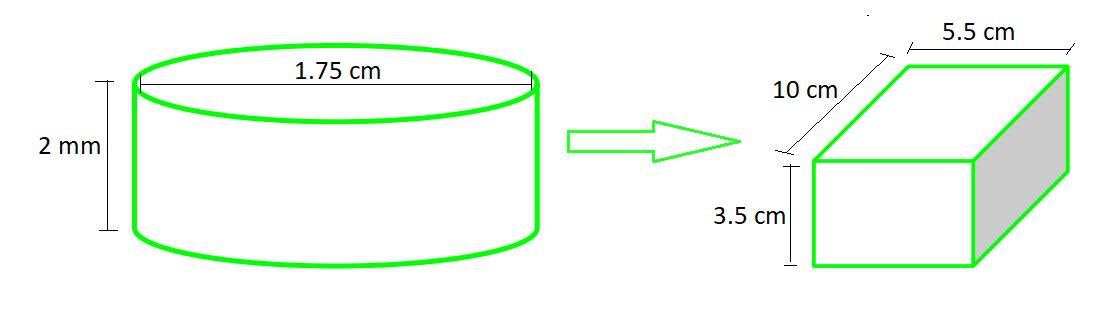
Solution:
👁 NCERT Solutions for Class 10 Maths Chapter 13 Surface Areas and Volumes
Given values,
Radius of cylindrical coin (r) =
Height of cylindrical coin (H) = 2 mm = cm
Length of Cuboid (l) = 5.5 cm
Breadth of Cuboid (b) =10 cm
Height of Cuboid (h)= 3.5 cm
Let n be the total number of coins
In this process the volume will be same, so
n × (Volume of each Coin) = Volume of Cylinder
n × (πR2H) = l × b × h
n × π × ()2× = 5.5 × 10 × 3.5
n = (taking π = )
n =
n = 400
Hence, 400 silver coins must be melted to form this cuboid.
Solution:
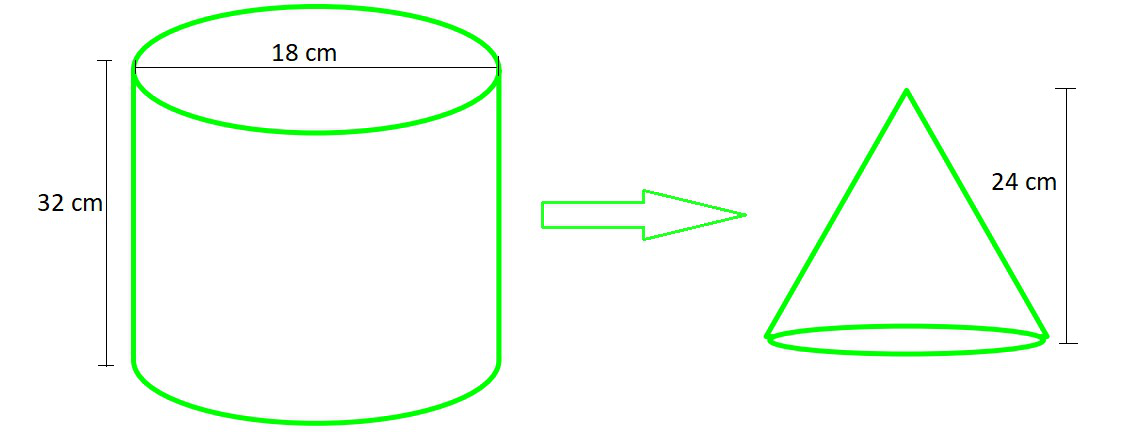
So basically here, the cylindrical shape is changed to conical shape
👁 NCERT Solutions for Class 10 Maths Chapter 13 Surface Areas and Volumes
Given values,
Radius of cylinder (r) = 18 cm
Height of cylinder (h) = 32 cm
Height of cone (H) = 24 cm
Let Radius of cone = R
In this process the volume will be same, so
Volume of Cone = Volume of Cylinder
πR2H = πr2h
R2 × (24) = 182 × 32 (cancel π from both side)
R2 =
R = √(18 × 18 × 4)
R = 36 cm
Slant height (l) = √H2 + R2
l = √(242 + 362)
l = √(12×2)2 + (12×3)2
l =12 √(4+9)
l = 12 √13 cm
Solution:
Given values,
Width of canal (w) = 6 m
Depth of canal (h) = 1.5 m
Speed of canal = 10 km/hr = (10,000 m/hr)
For 1hr (60 mins), we can take length (l) as = 10,000 m and
Volume in 1hr = (l × w × h)
= (10,000 × 6 × 1.5) m3
= 90,000 m3
So for 30 mins volume will be = m3
= 45,000 m3
Area irrigated in 30 minutes will be as:
Area × length of standing = Volume of canal in 30mins
Area =
Area = 562500 m2
Solution:
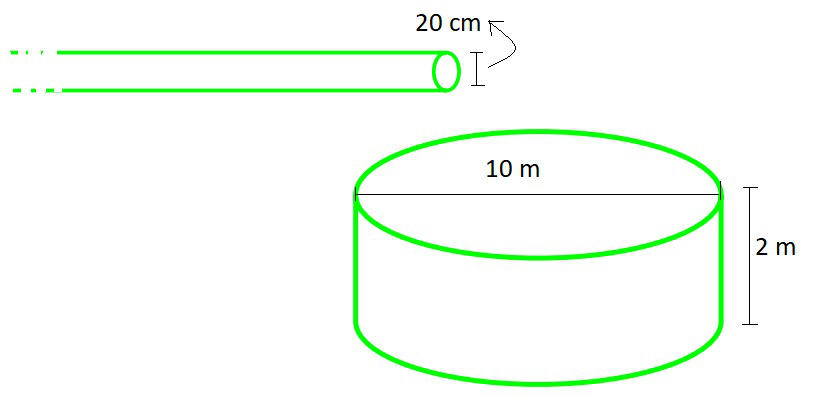
Given values,
👁 NCERT Solutions for Class 10 Maths Chapter 13 Surface Areas and Volumes
Radius of Pipe (R) = 10 cm = m
Radius of Cylindrical tank (r) = 5 m
Depth of Cylindrical tank (h) = 2 m
Speed of water flows in pipe = 3 km/hr = (3,000 m/hr)
Let Time to fill cylindrical tank = t
For 1hr (60 mins), we can take height of Pipe (H) as = 3,000 m and
Volume in 1hr = (πR2H)
= (π × ()2 × 3,000) m3
= 30π m3
In this process the volume will be same, so
t (in hr) × (Volume of Pipe in 1hr) = Volume of Cylindrical Tank
t × (30π) = πr2h
t × (30π) = π × 52 × 2
t =
t = hr
t = × 60 mins
t = 100 minutes
Hence, 100 minutes will be taken to fill the tank.
Solution:
Given values:
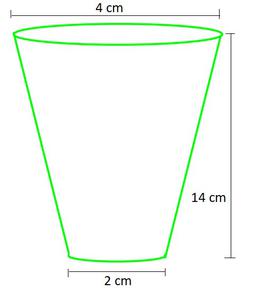
Height of frustum (h) = 14 cm
Radius of larger circle end (R) = = 2 cm
Radius of smaller circle end (r)= = 1 cm
👁 NCERT Solutions for Class 10 Maths Chapter 13 Surface Areas and Volumes
Capacity of frustum-shaped glass = Volume of Frustum
= πh (r2 + R2 + rR)
= × π × 14 ((1 × 1) + (2 × 2) × (2 × 1))
= × 14 × 7 (taking π=)
=
= 102.67 cm3
Hence, the capacity of frustum-shaped glass = 102.67 cm3
Solution:
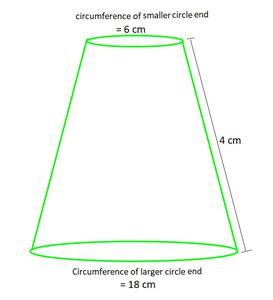
Slant height of frustum (l) = 4 cm
Let radius of smaller circle end = r
Let radius of larger circle end = R
👁 NCERT Solutions for Class 10 Maths Chapter 13 Surface Areas and Volumes
Circumference of circle = 2π × (radius of circle)
Circumference of larger circle = 2πR
18 cm2 = 2πR
R =
R = cm
Circumference of smaller circle = 2πr
6 cm2 = 2πr
r =
r = cm
Now, as curve surface area of frustum = π (r+R) l
= π × () × 4
= 12 × 4 (Taking π common and canceling it)
= 48cm2
Hence, the curved surface area of the frustum = 48cm2
Solution:
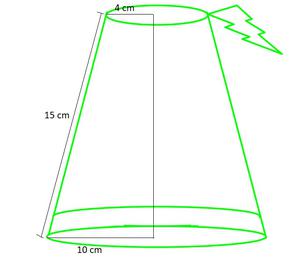
Given values:
Slant height of frustum (l)= 15 cm
Let radius of smaller circle end (r) = 4 cm
Let radius of larger circle end (R) = 10 cm
👁 NCERT Solutions for Class 10 Maths Chapter 13 Surface Areas and Volumes
Area of material used for making it = Curve surface area + area of upper base
= (π(r+R)l) + (πr2)
= π ((r+R)l + r2) (Taking π common)
= π ((4+10) × 15 + (4 × 4))
= × (226) (Taking π = )
= 710.286 cm2
Hence, the area of material used for making it = 710.286 cm2
Solution:
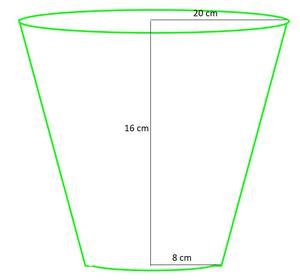
Given values:
Height of frustum (h)= 16 cm
Let radius of smaller circle end (r) = 8 cm
Let radius of larger circle end (R) = 20 cm
👁 NCERT Solutions for Class 10 Maths Chapter 13 Surface Areas and Volumes
The amount of milk to fill the container = Volume of frustum
= πh (r2 + R2 + rR)
= × 3.14 × 16 (8×8 + 20×20 + 8×20) (Taking π=3.14)
= × 3.14 × 16 × (624)
= 10449.92 cm3
Cost of 1 litre milk = ₹ 20
And as, 1 m3 = 1000 cm3 = 1 litre
10449.92 cm3 = () ×10449.92 litres
cost of 10449.92 cm3 = () × 20
= ₹ 208.998
Now, metal sheet used to make the container = Curve surface area + area of lower base
= (π(r+R)l) + (πr2)
= π ((r+R)l + r2) (Taking π common)
= π ((20+8) × (√(162+(20-8)2)) + (8 × 8)) (Slant height (l) = √(h2+(R-r)2))
= 3.14 × (28 × √400 + 64) (Taking π = 3.14)
= 3.14 × (624)
= 1959.36 cm2
Hence, the metal sheet used to make the container = 1959.36 cm2
As, cost of 100 cm2= ₹ 8
1959.36 cm2 = (8/100) × 1959.36
= ₹156.748
Hence, the cost of the milk which can completely fill the container = ₹ 208.998
and, the cost of metal sheet used to make the container = ₹156.748
Solution:
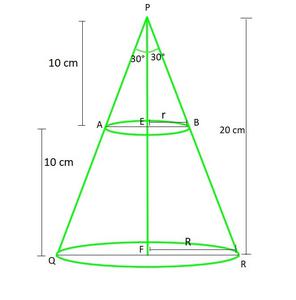
As the angle is cut into two equal parts, the height gets half too.
Let radius of smaller circle end = r
Let radius of larger circle end = R
👁 NCERT Solutions for Class 10 Maths Chapter 13 Surface Areas and Volumes
In ∆PFR and ∆PEB
tan ∝ =
tan 30° =
R =
r =
and as height of frustum = 10 cm
So according to the question,
Frustum is converted to cylindrical wire having diameter cm
Volume of Frustum = Volume of Cylinder
Volume of Frustum = πh (r2 + R2 + rR)
=
=
=
= cm3 .............................(1)
Volume of Cylinder = π(radius)2H
= π()2H .....................(2)
As (1) = (2) , then
7000π / 9 = 1/3 π(1/(16×2))2H
H = (cancel π from both side)
H = 796444.443 cm
H = 7964.44 m
Hence, the length of the wire = 7964.44 m
Solution:
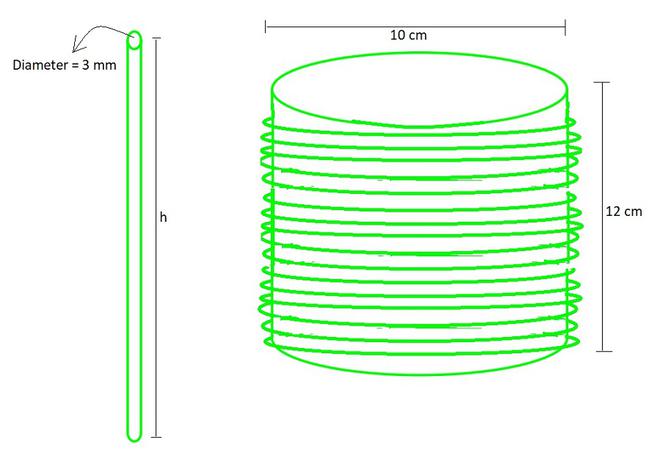
Given,
Radius of copper wire (r) = mm = cm
Height of cylinder (H) = 12 cm
Radius of Cylinder (R) = = 5 cm
👁 NCERT Solutions for Class 10 Maths Chapter 13 Surface Areas and Volumes
Length of copper wire needed for one round will be circumference of cylindrical circle end = 2πR
=2π(5)
length of each round = 10π cm
Now, to completely cover the cylinder with wire no of rounds (n) of copper wire should be:
n = height of cylinder / diameter of copper wire
n =
no. of rounds = 40
Now, Total length of copper wire will be:
h = no. of rounds × length of each round
h = 40×10π
h = 400×3.14 (taking π = 3.14)
h = 1256 cm
Volume of copper wire = πr2h
=π×()2×1256
=π××1256
= 88.82 cm3 (taking π = )
Now, as it is given that,
For 1cm3 = 8.88 g of wire
so, for 88.82 cm3 = 8.88×88.82 g
Mass of copper wire = 788.7216 g
Hence, the length and mass of the wire are and respectively.
Solution:
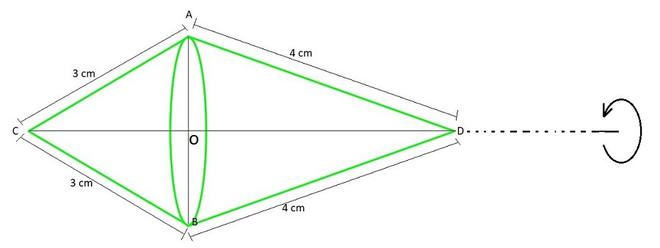
After revolving the triangle about its hypotenuse, we get two cones having slant height as 3 cm and 4 cm each.
Hypotenuse of triangle (CD) = √(32 + 42) = 5 cm
l1 = 3 cm
l2 = 4 cm
👁 NCERT Solutions for Class 10 Maths Chapter 13 Surface Areas and Volumes
ar(△ACD) = ×AC×AD = ½×AO×CD (as AC⊥AD and AO⊥CD)
⇒ AC×AD = AO×CD
⇒ 4×3 = AO×5
AO = cm
Hence, radius of cone base is cm
Now, Volume of double cone = Volume of cone 1 + Volume of cone 2
= ()πr2×OD + ()πr2×OC
= ()πr2×(OD+OC)
= πr2×CD
=
= 30.17 cm3
Now, Curve Surface area of double cone = CSA of cone 1 + CSA of cone 2
= πrl1 + πrl2
= πr(l1+l2)
= ×(3+4)
= 30.17 cm2
Hence, the volume and surface area of the double cone so formed is 3 and 2 .
Solution:
Given,
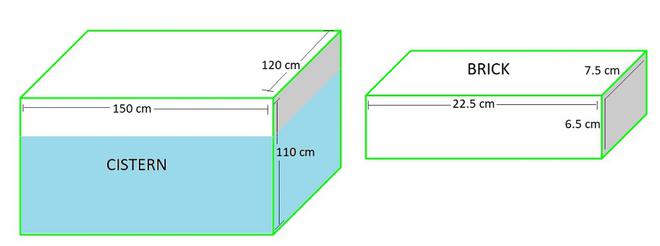
Length of Cistern (L) = 150 cm
Breadth of Cistern (W) = 120 cm
Height of Cistern (H) = 110 cm
Length of Brick (l) = 22.5 cm
Breadth of Brick (w) = 7.5 cm
Height of Brick (h) = 6.5 cm
👁 NCERT Solutions for Class 10 Maths Chapter 13 Surface Areas and Volumes
Volume of Cistern = L×B×H
= 150×120×110
= 1980000 cm3
Volume of Water = 129600 cm3
Empty space left in Cistern = 1980000-129600
= 1850400 cm3
Volume of Brick = l×b×h
= 22.5×7.5×6.5
= 1096.88 cm3
Volume of n Bricks = 1096.88×n cm3
Volume absorbed by each brick = ()th (volume of brick)
= ×1096.88 cm3
= 64.522 cm3
Then, Volume absorbed by n bricks = 64.522×n
Volume of brick = Empty space left in Cistern + volume absorbed by bricks
1096.88×n = 1850400 + 64.522×n
n×(1096.88-64.522) = 1850400
n =
n = 1792.40
n ≈ 1792
Hence, 1792 bricks can be put in without overflowing the water.
Solution:
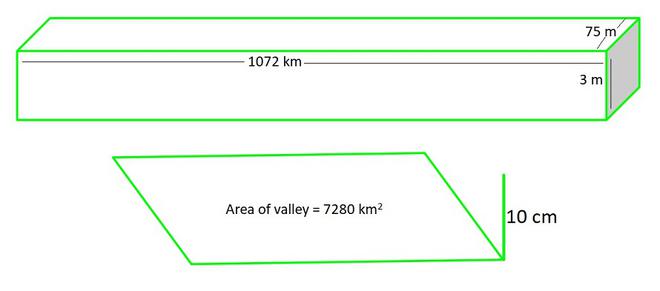
Length of river (l) = 1072 km
Width of river (w) = km = 0.075 km
Depth of river (h) = = 0.003 km
Depth of rainfall = km
👁 NCERT Solutions for Class 10 Maths Chapter 13 Surface Areas and Volumes
The total rainfall was approximately equivalent to the addition to the normal water of three rivers each
Which means,
has to be equal.
Let's check, for each case,
so,
Volume of three rivers = 3×(l×b×h)
= 3×(1072×0.075×0.003) km3
= 0.7236 km3 .............................(1)
Volume of rainfall in valley = Area of valley×depth of rainfall
= 7280×
= 0.728 km3.....................................(2)
From (1) and (2) we can see that,
Hence, proved, Total rainfall was approximately equivalent to the addition to the normal water of three rivers each.
Solution:
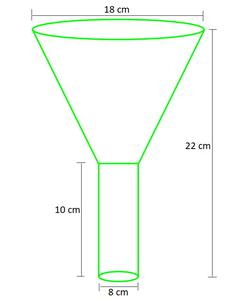
Oil funnel contains two shapes = frustum + Cylinder
Given values,
Larger radius of frustum (R) = = 9 cm
Smaller radius of frustum (r) = = 4 cm
Height of frustum (H) = 22-10 = 12 cm
Radius of cylinder (r) = = 4 cm
Height of cylinder (h) = 10 cm
👁 NCERT Solutions for Class 10 Maths Chapter 13 Surface Areas and Volumes
Area of the tin sheet required = CSA of frustum + CSA of cylinder
CSA of frustum = π(r+R)l
= π×(9+4)×√(122 + (9-4)2) (l =√(H2 + (R-r)2))
= π×13×13
= 169π cm2
CSA of cylinder = 2πrh
= 2×π×4×10
= 80π cm2
Area of the tin sheet required = 169π + 80π
= 249π
= 782.571 cm2 (Taking π=)
Hence, the area of the tin sheet required to make the funnel is
Solution:
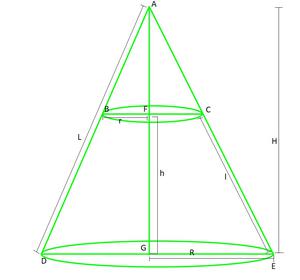
Let ADE be a cone. From the cone the frustum BCDE is cut by a plane parallel to its base. Here, r and R are the radii of the frustum ends of the cone and h be the frustum height.
Here, as BC||DE
👁 NCERT Solutions for Class 10 Maths Chapter 13 Surface Areas and Volumes
In △ADG and △ABF
So, ΔADG ∼ ΔABF (as BC||DE)
..............(1)
from (1), we get
1-() =
= 1 -
=
L(R-r) = Rl...........................(2) (By rearranging)
Total surface area of frustum = CSA of frustum + Area of upper circular end + Area of the lower circular end
- CSA of frustum = CSA of cone ADE - CSA of cone ABC
= πRL - πr(L-l)
= πL(R-r)+πrl
= πRl+πrl (from (2) replacing L(R-r) = Rl )
= π(R+r)l
- Area of upper circular end = πR2
- Area of the lower circular end = πr2
Total surface area of frustum = π(R+r)l + πR2 + πr2
Solution:
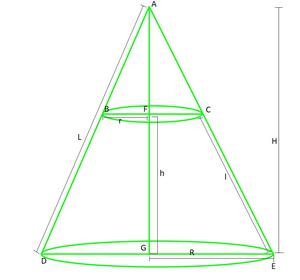
Let ADE be a cone. From the cone the frustum BCDE is cut by a plane parallel to its base. Here, r and R are the radii of the frustum ends of the cone and h be the frustum height.
Here, as BC||DE
👁 NCERT Solutions for Class 10 Maths Chapter 13 Surface Areas and Volumes
In △ADG and △ABF
So, ΔADG ∼ ΔABF (as BC||DE)
.....................(1)
from (1), we get
1-() =
= 1 -
=
H(R-r) = Rh...........................(2) (By rearranging)
Total volume of frustum of the cone will be = Volume of cone ADE – Volume of cone ABC
= πR2H - πr2(H-h)
= πR2H - πr2H + πr2h
= π(H(R2-r2)+r2h)
= π(H(R-r)(R+r)+r2h) (Replacing (R2-r2) = (R-r)(R+r))
= π(Rh(R+r)+r2h) (from (2) replacing H(R-r) = Rh )
= π(R2h+Rrh+r2h)
= πh(R2+Rr+r2) (Taking h common)
Hence, Total volume of frustum of the cone will be = πh(R2+Rr+r2)
Solution:
Given,
Radius of copper wire (r) = mm = cm
Height of cylinder (H) = 12 cm
Radius of Cylinder (R) = = 5 cm
👁 NCERT Solutions for Class 10 Maths Chapter 13 Surface Areas and VolumesLength of copper wire needed for one round will be circumference of cylindrical circle end = 2πR
=2π(5)
length of each round = 10π cm
Now, to completely cover the cylinder with wire no of rounds (n) of copper wire should be:
n = height of cylinder / diameter of copper wire
n =
no. of rounds = 40
Now, Total length of copper wire will be:
h = no. of rounds × length of each round
h = 40×10π
h = 400×3.14 (taking π = 3.14)
h = 1256 cm
Volume of copper wire = πr2h
=π×()2×1256
=π××1256
= 88.82 cm3 (taking π = )
Now, as it is given that,
For 1cm3 = 8.88 g of wire
so, for 88.82 cm3 = 8.88×88.82 g
Mass of copper wire = 788.7216 g
Hence, the length and mass of the wire are and respectively.
Solution:
After revolving the triangle about its hypotenuse, we get two cones having slant height as 3 cm and 4 cm each.
Hypotenuse of triangle (CD) = √(32 + 42) = 5 cm
l1 = 3 cm
l2 = 4 cm
👁 NCERT Solutions for Class 10 Maths Chapter 13 Surface Areas and Volumesar(△ACD) = ×AC×AD = ½×AO×CD (as AC⊥AD and AO⊥CD)
⇒ AC×AD = AO×CD
⇒ 4×3 = AO×5
AO = cm
Hence, radius of cone base is cm
Now, Volume of double cone = Volume of cone 1 + Volume of cone 2
= ()πr2×OD + ()πr2×OC
= ()πr2×(OD+OC)
= πr2×CD
=
= 30.17 cm3
Now, Curve Surface area of double cone = CSA of cone 1 + CSA of cone 2
= πrl1 + πrl2
= πr(l1+l2)
= ×(3+4)
= 30.17 cm2
Hence, the volume and surface area of the double cone so formed is 3 and 2 .
Solution:
Given,
Length of Cistern (L) = 150 cm
Breadth of Cistern (W) = 120 cm
Height of Cistern (H) = 110 cm
Length of Brick (l) = 22.5 cm
Breadth of Brick (w) = 7.5 cm
Height of Brick (h) = 6.5 cm
👁 NCERT Solutions for Class 10 Maths Chapter 13 Surface Areas and VolumesVolume of Cistern = L×B×H
= 150×120×110
= 1980000 cm3
Volume of Water = 129600 cm3
Empty space left in Cistern = 1980000-129600
= 1850400 cm3
Volume of Brick = l×b×h
= 22.5×7.5×6.5
= 1096.88 cm3
Volume of n Bricks = 1096.88×n cm3
Volume absorbed by each brick = ()th (volume of brick)
= ×1096.88 cm3
= 64.522 cm3
Then, Volume absorbed by n bricks = 64.522×n
Volume of brick = Empty space left in Cistern + volume absorbed by bricks
1096.88×n = 1850400 + 64.522×n
n×(1096.88-64.522) = 1850400
n =
n = 1792.40
n ≈ 1792
Hence, 1792 bricks can be put in without overflowing the water.
Solution:
Length of river (l) = 1072 km
Width of river (w) = km = 0.075 km
Depth of river (h) = = 0.003 km
Depth of rainfall = km
👁 NCERT Solutions for Class 10 Maths Chapter 13 Surface Areas and VolumesThe total rainfall was approximately equivalent to the addition to the normal water of three rivers each
Which means,
has to be equal.
Let's check, for each case,
so,
Volume of three rivers = 3×(l×b×h)
= 3×(1072×0.075×0.003) km3
= 0.7236 km3 .............................(1)
Volume of rainfall in valley = Area of valley×depth of rainfall
= 7280×
= 0.728 km3.....................................(2)
From (1) and (2) we can see that,
Hence, proved, Total rainfall was approximately equivalent to the addition to the normal water of three rivers each.
Solution:
Oil funnel contains two shapes = frustum + Cylinder
Given values,
Larger radius of frustum (R) = = 9 cm
Smaller radius of frustum (r) = = 4 cm
Height of frustum (H) = 22-10 = 12 cm
Radius of cylinder (r) = = 4 cm
Height of cylinder (h) = 10 cm
👁 ImageArea of the tin sheet required = CSA of frustum + CSA of cylinder
CSA of frustum = π(r+R)l
= π×(9+4)×√(122 + (9-4)2) (l =√(H2 + (R-r)2))
= π×13×13
= 169π cm2
CSA of cylinder = 2πrh
= 2×π×4×10
= 80π cm2
Area of the tin sheet required = 169π + 80π
= 249π
= 782.571 cm2 (Taking π=)
Hence, the area of the tin sheet required to make the funnel is
Solution:
Let ADE be a cone. From the cone the frustum BCDE is cut by a plane parallel to its base. Here, r and R are the radii of the frustum ends of the cone and h be the frustum height.
Here, as BC||DE
👁 NCERT Solutions for Class 10 Maths Chapter 13 Surface Areas and VolumesIn △ADG and △ABF
So, ΔADG ∼ ΔABF (as BC||DE)
..............(1)
from (1), we get
1-() =
= 1 -
=
L(R-r) = Rl...........................(2) (By rearranging)
Total surface area of frustum = CSA of frustum + Area of upper circular end + Area of the lower circular end
- CSA of frustum = CSA of cone ADE - CSA of cone ABC
= πRL - πr(L-l)
= πL(R-r)+πrl
= πRl+πrl (from (2) replacing L(R-r) = Rl )
= π(R+r)l
- Area of upper circular end = πR2
- Area of the lower circular end = πr2
Total surface area of frustum = π(R+r)l + πR2 + πr2
Solution:
Let ADE be a cone. From the cone the frustum BCDE is cut by a plane parallel to its base. Here, r and R are the radii of the frustum ends of the cone and h be the frustum height.
Here, as BC||DE
👁 NCERT Solutions for Class 10 Maths Chapter 13 Surface Areas and VolumesIn △ADG and △ABF
So, ΔADG ∼ ΔABF (as BC||DE)
.....................(1)
from (1), we get
1-() =
= 1 -
=
H(R-r) = Rh...........................(2) (By rearranging)
Total volume of frustum of the cone will be = Volume of cone ADE – Volume of cone ABC
= πR2H - πr2(H-h)
= πR2H - πr2H + πr2h
= π(H(R2-r2)+r2h)
= π(H(R-r)(R+r)+r2h) (Replacing (R2-r2) = (R-r)(R+r))
= π(Rh(R+r)+r2h) (from (2) replacing H(R-r) = Rh )
= π(R2h+Rrh+r2h)
= πh(R2+Rr+r2) (Taking h common)
Hence, Total volume of frustum of the cone will be = πh(R2+Rr+r2)
Also Check:
- NCERT Solutions for Class 10 Maths Chapter 1 Real Numbers
- NCERT Solutions for Class 10 Maths Chapter 2 Polynomials
- NCERT Solutions for Class 10 Maths Chapter 3 Pair of Linear Equations in Two Variables
- NCERT Solutions for Class 10 Maths Chapter 4 Quadratic Equation
- NCERT Solutions for Class 10 Maths Chapter 5 Arithmetic Progressions
- NCERT Solutions for Class 10 Maths Chapter 6 Triangles
- NCERT Solutions for Class 10 Maths Chapter 7 Coordinate Geometry