|
VOOZH | about |
|
VOOZH | about |
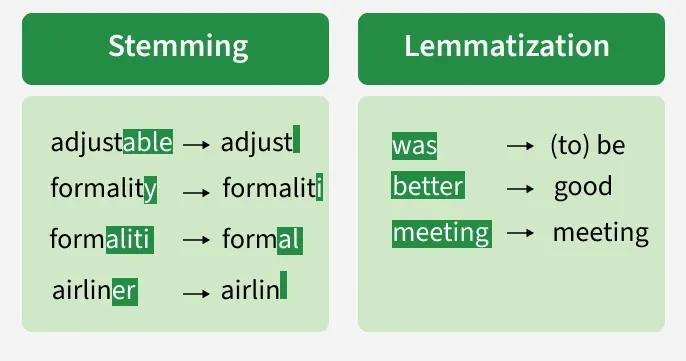
Lemmatization and stemming are two popular text‑preprocessing techniques in NLP used to reduce words to their base form. While stemming cuts words down to their root by trimming endings, lemmatization uses linguistic rules to return meaningful base words (lemmas). Understanding the difference helps improve text analysis, search accuracy and NLP model performance.
Stemming is a rule-based text normalisation technique that reduces words to their root form by removing prefixes or suffixes. The resulting form called a stem, may not be a valid or meaningful word in the language.
In essence, stemming performs mechanical truncation of words.
Example:
| Original Word | Stem |
|---|---|
| running | run |
| studies | studi |
| smiling | smile |
| communication | commun |
Output:
['run', 'studi', 'smile', 'commun']
Lemmatization is a linguistically driven text normalization technique that converts words into their base dictionary form, known as a lemma, by considering grammar, vocabulary and context.
| Original Word | Lemma | POS |
|---|---|---|
| running | run | Verb |
| better | good | Adjective |
| studies | study | Noun |
| was | be | Verb |
Output:
['run', 'good', 'study', 'be']
Let's compare the two techniques:
Aspect | Lemmatization | Stemming |
|---|---|---|
Definition | Converts words to their base or dictionary form (lemma). | Reduces words to their root form (stem) which may not be a valid word. |
Complexity | Higher complexity, context-aware. | Lower complexity, context-agnostic. |
Algorithms | Uses dictionaries and morphological analysis. | Uses rule-based algorithms like Porter, Snowball and Lancaster Stemmers. |
Accuracy | Produces more accurate and meaningful words. | Less accurate, may produce non-meaningful stems. |
Output Example | "Running" → "run", "Better" → "good". | "Running" → "run" or "runn", "Better" → "bett". |
Use in Search Engines | Better search results through understanding context. | Useful for quick search indexing |
Text Analysis | Essential for tasks needing accurate word forms (e.g., sentiment analysis, topic modeling) | Used for initial stages of preprocessing to reduce word variability |
Machine Translation | Helps in producing grammatically correct translations | Less common due to potential inaccuracy |
Information Retrieval | Suitable for detailed and precise analysis | Useful for reducing data dimensionality |