VOOZH about

URL: https://www.geeksforgeeks.org/nlp/wav2vec2-self-a-supervised-learning-technique-for-speech-representations/

⇱ Wav2Vec2 Model - GeeksforGeeks


  • Courses
  • Tutorials
  • Interview Prep

Wav2Vec2 Model

Last Updated : 14 Apr, 2026

Wav2Vec2 is a self-supervised learning model designed for speech recognition. It learns meaningful representations directly from raw audio using large amounts of unlabeled data, and can later be fine-tuned for tasks such as transcription with minimal labeled data.

  • Learns speech patterns and features directly from raw audio
  • Builds a general understanding of spoken language that can be reused across tasks
  • Requires less labeled data due to self-supervised pre-training
  • Represents audio as discretized vector embeddings (speech units) for efficient processing

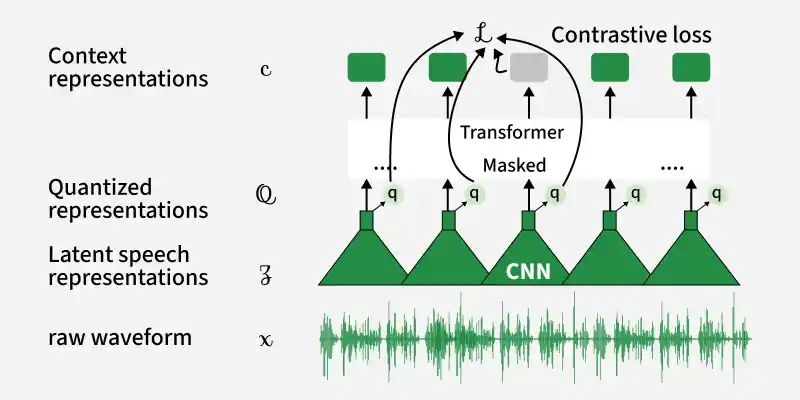
Architecture of Wav2Vec2 Model

👁 architecture_of_wav2vec2
Architecture

1. Feature encoder

The feature encoder is the first component of Wav2Vec2 that processes raw audio input. It takes the audio waveform and converts it into a sequence of meaningful features.

  • Takes raw audio as input
  • Uses convolution layers to extract important patterns from sound
  • Converts continuous audio into compact feature representations
  • Reduces the length of the audio sequence while preserving useful information
👁 Feature-encoder
Feature Encoder of Wav2Vec2

2. Transformer Encoder (Context Network)

The Transformer encoder builds a deeper understanding of the extracted audio features by analyzing their relationships over time.

  • Takes features from the feature encoder as input
  • Learns context by understanding how different parts of speech relate to each other
  • Uses attention mechanisms to focus on important parts of the audio
  • Produces context-aware representations of the speech

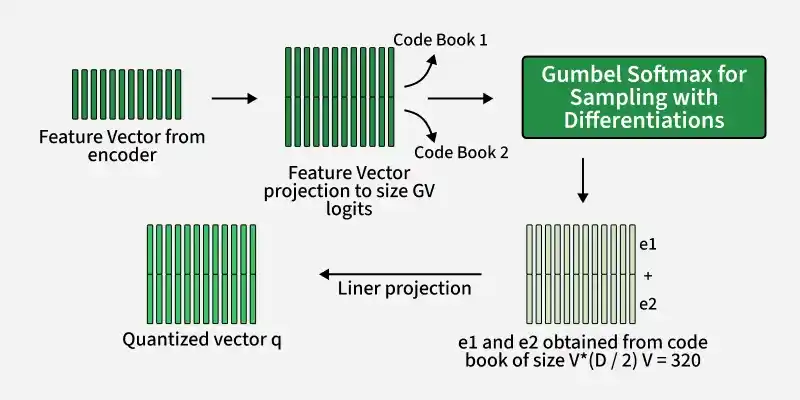
3. Quantization module

The quantization module converts continuous audio features into discrete representations that act like speech units.

👁 wav2vec2_quantization_process
Quantization
  • Takes features from the feature encoder
  • Converts them into a limited set of representative vectors (discrete units)
  • Helps the model learn structured and reusable representations of speech
  • Provides target representations used during training

Implementation

Step1: Install Libraries

Installs all required libraries for audio processing and model usage

!pip install transformers datasets torch -q

Step2: Import Libraries

  • datasets: to load sample audio
  • transformers: to load Wav2Vec2 model
  • torch: for model execution

Step3: Loading Dataset and Preprocessing

Loading Minds 14 dataset and split the dataset in 80:20 ratio.

Step4: Load Lightweight Wav2Vec2 Model

  • Uses smaller base model (faster than large models)
  • processor handles preprocessing and decoding

Output:

👁 output
Output

Step5: Select an Audio Sample

Extracts raw audio from dataset

Step 6: Convert Audio to Model Input

  • Converts audio to model understandable format
  • Adds necessary padding and normalization

Step 7: Run the Model

  • Model processes audio
  • Outputs raw predictions (logits)

Step 8: Decode Output to Text

  • Converts model output to readable text
  • Shows comparison with actual transcription

Output:

👁 output2
Output

Download full code from here

Applications

  • Converts speech into text for applications like voice typing, transcription and subtitles
  • Powers virtual assistants and voice controlled systems by understanding spoken commands
  • Used in call center analytics to analyze customer conversations
  • Supports multilingual speech processing and translation systems
  • Helps in accessibility tools such as speech to text for hearing impaired users
  • Useful in media, education and research for processing large amounts of audio data

Limitations

  • Requires fine tuning to perform accurate speech recognition, pre-trained models alone are not sufficient
  • Performance may drop with noisy audio, strong accents or unclear speech
  • Large model size leads to higher computational and memory requirements
  • Needs good quality audio input for best results
  • May not generalize well to specialized domains without domain specific training
  • Real time deployment can be challenging due to processing latency
Comment

Explore