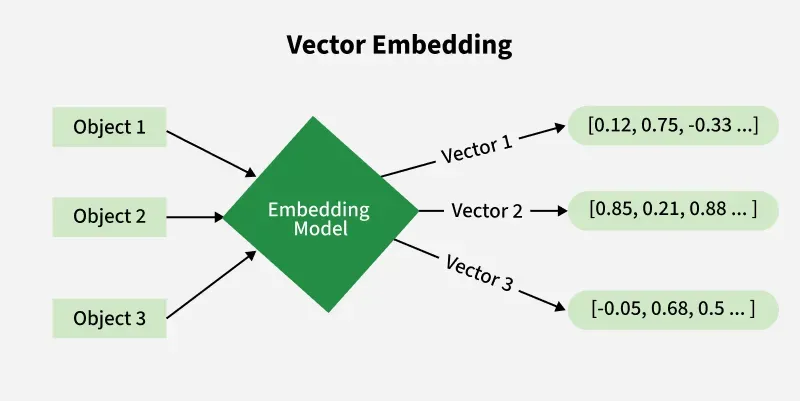
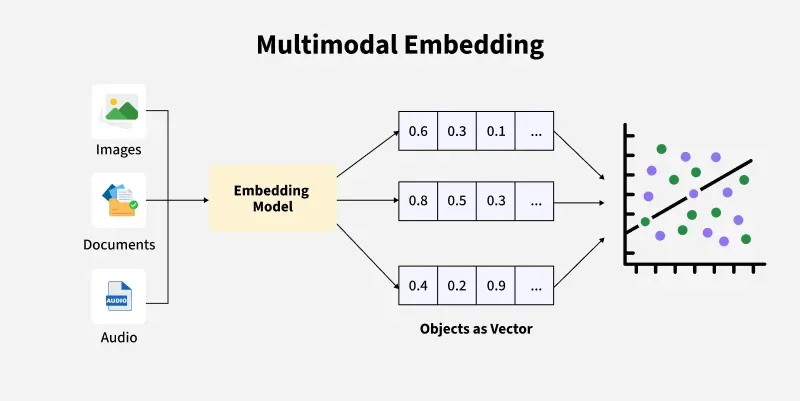
Vector embedding are digital fingerprints or numerical representations of words or other pieces of data. Each object is transformed into a list of numbers called a vector. These vectors captures properties of the object in a more manageable and understandable form for machine learning models.
Here, each object is transformed into a numerical vector using an embedding model. These vectors are capturing features and relationships.
What are Vectors?
A vector is a one dimensional array of numbers containing multiple scalars of the same type of data.
Vectors represents properties, features in a more machine understandable way.
Let's take an example to represent vectors: representation of vectors
Use of Vector embedding
Compare Similarities: Measures vector distances to identify semantically similar data.
Clustering: Groups related data using algorithms like K-means or DBSCAN.
Perform Arithmetic Operations: Captures relationships and analogies through vector math.
Feed Machine Understandable Data: Converts complex data into vectors for machine processing.
Types of Vector embeddings
1. Word embedding
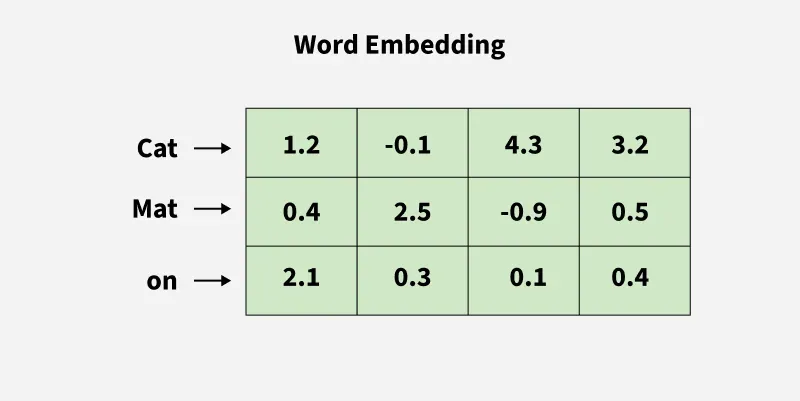
Word embeddings captures not only the semantic meaning of words but also their contextual relationship to other words which help them to classify similarities and cluster different points based on their properties and features.
For example: In the image, each word is transformed into numeric vectors and similar words have closer vector representations allowing models to understand relationship between them.
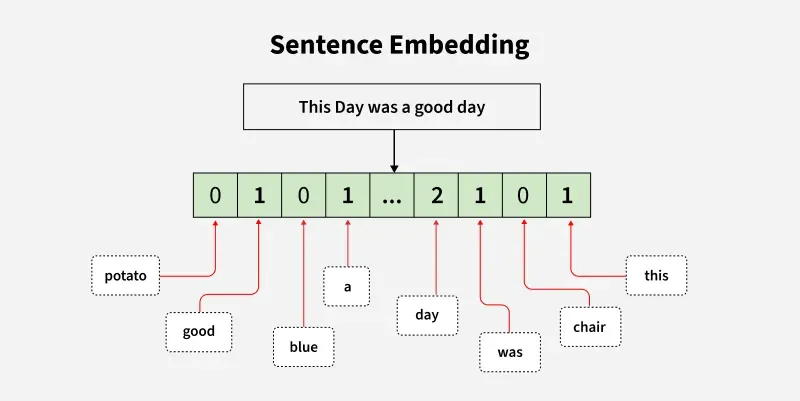
Sentence embeddings represent the entire sentence as a single vector that captures its overall meaning.
It aims at finding the semantic meaning of entire phrases or sentences rather than individual words. They are generated with SBERT or other variants of sentence transformers.
For example: In the image, each word of the sentence is transformed into numeric vectors and zero is imparted to words which are not present in the sentence.
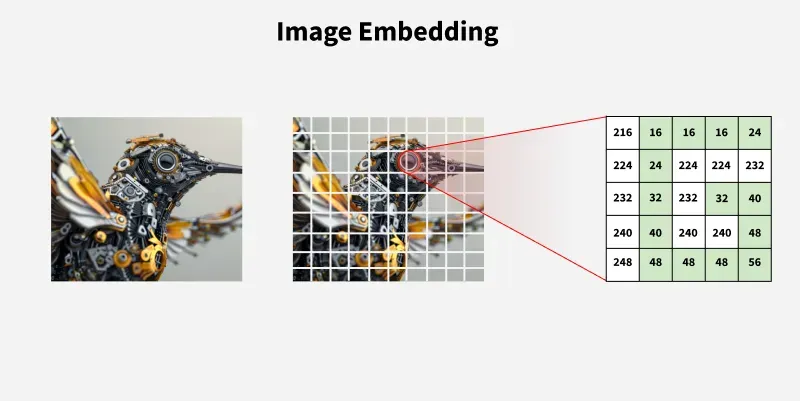
Image embeddings transforms images into numerical representations through which our model can perform image search, object recognition, and image generation.
For example: Image is converted into numerical vectors. Image is divided into grids then we have represented each part using pixel values.
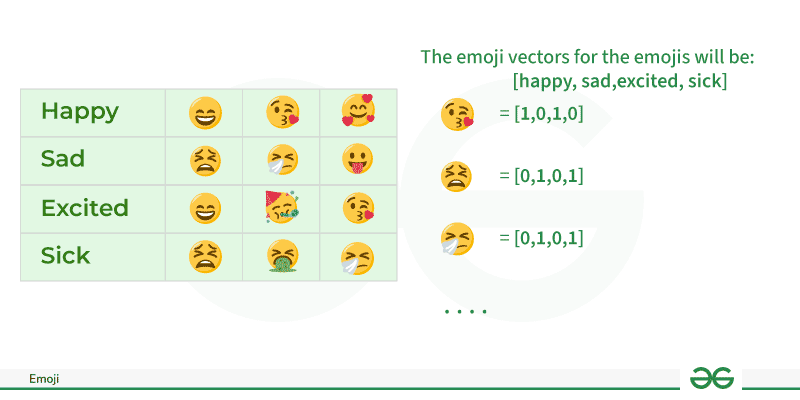
Let us take an example of Word embedding to understand how vectors are generated by taking emotions. Here we are transforming each emoji into a vector and the conditions will be our features.
Image embeddings transforms images into numerical representations to perform image search, object recognition, and image generation.
Product embeddings gives personalized recommendations in the field of e-commerce by finding similar products based on user preferences and purchase history.
Audio embeddings can be used to transform audio data into embeddings to revolutionize music discovery and speech recognition.
Time series data can be converted into embeddings to uncover hidden patterns and make accurate predictions.
Graph data like social networks can be represented as vectors to analyze complex relationships and extract valuable features.
Document embeddings can be used to transform documents into embeddings that can be used in power efficient search engines.