|
VOOZH | about |
|
VOOZH | about |
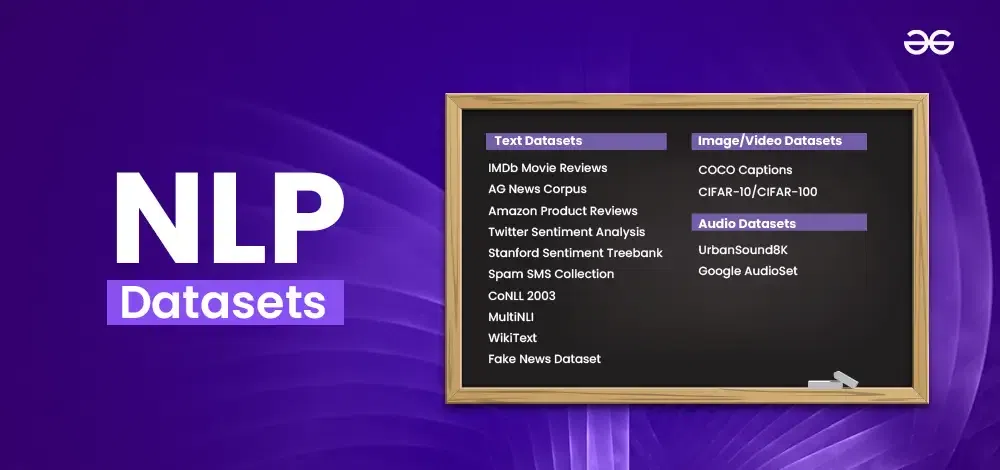
Datasets for natural language processing (NLP) are essential for expanding artificial intelligence research and development. These datasets provide the basis for developing and assessing machine learning models that interpret and process human language. The variety and breadth of NLP tasks, which include sentiment analysis and machine translation, call for a wide range of carefully chosen datasets.
We will examine the list of top NLP datasets in this article.
Table of Content
Text datasets are a crucial component of Natural Language Processing (NLP) as they provide the raw material for training and evaluating language models. These datasets consist of collections of text documents, such as books, news articles, social media posts, or transcripts of spoken language.
The IMDb Movie Reviews dataset comprises a large collection of user-generated movie reviews sourced from the Internet Movie Database (IMDb). Each review is paired with a corresponding sentiment label indicating whether the review expresses a positive or negative opinion about the movie. The dataset offers a diverse range of films, covering various genres, release years, and cultural backgrounds, making it suitable for sentiment analysis and opinion mining tasks in Natural Language Processing (NLP).
Description:
The AG News Corpus is a popular dataset commonly used for text classification tasks in Natural Language Processing (NLP). It consists of news articles collected from the AG's corpus of news articles on the web, categorized into four classes: World, Sports, Business, and Science/Technology. Each article is accompanied by a title and a short description, making it suitable for tasks like topic classification and sentiment analysis. With its diverse range of topics and well-labeled categories, the AG News Corpus serves as a valuable resource for training and evaluating machine learning models in various NLP applications.
Description:
The Amazon Product Reviews dataset is a valuable resource in Natural Language Processing (NLP), containing a vast collection of user-generated reviews for products available on the Amazon platform. Each review is associated with the corresponding product and often includes additional metadata such as ratings, helpfulness votes, and timestamps. This dataset covers a wide range of product categories, including electronics, books, home goods, and more, making it versatile for various NLP tasks such as sentiment analysis, aspect-based sentiment analysis, and recommendation systems. Researchers and developers utilize this dataset to train and evaluate machine learning models for understanding consumer sentiments, product preferences, and market trends.
Description:
The Twitter Sentiment Analysis dataset is a widely used resource in Natural Language Processing (NLP), consisting of tweets along with their corresponding sentiment labels. These tweets are typically labeled with sentiment categories such as positive, negative, or neutral, reflecting the emotional polarity or sentiment expressed in the tweet. This dataset covers a diverse range of topics and user demographics, making it valuable for training and evaluating sentiment analysis models, opinion mining, and social media analytics. Researchers and developers leverage this dataset to understand public opinion, track trends, detect sentiment shifts, and build applications for sentiment analysis in real-time social media data streams.
Description:
The Stanford Sentiment Treebank (SST) is a widely used dataset in Natural Language Processing (NLP) for fine-grained sentiment analysis tasks. Unlike traditional sentiment analysis datasets that label entire sentences or documents with a single sentiment label, SST provides sentiment annotations at the phrase or sub-sentence level. This means that each phrase or sentence in the dataset is annotated with its sentiment polarity (positive, negative, or neutral), allowing for more nuanced sentiment analysis.
Description:
The Spam SMS Collection dataset is a well-known resource for studying and addressing the issue of spam or unwanted text messages. It consists of a collection of SMS messages, where each message is labeled as either spam or non-spam (ham). This dataset is widely used in Natural Language Processing (NLP) for text classification tasks, specifically spam detection.
Description:
The CoNLL 2003 dataset is a benchmark dataset widely used for Named Entity Recognition (NER) tasks in Natural Language Processing (NLP). It was introduced as part of the CoNLL (Conference on Natural Language Learning) shared task in 2003 and has since become a standard dataset for evaluating NER systems.
Description:
The MultiNLI (Multi-Genre Natural Language Inference) dataset is a large-scale collection of sentence pairs labeled for textual entailment, also known as natural language inference (NLI). Introduced as part of the General Language Understanding Evaluation (GLUE) benchmark, MultiNLI encompasses a diverse range of genres, domains, and writing styles, making it a comprehensive resource for evaluating models' ability to understand natural language reasoning across different contexts.
Description:
datasets library.The WikiText dataset is a large-scale language modeling dataset extracted from Wikipedia articles. It serves as a valuable resource for training and evaluating language models in Natural Language Processing (NLP), particularly for tasks such as next-word prediction, text generation, and language understanding.
Description:
The Fake News Dataset is a curated collection of news articles labeled as either real or fake, designed to facilitate research and development in detecting and combating misinformation and fake news dissemination. This dataset plays a crucial role in Natural Language Processing (NLP) tasks, particularly in text classification, where models are trained to distinguish between genuine and fabricated news articles.
Description:
Image and video datasets are essential resources for training and evaluating computer vision models. These datasets typically consist of large collections of images or videos, often annotated with labels or bounding boxes, enabling models to learn patterns, objects, and actions.
The COCO (Common Objects in Context) Captions dataset is a widely used resource in computer vision and Natural Language Processing (NLP). It consists of images from a wide range of everyday scenes, each annotated with descriptive captions. This dataset serves as a valuable benchmark for image captioning tasks, where models are trained to generate human-like descriptions for images.
Description:
The CIFAR-10 and CIFAR-100 datasets are widely used benchmarks in the field of computer vision, particularly for image classification tasks. They consist of small, low-resolution images categorized into multiple classes, serving as valuable resources for training and evaluating machine learning models.
Description:
Audio datasets are essential resources for training and evaluating models in speech and audio-related tasks. These datasets typically contain recordings of speech, music, environmental sounds, or other acoustic signals, along with annotations or labels that enable models to learn patterns and perform various audio-related tasks.
The UrbanSound8K dataset is a widely used resource in the field of audio analysis, particularly for sound classification and environmental sound recognition tasks. It consists of thousands of short audio clips spanning various urban environments, each labeled with one of several sound classes, such as car horn, dog bark, street music, jackhammer, and more.
Description:
Google AudioSet is a large-scale dataset designed for audio event recognition and sound classification tasks. It consists of millions of annotated audio segments sourced from YouTube videos, covering a wide range of environmental sounds, musical instruments, human activities, and more.
Description:
In conclusion, NLP datasets serve as the cornerstone of advancements in artificial intelligence and language understanding. By carefully selecting, curating, and utilizing these datasets, researchers and practitioners can unlock new insights, develop innovative applications, and drive progress towards more intelligent and human-like AI systems.