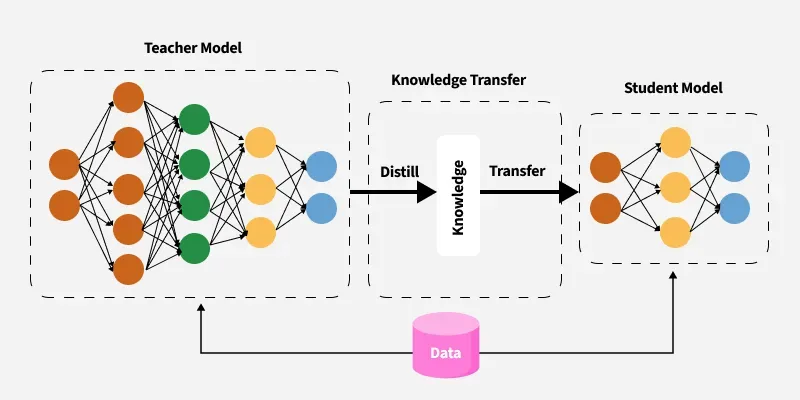
LLM Distillation is a specialized form of Knowledge Distillation (KD) that compresses large-scale LLMs into smaller, faster and more efficient models while preserving a significant portion of the performance. It enables lightweight models to approximate the capabilities of massive LLMs making them deployable on a broader range of applications and devices.
Knowledge Transfer: Transferring learned knowledge from a large teacher model to a smaller student model.
Teacher Model: A large, pretrained LLM that guides the student model during distillation.
Student Model: A smaller, more efficient model trained to mimic the teacher’s outputs.
Soft Labels: Probability distributions from the teacher used instead of hard class labels, conveying richer information.
KL Divergence: A loss function measuring the difference between teacher and student output distributions.
Inference Efficiency: Distilled models require less computation, enabling faster predictions with lower latency.
Feature Matching: Aligning internal representations between teacher and student beyond just output logits.
Distillation Techniques
Various techniques are used to transfer knowledge from a teacher model to a student model while maintaining performance and efficiency.
Knowledge Distillation
The student model learns from the teacher’s output probabilities (soft targets) along with ground truth labels. Soft targets provide richer information, helping the student capture complex patterns and improve accuracy.
Soft targets offer a probability distribution over possible outputs instead of a single correct answer.
Helps the student model capture intricate patterns and nuanced knowledge.
Leads to more accurate and reliable student performance.
Facilitates smoother and more effective training by preserving crucial teacher knowledge.
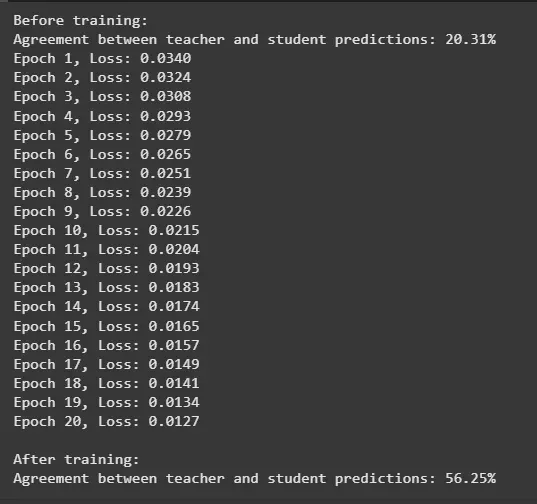
Now we will define the Student Model class which is similar to the teacher but with fewer neurons and layers (smaller model). This reflects the distilled, compressed model architecture.
Several techniques are commonly used to distill large language models:
1. Logit-Based Distillation
The student model learns from the soft probability distributions of the teacher rather than just hard labels. It uses Kullback-Leibler (KL) divergence loss:
Where T (temperature) smooths the soft probabilities, helping the student generalize better.
2. Feature-Based Distillation
Instead of just logits, the hidden representations from intermediate layers of the teacher model are transferred to the student. The student learns to mimic internal activations using an L2 loss or mean squared error (MSE) between corresponding layers.
3. Progressive Layer Dropping
Instead of using all layers of the teacher model, the student selectively learns from a subset of layers to reduce redundancy.
4. Task-Specific Distillation
The student model is fine-tuned on specific downstream tasks (e.g., sentiment analysis, summarization) to optimize performance for real-world applications.
Benefits
Computational Efficiency: Smaller models require significantly less memory, computation power and storage. They enable LLMs to run on consumer hardware, mobile devices or edge computing environments.
Reduced Latency: A distilled LLM provides faster inference times, making it more suitable for real-time applications such as chatbots and virtual assistants.
Lower Energy Consumption: Deploying a lightweight model results in lower energy usage, which is crucial for sustainability and cost-effective AI solutions.
Maintained Performance: Despite being smaller, a well-distilled model retains much of the accuracy and capabilities of the teacher model.
Applications
Deploying LLMs on Edge Devices: Mobile apps, IoT devices and embedded systems benefit from lightweight LLMs that maintain high accuracy.
Optimizing Chatbots and Virtual Assistants: Virtual assistants like Siri, Google Assistant and Alexa can use distilled models for fast and efficient responses.
Efficient Search and Recommendation Systems: Search engines and personalized recommendation models can utilize small but effective LLMs to deliver results quickly.
Privacy-Preserving AI: Distilled models allow AI to be deployed on-device, reducing the need for cloud-based processing and improving privacy.
Challenges
Trade-off Between Model Size and Performance: Reducing model size too much can lead to significant performance degradation and finding the right balance is important for effective distillation.
Knowledge Transfer Limitations: Some complex knowledge from the teacher model may be lost in the distillation process.
Computational Costs of Distillation: The process itself is expensive because it requires training the student model on vast amounts of teacher-generated data.
Domain-Specific Adaptation: Some tasks require domain-specific fine-tuning after distillation to ensure high accuracy.