|
VOOZH | about |
|
VOOZH | about |
Image segmentation is a fundamental computer vision task that involves partitioning an image into meaningful and semantically homogeneous regions. The goal is to simplify the representation of an image or make it more meaningful for further analysis. These segments typically correspond to objects or regions of interest within the image.
The Watershed Algorithm is a classical image segmentation technique that is based on the concept of watershed transformation.The segmentation process will take the similarity with adjacent pixels of the image as an important reference to connect pixels with similar spatial positions and gray values.
The Watershed Algorithm is used when segmenting images with touching or overlapping objects. It excels in scenarios with irregular object shapes, gradient-based segmentation requirements, and when marker-guided segmentation is feasible.
The watershed algorithm divides an image into segments using topographic information. It treats the image as a topographic surface, identifying catchment basins based on pixel intensity. Local minima are marked as starting points, and flooding with colors fills catchment basins until object boundaries are reached. The resulting segmentation assigns unique colors to regions, aiding object recognition and image analysis.
The whole process of the watershed algorithm can be summarized in the following steps:
OpenCV (Open Source Computer Vision Library) is an open-source computer vision and machine learning software library. OpenCV contains hundreds of computer vision algorithms, including object detection, face recognition, image processing, and machine learning.
Here are the implementation steps for the watershed Algorithm using OpenCV:
We define a function "imshow" to display the processed image. The code loads an image named "coin.jpg".
We convert the image to grayscale using OpenCV's "cvtColor" method. The grayscale image is stored in a variable "gray".
Output:
The cv2.cvtColor() function takes two arguments: the image and the conversion flag cv2.COLOR_BGR2GRAY, which specifies the conversion from BGR color space to grayscale.
A crucial step in image segmentation is thresholding, which changes a grayscale image into a binary image. It is essential for distinguishing the items of attention from the backdrop.
When using the cv2.THRESH_BINARY_INV thresholding method in OpenCV, the cv2.THRESH_OTSU parameter is added to apply Otsu's binarization process. Otsu's method automatically determines an optimal threshold by maximizing the variance between two classes of pixels in the image. It aims to find a threshold that minimizes intra-class variance and maximizes inter-class variance, effectively separating the image into two groups of pixels with distinct characteristics.
Otsu's binarization process
Otsu's binarization is a technique used in image processing to separate the foreground and background of an image into two distinct classes. This is done by finding the optimal threshold value that maximizes the variance between the two classes. Otsu's method is known for its simplicity and computational efficiency, making it a popular choice in applications such as document analysis, object recognition, and medical imaging.
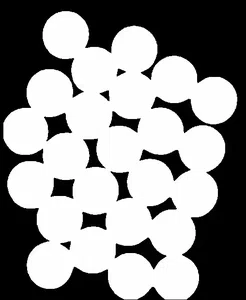
Output:
👁 Threshold Image - GeeksforgeeksTo clean the object's outline (boundary line), noise is removed using morphological gradient processing.
Morphological Gradient Processing
The morphological gradient is a tool used in morphological image processing to emphasize the edges and boundaries of objects in an image. It is obtained by subtracting the erosion of an image from its dilation. Erosion shrinks bright regions in an image, while dilation expands them, and the morphological gradient represents the difference between the two. This operation is useful in tasks such as object detection and segmentation, and it can also be combined with other morphological operations to enhance or filter specific features in an image.
Output:
Next, we need to get a hold of the black area, which is the background part of this image. If the white part is the required area and is well-filled, that means the rest is the background.
We apply several morphological operations on our binary image:
Output:
There is a gray area between the white area in this part of the background and the clearly visible white part of the foreground. This is still uncharted territory, an undefined part. Sow we will subtract this area.
Here are the steps:
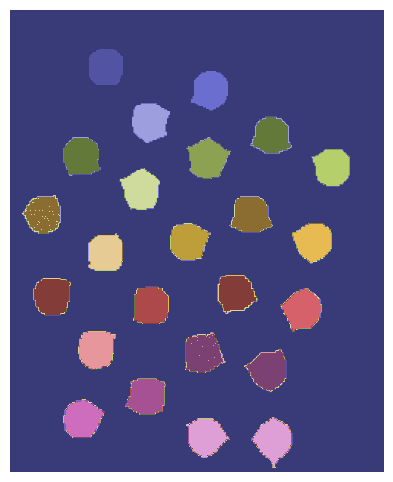
Output:
This marker image, created by labeling the sure foreground and marking the unknown region, serves as input to the Watershed Algorithm. It guides the algorithm in segmenting the image based on these labeled regions. Each distinct color or label represents a separate segment or region in the image
Applying Watershed Algorithm to Markers
Applying watershed() function. Steps taken:
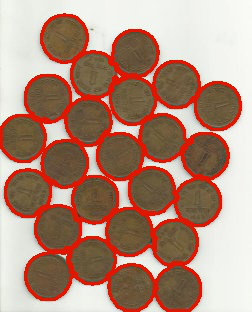
Output:
The outline of each object is drawn in red in the image.
Hence, the code implements the watershed algorithm using OpenCV to segment an image into separate objects or regions. The code first loads the image and converts it to grayscale, performs some preprocessing steps, places markers on the local minima, floods the image with different colors, and finally identifies the boundaries between the regions. The resulting segmented image is then displayed.
In conclusion, the watershed algorithm is a powerful image segmentation technique that uses topographic information to divide an image into multiple segments or regions. The watershed algorithm is more thoughtful than other segmentation methods, and it is more in line with the impression of the human eye on the image. It is widely used in medical imaging and computer vision applications and is a crucial step in many image processing pipelines. Despite its limitations, the watershed algorithm remains a popular choice for image segmentation tasks due to its ability to handle images with significant amounts of noise and irregular shapes.