|
VOOZH | about |
|
VOOZH | about |
In this article, we will learn how to use Recurrent Neural Networks for Sentiment Analysis. We will use the Product Reviews dataset which has around 25000 customer reviews. Our end goal will be to give a rating according to the review given.
Sentiment Analysis is the process of extracting information from the texts. It involves various steps of Natural Language Processing like, text cleaning, text vectorization, stemming, lemmatization, and many more. We will use the above mentioned steps to finally generate a model that can give rating predictions to the reviews.
Recurrent Neural Networks are a type of neural network which uses previous information to give output. We will use RNN with different setups to get maximum accuracy. Further, we will also use LSTM (Long Short Term Memory) which is an extension to RNN, to further increase the accuracy.
We've used the dataset i.e. Consumer Reviews of Products. The dataset contains information like reviews and ratings.
The Amazon dataset contains 25000 customer reviews on Amazon products. Here is how we can load the dataset and get information on it.
Link for Dataset :Link
Output:
(25000, 2)
<class 'pandas.core.frame.DataFrame'>
RangeIndex: 25000 entries, 0 to 24999
Data columns (total 2 columns):
 # Column Non-Null Count Dtype
--- ------ -------------- -----
 0 Review 24999 non-null object
 1 Sentiment 25000 non-null int64
dtypes: int64(1), object(1)
memory usage: 390.8+ KB
None
From the above output, we can see that the dataset is of the shape (25000, 2), which shows that it has 25000 rows and 2 columns.
1. As we've to just get a sentiment analysis of reviews, so let's extract useful information from the dataset. Also, let's look at how many null values are present in this dataset.
Output:
Null Values:
Review 1
Sentiment 0
dtype: int64
Null Values after dropping:
Review 0
Sentiment 0
dtype: int644
Let's take a look at the number of values of each unique item in the Sentiment column.
1 5000
2 5000
3 5000
4 5000
5 4999
Name: Sentiment, dtype: int64
2. Text Cleaning: In this step, we will clean the 'reviews.text' column. We will remove the unwanted HTML tags, brackets, or special characters that may be present in the texts. We will use Regex to clean the text.
4. Tokenization & Text Encoding: In this step, we will use tokenization to first generate the tokens. For this, we will use Tokenizer from the Tensorflow library. And we will encode the text using the same.
We have around 5 unique values in the 'reviews.rating' column. So let's use one-hot encoding to represent each value in the rating as separate columns.
Also, in this step, we have initialized X(input) and y(output) to the model.
Output:
(24999, 500) (24999, 5)
5. Train-Test Split: In this step, we will split our dataset into training and testing datasets. We will split the dataset into 80-20%, i.e. 80% for the training and 20% for testing.
Output:
(19999, 500) (5000, 500) (19999, 5) (5000, 5)Step 4: Model Building, Compiling andLet's Training
1. Build the Model: In this step, let's build our model using RNN.
Output:
Model: "Simple_RNN"
_________________________________________________________________
 Layer (type) Output Shape Param #
=================================================================
 embedding_1 (Embedding) (None, 500, 500) 19819500

 simple_rnn_2 (SimpleRNN) (None, 500, 128) 80512

 simple_rnn_3 (SimpleRNN) (None, 64) 12352

 dense_1 (Dense) (None, 5) 325

=================================================================
Total params: 19,912,689
Trainable params: 19,912,689
Non-trainable params: 0
_________________________________________________________________
None
2. Compiling the model and Model Evaluation: Let's compile and train the model we defined in the above step. Then we will see the accuracy of the model on the test dataset.
Output:
Epoch 1/2
313/313 [==============================] - 411s 1s/step - loss: 1.4465 - accuracy: 0.3333
- val_loss: 1.2963 - val_accuracy: 0.4178
Epoch 2/2
313/313 [==============================] - 370s 1s/step - loss: 0.9909 - accuracy: 0.5994
- val_loss: 1.4120 - val_accuracy: 0.4074
157/157 [==============================] - 13s 83ms/step - loss: 1.4120 - accuracy: 0.4074
Simple_RNN Score---> [1.4119665622711182, 0.4074000120162964]
Let's use LSTM and see how the model performance is changing. We will simply start with defining the model, compiling and then training. To understand the theoretical aspects of LSTM please visit this article Long Short Term Memory Networks Explanation.
Output:
Model: "LSTM_Model"
_________________________________________________________________
 Layer (type) Output Shape Param #
=================================================================
 embedding_2 (Embedding) (None, 500, 500) 19819500

 lstm (LSTM) (None, 100) 240400

 dropout (Dropout) (None, 100) 0

 dense_2 (Dense) (None, 5) 505

=================================================================
Total params: 20,060,405
Trainable params: 20,060,405
Non-trainable params: 0
_________________________________________________________________
Output:
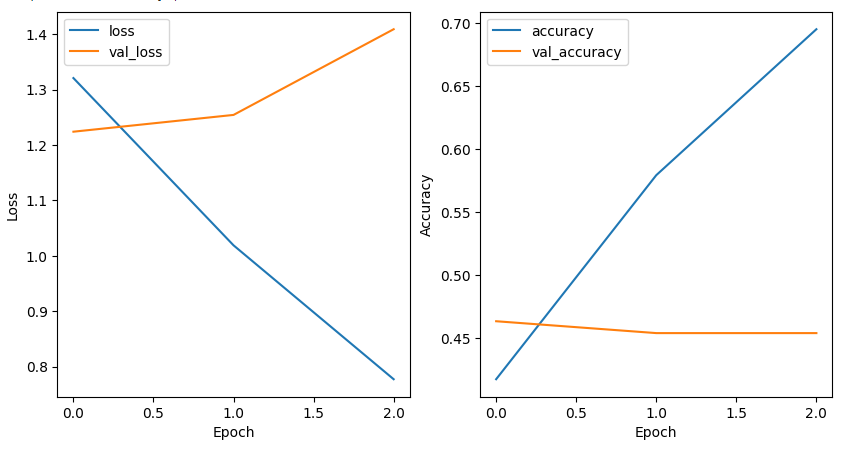
Epoch 1/3
313/313 [==============================] - 59s 176ms/step - loss: 1.3207 - accuracy: 0.4177
- val_loss: 1.2239 - val_accuracy: 0.4636
Epoch 2/3
313/313 [==============================] - 33s 107ms/step - loss: 1.0189 - accuracy: 0.5793
- val_loss: 1.2542 - val_accuracy: 0.4542
Epoch 3/3
313/313 [==============================] - 26s 83ms/step - loss: 0.7772 - accuracy: 0.6949
- val_loss: 1.4089 - val_accuracy: 0.4542
157/157 [==============================] - 2s 10ms/step - loss: 1.4089 - accuracy: 0.4542
LSTM model Score---> [1.408874273300171, 0.45419999957084656]
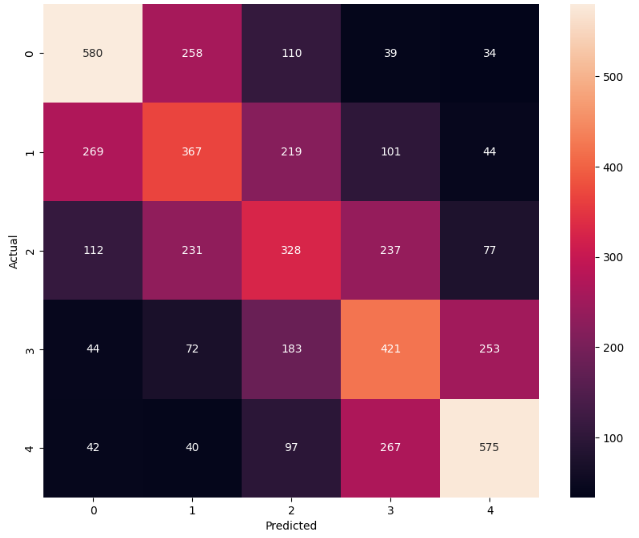
Thus we got the final accuracy of 45% using LSTM. Let's take a look at the classification report of this LSTM model.
Output:
Output:
Output:
 precision recall f1-score support
 0 0.55 0.57 0.56 1021
 1 0.38 0.37 0.37 1000
 2 0.35 0.33 0.34 985
 3 0.40 0.43 0.41 973
 4 0.58 0.56 0.57 1021
 accuracy 0.45 5000
 macro avg 0.45 0.45 0.45 5000
weighted avg 0.45 0.45 0.45 5000
Let's take a look at how the model is performing on the text we give in. For this make a custom function in which we will pass out text and it will generate the rating using the model.
Output:
The rating according to the review is: 1
The rating according to the review is: 5
Notebook: click here.
For Dataset: click here.