 |
VOOZH | about |
|
VOOZH | about |
Our everyday lives are full of various types of audio signals. Our brains are capable of distinguishing different audio signals from each other by default. But machines don't have this capability. To learn audio classification, different approaches can be used. One of them is classification using spectrograms. Audio classification is an important task that is required for various applications like speech recognition, music genre classification, environmental sound analysis, forensic departments, and many more. In this article, we will explore the implementation guide for classifying audio signals using Spectrogram.
A spectrogram is a visual 2D representation of audio signals in the frequency domain that displays how the frequencies within a sound evolve over time by breaking down an audio signal into small segments and computing the intensity of different frequency components within each segment. The spectrogram, or time-frequency representation of an audio signal, helps us to understand valuable insights about the audio content, like distinguishing between various sounds, patterns, or characteristics. The efficient creation of spectrograms is a key step in audio classification using spectrograms. This spectrogram creation process involves various steps, which are discussed below.
The fourth step is an extra step which is only performed for audio classification. Please find the 'Data pre-processing' sub-section.
You can download the Barbie Vs Puppy dataset from here.
We will import all necessary Python libraries like NumPy, Sckit Learn, Matplotlib, Librosa etc.
Our dataset is a zip file which contains audio files(.wav) in two respective folders. So, our first task is to extract its contains to out runtime.
It is the most important step when we are attempting to perform audio classification using spectrograms. We will load each of the audio files till 3s for spectrogram generation as per machine capabilities. You can extent it if required. In our present dataset most of the audio files are within a range of 3s. Here we will generate mel-Spectrograms for better classification.
In this step, we will use Label Encoder to encode the target labels and then we will split the dataset into training and testing(80:20). After that we will scale all to spectrograms to a certain length to ensure all the spectrograms have same length. Otherwise, we can not be able to classify them.
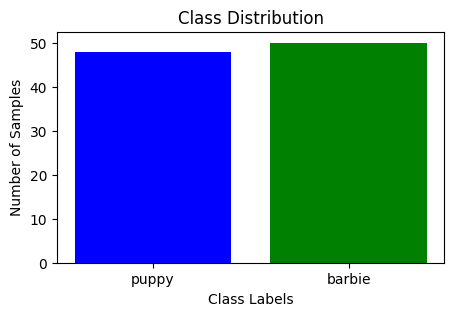
Now we will perform EDA to gain knowledge about dataset.
Output:
Output:
After EDA, we can say that we are going to perform Binary classification of audio as there are only two classes(barbie and puppy) present as target. So, we can choose a wide range of classification models for this task. Here, we are going to implement Gradient Boosting classifier of ensemble learning technique. We will pass all parameters of its to there default values. Only one parameter called 'random_state' will be specified to handle the randomness during model training and to ensure that the model will produce same result for each execution. Finally, we will evaluate this model's performance in the terms of accuracy and F1-score.
Output:
Accuracy: 0.7500
F1 score: 0.8000
Note: By using same data-preprocessing code you can implement different classifier models as per your choice. Only for example Gradient Boosting classifier is implemented. All other model implementation will be same as it is.
We can conclude that, Audio classification using spectrogram is a long and calculative technique. However, it can effectively useful for audio classification. Our model performed moderately well with a accuracy of 65% and achived a decent F1-score of approximately 70%. These results show that audio classification using spectrogram may be a lengthy process but by using correct model and hyperparameter-tuning, we can achieve outstanding results for classification of audio.

.png)
.png)