|
VOOZH | about |
|
VOOZH | about |
OpenCV (Open Source Computer Vision Library) is an open-source software toolkit for computer vision and machine learning tasks. Originally developed by Intel, it is now maintained by the OpenCV Foundation and a large community of contributors. OpenCV enables developers to process and analyze visual data such as images and videos with efficiency.
It supports multiple languages including Python, C++, Java and works across all major operating systems. OpenCV is released under the BSD license, making it freely available for both academic and commercial use.
OpenCV has become a fundamental tool in computer vision development with applications like facial recognition, augmented reality and self-driving cars. It offers optimized algorithms for real-time image and video analysis, making it ideal for applications that demand speed, accuracy and scalability.
Its design prioritizes computational efficiency through low-level implementation, while offering Python for ease of use. Hence, OpenCV offers the flexibility and performance needed to handle visual data intelligently.
Unlike humans, computers don’t “see” images, they interpret them as numeric matrices:
A typical image processing flow in OpenCV includes:
This workflow is foundational to computer vision tasks across research and industry.
To get started with OpenCV, we’ll first need to install the library. The easiest way is by using pip:
If we also want support for advanced modules like face detection, stitching and extra algorithms, we can install the contrib package:
After installation, we simply import it in our Python script using:
Here we import required libraries
Download image and add image path from system:
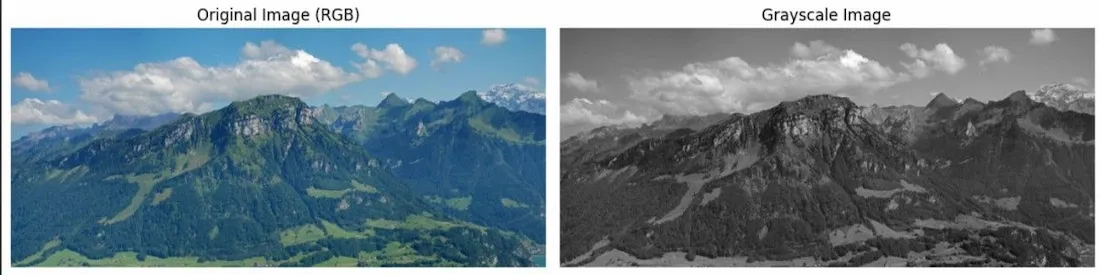
img becomes a NumPy array containing the pixel values.Displays both versions side by side using matplotlib.
Output:
OpenCV provides a wide set of capabilities that make it versatile for various computer vision tasks:
OpenCV is used across domains, powering practical systems such as:
Its light structure makes OpenCV suitable for everything from embedded systems to enterprise-level applications. By understanding how images are represented and manipulated at a low level, OpenCV empowers developers to build applications that see and respond to the world visually.
For a deeper understanding in OpenCV refer to OpenCV tutorial.