|
VOOZH | about |
|
VOOZH | about |
DeepMind, the renowned AI research lab, has unveiled its AI model named RoboCat, capable of performing a wide range of complex tasks using various models of robotic arms. Unlike previous models, RoboCat stands out for its ability to solve multiple tasks and adapt seamlessly to different real-world robots. Let’s delve into the details of this remarkable achievement & explore how RoboCat is set to revolutionize the field of robotics.
Also Read: Amazon’s Secret AI Robot for Home Can Do Everything and More
DeepMind’s breakthrough AI model, RoboCat, showcases an unprecedented level of versatility in robotics. As stated by Alex Lee, a research scientist at DeepMind, RoboCat is a single large model capable of tackling diverse tasks across multiple real robotic embodiments. This means that the model can quickly adapt to new tasks and different robot configurations. This marks a significant milestone in the field of robotics.
Also Read: Jizai Arms – AI Robotic Arms That Turns You Into Spider-Man
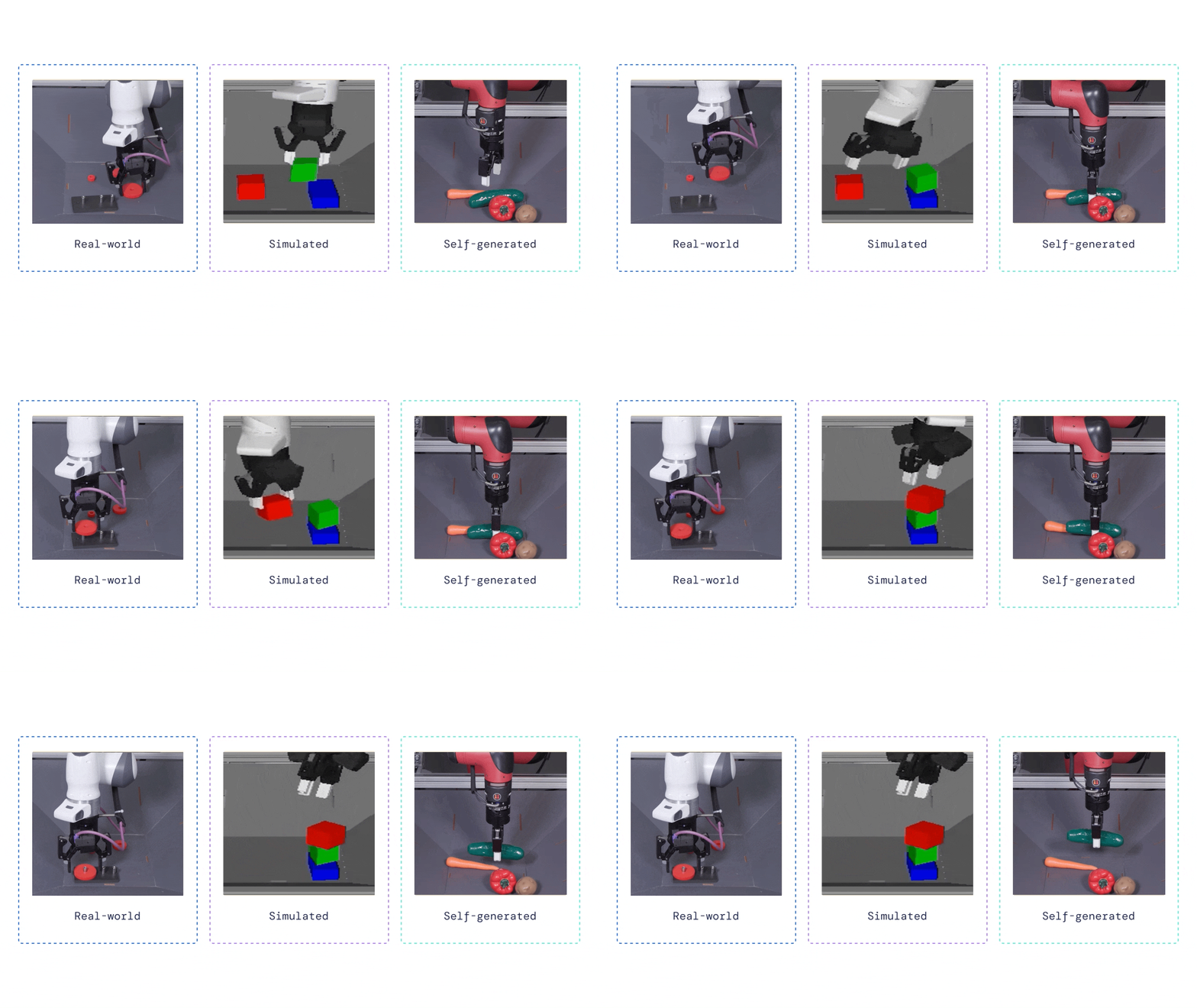
RoboCat draws inspiration from GATO, another AI model developed by DeepMind. GATO possesses the remarkable ability to analyze and respond to text, images, and events. By leveraging this concept, DeepMind’s researchers trained RoboCat on a vast dataset. This comprised images and action data collected from both simulated and real-life robotics environments.
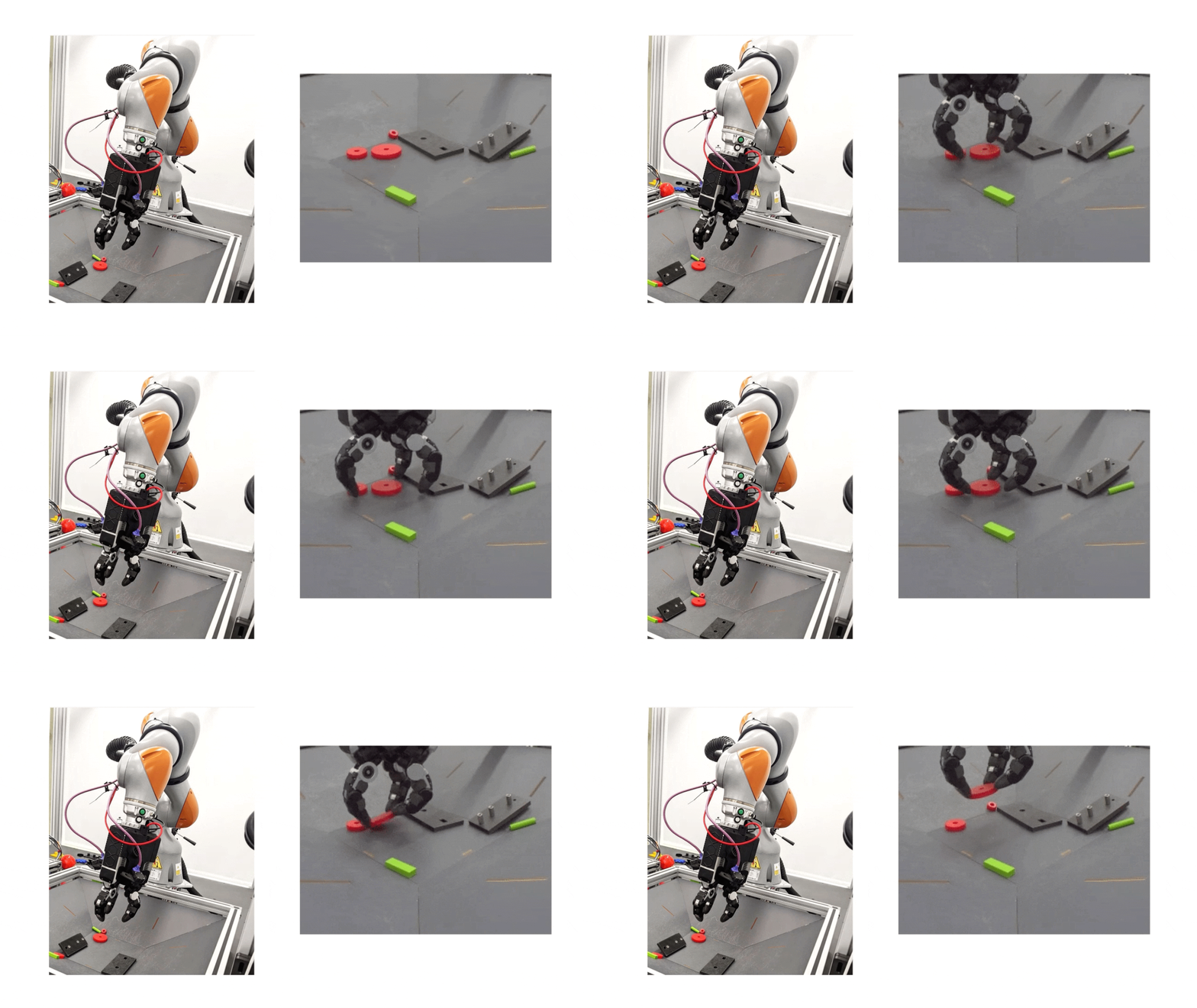
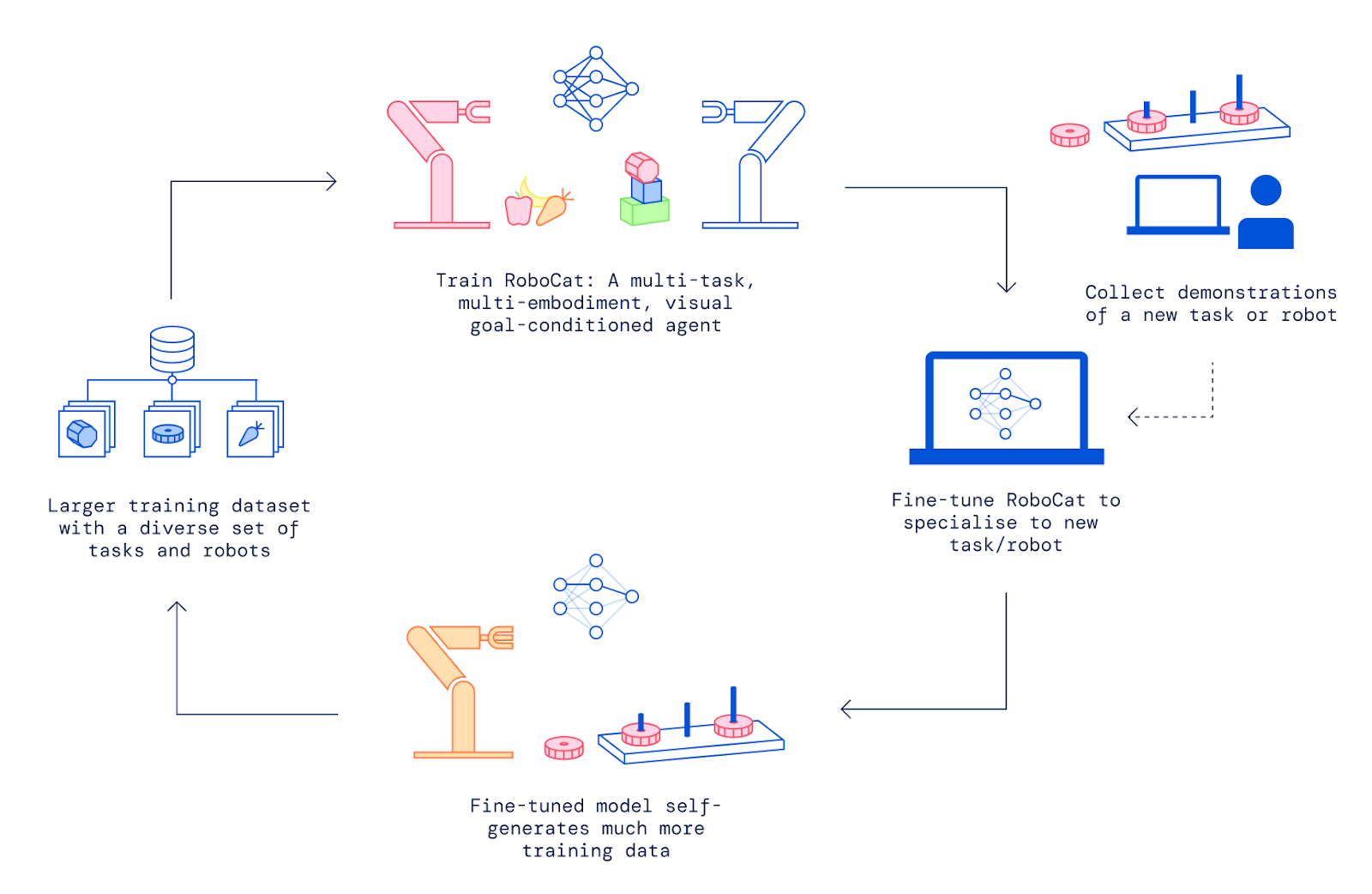
To train RoboCat, the team at DeepMind gathered 100 – 1,000 demonstrations of various tasks performed by a human-controlled robotic arm. These demonstrations served as the foundation for fine-tuning the model on specific tasks, creating specialized “spin-off” models. Each spin-off model underwent rigorous practice, averaging 10,000 iterations on the respective task.
Also Read: World’s First AI-Powered Arm: All You Need to Know
The final version of RoboCat was trained on an impressive total of 253 tasks and benchmarked against 141 variations of those tasks, encompassing both simulated and real-world scenarios. DeepMind reports that the model successfully learned to operate different robotic arms after observing 1,000 human-controlled demonstrations over several hours. However, the success rates varied significantly, ranging from 13% to 99% across different tasks, with the number of demonstrations being a determining factor.
Also Read: Alphabet Unleashes Flowstate: Robotic App Development Platform for Everyone
Despite the varying success rates, DeepMind believes that RoboCat has the potential to lower the barriers to solving new tasks in robotics. Alex Lee explains that even with a limited number of demonstrations for a new task, RoboCat can be fine-tuned and generate additional data to further enhance its performance. The ultimate goal is to reduce the number of demonstrations required to teach RoboCat a new task to fewer than 10, which could revolutionize the field of robotics.
Also Read: Meet Phoenix Robot of Sanctuary AI and Tesla’s Latest Launch, Optimus!
DeepMind’s RoboCat represents a significant breakthrough in robotics. It showcases the ability of a single AI model to adapt and excel across multiple tasks and different robot embodiments. By leveraging its training on a vast dataset and harnessing the power of fine-tuning, RoboCat has laid the foundation for future advancements in the field. With the potential to streamline the process of teaching robots new tasks, RoboCat may herald a new era of innovation. Exciting times lie ahead as RoboCat paves the way for a future where robots can seamlessly adapt and learn with minimal human intervention.
Sabreena is a GenAI enthusiast and tech editor who's passionate about documenting the latest advancements that shape the world. She's currently exploring the world of AI and Data Science as the Manager of Content & Growth at Analytics Vidhya.
GPT-4 vs. Llama 3.1 – Which Model is Better?
Llama-3.1-Storm-8B: The 8B LLM Powerhouse Surpa...
A Comprehensive Guide to Building Agentic RAG S...
Top 10 Machine Learning Algorithms in 2026
45 Questions to Test a Data Scientist on Basics...
90+ Python Interview Questions and Answers (202...
8 Easy Ways to Access ChatGPT for Free
Prompt Engineering: Definition, Examples, Tips ...
What is LangChain?
What is Retrieval-Augmented Generation (RAG)?
Edit
Resend OTP
Resend OTP in 45s