|
VOOZH | about |
|
VOOZH | about |
Recurrent Neural Networks (RNNs) are a type of neural network that is used for tasks involving sequential data such as text classification. They are designed to handle sequences making them ideal for tasks where understanding the relationship between words in a sentence is important.
Recurrent Neural Networks (RNNs) are designed to capture the dependencies and context within sequential data which makes them ideal for language-related tasks. They can remember information from previous inputs which helps them understand the context of words. Text classification tasks like sentiment analysis, require us to understand the context of words in a sentence. RNNs are especially good for these tasks because they:
Let's see the steps required to implement an RNN model for sentiment analysis using the IMDB movie review dataset.
We need to import necessary libraries such as TensorFlow for model building, NumPy for handling numerical operations and Matplotlib for visualizations.
The IMDB dataset contains movie reviews, labeled as positive or negative. We load the dataset and separate it into training and testing datasets. Batching the data into smaller chunks improves efficiency during training.
We print a sample review and its corresponding label (0 for negative, 1 for positive) to understand the structure of the dataset.
Output:
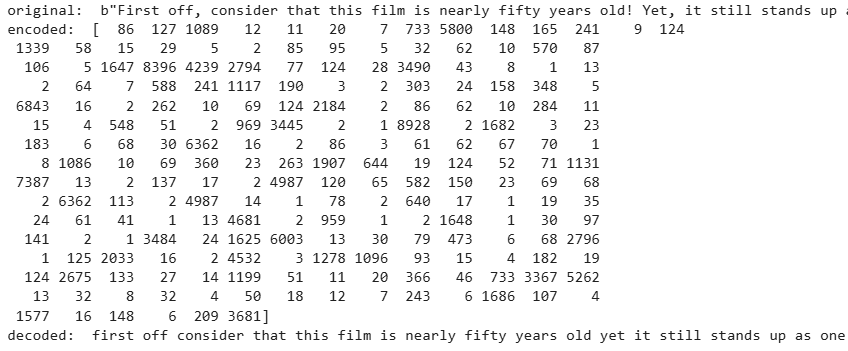
To convert the text into a numerical form, we use TensorFlow's text vectorization layer which tokenizes the text and converts each word into a sequence of integers. This prepares the text data for the neural network. We can also see in the example below how we can encode and decode the sample review into a vector of integers.
Output:
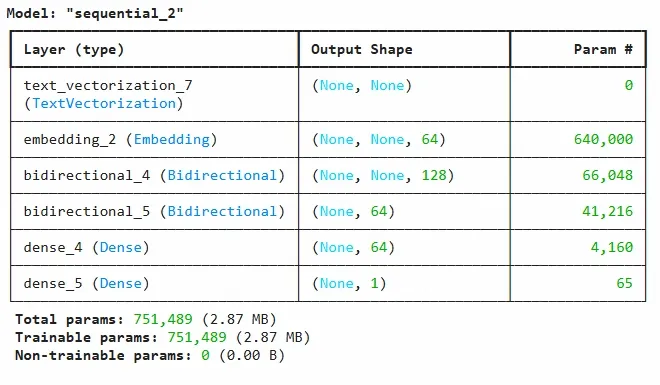
We define the architecture of the RNN. This consists of the following layers:
Output:
Now, we compile the model. The binary cross-entropy loss function is used since this is a binary classification task (positive or negative sentiment). We also specify the Adam optimizer and track accuracy as the evaluation metric.
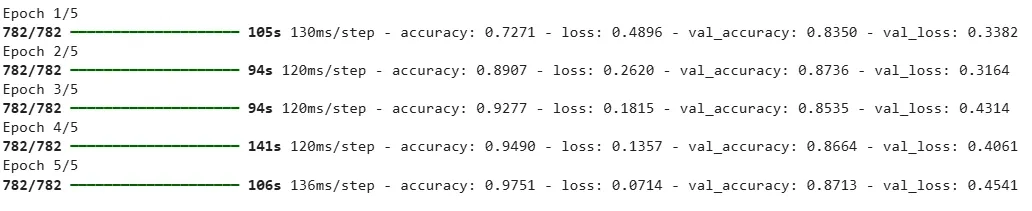
Next, we train the model using the training dataset for 5 epochs and validate it on the test dataset to evaluate its performance on unseen data.
Output:
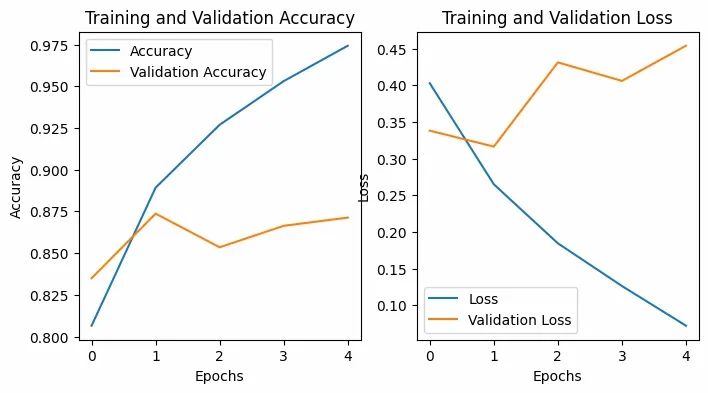
To visualize the performance of the model, we plot the training and validation accuracy and loss across epochs.
Output:
Here we visualized the training and validation accuracy as well as the training and validation loss over epochs. It extracts accuracy and loss values from the training history (history_dict). Here the left subplot displays accuracy trends and the right subplot shows loss trends over epochs.
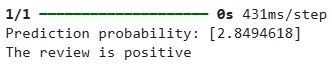
Finally, we test the trained model with a random movie review. The model predicts whether the review is positive or negative based on its learned patterns.
Output:
Here for the sample text the review is Positive which is true so we can say that our model is working fine.
Recurrent Neural Networks (RNNs) offer various advantages for text classification tasks in Natural Language Processing (NLP):
Despite being useful, RNNs have some limitations when used for text classification:
By mastering RNNs we can create models that efficiently process and classify complex text data so that we can understand patterns and structures of language.